Home
Class 12
PHYSICS
When a system is taken from state i to s...

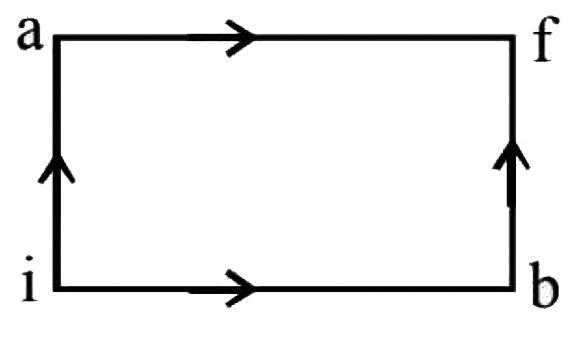
When a system is taken from state i to state f along the path iaf, it is found that `Q=50 cal and W=20 cal`. Along the path ibf `Q=36cal`. W along the path ibf is

A

`6` cal

B

`16` cal

C

`66` cal

D

`14` cal

Text Solution

Verified by Experts

The correct Answer is:

A

As a thermodynamic system is taken from state to state f, then the internal energy of the system remains the same irrespective of the path followed `(Q-W)_(faf) = (Q-W)_(lbf) implies 50 -20 = 36 W implies W = 6` cal
Promotional Banner

Topper's Solved these Questions

  • GEOMETRICAL OPTICS

    ALLEN |Exercise EXERCISE - 05 (B)|58 Videos
  • GEOMETRICAL OPTICS

    ALLEN |Exercise EXERCISE - 05 (B) (MCQ)|9 Videos
  • GEOMETRICAL OPTICS

    ALLEN |Exercise EXERCISE - 04 (B)|15 Videos
  • CURRENT ELECTRICITY

    ALLEN |Exercise EX.II|66 Videos
  • GRAVITATION

    ALLEN |Exercise EXERCISE 4|9 Videos

Similar Questions

Explore conceptually related problems

When a system is taken from state a to state b, in figure along the path a to c to b , 60J of heat flow into the system, and 30 J of work is done : (i) How much heat flows into the system along the path a to d to b if the work is 10J . (ii) When the system is returned from b to along the curved path, the work done by the system is -20J . Does the system absorb or liberate heat, and how much ? (iii) If , U_(a) = 0 and U_(d)= 22J , find the heat absorbed in the process a to d and d to b .

A thermodynamic system is taken from an initial state I with internal energy U_i=-100J to the final state f along two different paths iaf and ibf, as schematically shown in the figure. The work done by the system along the pat af, ib and bf are W_(af)=200J, W_(ib)=50J and W_(bf)=100J respectively. The heat supplied to the system along the path iaf, ib and bf are Q_(iaf), Q_(ib),Q_(bf) respectively. If the internal energy of the system in the state b is U_b=200J and Q_(iaf)=500J , The ratio (Q_(bf))/(Q_(ib)) is

When an spacecraft goes from earth to moon along a straight path, what changes occurs in weight?

A particle of mass m is taken from position A to position B along the circular path by a constant horizontal force vecF . What will be the work done by the force vecF ? Here radius of Track is R. ltimg src="https://d10lpgp6xz60nq.cloudfront.net/physics_images/ALN_PHY_R01_E06_010_Q01.png" width="80%"gt

A system is taken along different path in the graph of P to V from its initial state to final state. Which of following quantity does not depend on the path of the system ?

Statement - 1 : A gas is taken from state A to state B through two different paths. Molar specific heat capacity in path (A) is more as compared to (B) Statement- 2 : Specific heat C =(Q)/(nDeltaT) & Q = DeltaU + W and W is equal to area under P-V diagram.

In changing the state of a gas adiabatically from an equilibrium state A to another equilibrium state B, an amount of work equal to 22.3 J is done on the system. If the gas is taken from state A to B via process in which the net heat absorbed by the system is 9.35 cal, how much is the net work done by the system in the latter case ? (Take 1 cal = 4.19 )

In the given figure an ideal gas changes its state from A to state C by two paths ABC and AC . (i) Find the path along which work done is the least. (ii) The internal energy of gas at A is 10J and amount of heat supplied to change its state to C through the path AC is 200J . Calculate the internal energy at C . (iii) How much is the heat involved in the process ABC and ADC ?

Consider a P-V diagram in which the path followed by one mole of perfect gas in a cylindrical container is shown in figure. (a) Find the work done when the gas is taken from state 1 to state 2. (b) What is the ratio of temperature T_1/T_2 if V_2=2V_1 ? (c) Given the internal energy for one mole of gas at temperature T is 3/2RT , find the heat 2 supplied to the gas when it is taken from state 1 to 2, with V_2 = 2V_1

ALLEN -GEOMETRICAL OPTICS-EXERCISE - 05 (A)
  1. The work of 146 kJ is performed in order to compress one kilo mole of ...

    Text Solution

    |

  2. A Carnot engine, having an efficiency of eta=1//10 as heat engine, is ...

    Text Solution

    |

  3. When a system is taken from state i to state f along the path iaf, it ...

    Text Solution

    |

  4. Two moles of helium gas are taken over the cycle ABCDA, as shown in th...

    Text Solution

    |

  5. Two moles of helium gas are taken over the cycle ABCDA, as shown in th...

    Text Solution

    |

  6. Two moles of helium gas are taken over the cycle ABCDA, as shown in th...

    Text Solution

    |

  7. A diatomic ideal gas is used in a Carnot engine as the working substan...

    Text Solution

    |

  8. A thermally insulated vessel contains an ideal gas of molecular mass M...

    Text Solution

    |

  9. A carnot engine operating between temperatures T(1) and T(2) has effic...

    Text Solution

    |

  10. Helium gas goes through a cycle ABCDA (consisting of two isochoric and...

    Text Solution

    |

  11. A Carnot engine, whose efficiency is 40%, takes in heat from a source ...

    Text Solution

    |

  12. The above p-v diagram represents the thermodynamic cycle of an engine,...

    Text Solution

    |

  13. One mole of a diatomic ideal gas undergoes a cyclic process ABC as sho...

    Text Solution

    |

  14. Three rods of Copper, Brass and Steel are welded together to from a Y ...

    Text Solution

    |

  15. A solid body of constant heat capacity 1J//^@C is being heated by keep...

    Text Solution

    |

  16. Consider a spherical shell of radius R at temperature T. The black bod...

    Text Solution

    |

  17. Consider an ideal gas confined in an isolated closed chamber. As the g...

    Text Solution

    |

  18. The P - V diagram of 2 gm of helium gas for a certain process A rarr B...

    Text Solution

    |

  19. In an ideal gas at temperature T , the average force that a molecule a...

    Text Solution

    |

  20. An experiment takes 10 minutes to raise the temperature of water in a ...

    Text Solution

    |
