Home
Class 12
PHYSICS
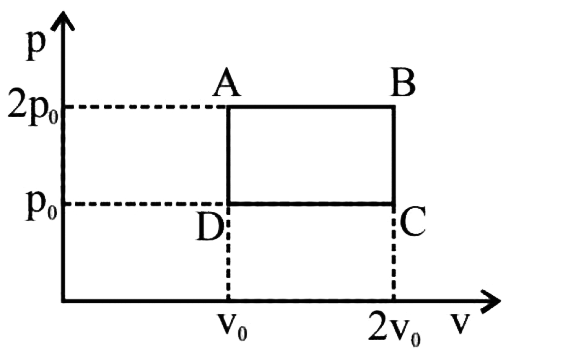
The above p-v diagram represents the the...


The above p-v diagram represents the thermodynamic cycle of an engine, operating with an ideal monoatomic gas. The amount of heat, extracted from the source in a single cycle is

A

`P_(0)V_(0)`

B

`((13)/(2))p_(0)v_(0)`

C

`((11)/(2))p_(0)v_(0)`

D

`4p_(0)v_(0)`

Text Solution

Verified by Experts

The correct Answer is:
B

`eta=(1-(T_(2))/(T_(1)))xx 100 implies (40)/(100) = 1-(T_(2))/(500) implies T_(2) = 300K` Again `(60)/(100) = 1-(300)/(T_(1)) implies T_(1) = 750K`
heat supplied =`nC_(v)(2T_(0) - T_(0)) + nC_(P)(4T_(0) -2T_(0)) = (n.3RT_(0))/(2) + (D5R)/(2)(2T_(0)) = (13)/(2)nRT_(0) = (13)/(2)P_(0)V_(0)`
Promotional Banner

Topper's Solved these Questions

  • GEOMETRICAL OPTICS

    ALLEN |Exercise EXERCISE - 05 (B)|58 Videos
  • GEOMETRICAL OPTICS

    ALLEN |Exercise EXERCISE - 05 (B) (MCQ)|9 Videos
  • GEOMETRICAL OPTICS

    ALLEN |Exercise EXERCISE - 04 (B)|15 Videos
  • CURRENT ELECTRICITY

    ALLEN |Exercise EX.II|66 Videos
  • GRAVITATION

    ALLEN |Exercise EXERCISE 4|9 Videos

Similar Questions

Explore conceptually related problems

Let barv,v_(rms) and v_p respectively denote the mean speed. Root mean square speed, and most probable speed of the molecules in an ideal monoatomic gas at absolute temperature T. The mass of a molecule is m. Then

In Fig., a container is shown to have a movable (without friction) piston on top. The container and the piston are all made of perfectly insulating material allowing no heat transfer between outside and inside the container. The container is divided into two compartments by a rigid partition made of a thermally conducting material that allows slow transfer of heat. the lower compartment of the container is filled with 2 moles of an ideal monoatomic gas at 700 K and the upper compartment is filled with 2 moles of an ideal diatomic gas at 400 K. the heat capacities per mole of an ideal monoatomic gas are C_(upsilon) = (3)/(2) R and C_(P) = (5)/(2) R , and those for an ideal diatomic gas are C_(upsilone) = (5)/(2) R and C_(P) = (7)/(2) R. Consider the partition to be rigidly fixed so that it does not move. when equilibrium is achieved, the final temperature of the gases will be

In Fig., a container is shown to have a movable (without friction) piston on top. The container and the piston are all made of perfectly insulating material allowing no heat transfer between outside and inside the container. The container is divided into two compartments by a rigid partition made of a thermally conducting material that allows slow transfer of heat. the lower compartment of the container is filled with 2 moles of an ideal monoatomic gas at 700 K and the upper compartment is filled with 2 moles of an ideal diatomic gas at 400 K. the heat capacities per mole of an ideal monoatomic gas are C_(upsilon) = (3)/(2) R and C_(P) = (5)/(2) R , and those for an ideal diatomic gas are C_(upsilone) = (5)/(2) R and C_(P) = (7)/(2) R. Now consider the partition to be free to move without friction so that the pressure of gases in both compartments is the same. the total work done by the gases till the time they achieve equilibrium will be

Refrigerator is an apparatus which takes heat from a cold body, work is done on it and the work done together with the heat absorbed is rejected to the source. An ideal refrigerator can be regarded as Carnot's ideal heat engine working in the reverse direction. The coefficient of performance of refrigerator is defined as beta = ("Heat extracted from cold reservoir")/("work done on working substance") = (Q_(2))/(W) = (Q_(2))/(Q_(1)- Q_(2)) = (T_(2))/(T_(1) - T_(2)) A Carnot's refrigerator takes heat from water at 0^(@)C and discards it to a room temperature at 27^(@)C . 1 Kg of water at 0^(@)C is to be changed into ice at 0^(@)C. (L_(ice) = 80"kcal//kg") How many calories of heat are discarded to the room?

Refrigerator is an apparatus which takes heat from a cold body, work is done on it and the work done together with the heat absorbed is rejected to the source. An ideal refrigerator can be regarded as Carnot's ideal heat engine working in the reverse direction. The coefficient of performance of refrigerator is defined as beta = ("Heat extracted from cold reservoir")/("work done on working substance") = (Q_(2))/(W) = (Q_(2))/(Q_(1)- Q_(2)) = (T_(2))/(T_(1) - T_(2)) A Carnot's refrigerator takes heat from water at 0^(@)C and discards it to a room temperature at 27^(@)C . 1 Kg of water at 0^(@)C is to be changed into ice at 0^(@)C. (L_(ice) = 80"kcal//kg") What is the coefficient of performance of the machine?

Refrigerator is an apparatus which takes heat from a cold body, work is done on it and the work done together with the heat absorbed is rejected to the source. An ideal refrigerator can be regarded as Carnot's ideal heat engine working in the reverse direction. The coefficient of performance of refrigerator is defined as beta = ("Heat extracted from cold reservoir")/("work done on working substance") = (Q_(2))/(W) = (Q_(2))/(Q_(1)- Q_(2)) = (T_(2))/(T_(1) - T_(2)) A Carnot's refrigerator takes heat from water at 0^(@)C and discards it to a room temperature at 27^(@)C . 1 Kg of water at 0^(@)C is to be changed into ice at 0^(@)C. (L_(ice) = 80"kcal//kg") What is the work done by the refrigerator in this process ( 1 "cal" = 4.2 "joule" )

The straight lines in the figure depict the variations in temperature DeltaT as a function of the amount of heat supplied Q is different process involving the change of state of a monoatomic and a diatomic ideal gas . The initial states, ( P,V,T ) of the two gases are the same . Match the processes as described, with the straight lines in the graph as numbered. {:(,"Column-I",,"Column-II"),((A),"Isobaric process of monoatomic gas." ,(p),"1" ),((B),"Isobaric process of diatomic gas" ,(q),"2" ),((C),"Isochoric process of monoatomic gas" ,(r),"Minimum at section B"), ((D),"Isochoric process of diatomic gas" ,(s),"x-axis (i.e.'Q' axis)"):}

The volume of one mole of an ideal gas with adiabatic exponent gamma is varied according to V=b/T , where b is a constant. Find the amount of Heat is absorbed by the gas in this process temperature raised by DeltaT

Molar heat capacity of an ideal gas in the process PV^(x) = constant , is given by : C = (R)/(gamma-1) + (R)/(1-x) . An ideal diatomic gas with C_(V) = (5R)/(2) occupies a volume V_(1) at a pressure P_(1) . The gas undergoes a process in which the pressure is proportional to the volume. At the end of the process the rms speed of the gas molecules has doubled from its initial value. The molar heat capacity of the gas in the given process is :-

One mole of an ideal gas is heated isobarically from the freezing point to the boiling point of water each under normal pressure . Find out the work done by the gas and the change in its internal energy. The amount of heat involved is 1 kJ.

ALLEN -GEOMETRICAL OPTICS-EXERCISE - 05 (A)
  1. A carnot engine operating between temperatures T(1) and T(2) has effic...

    Text Solution

    |

  2. Helium gas goes through a cycle ABCDA (consisting of two isochoric and...

    Text Solution

    |

  3. A Carnot engine, whose efficiency is 40%, takes in heat from a source ...

    Text Solution

    |

  4. The above p-v diagram represents the thermodynamic cycle of an engine,...

    Text Solution

    |

  5. One mole of a diatomic ideal gas undergoes a cyclic process ABC as sho...

    Text Solution

    |

  6. Three rods of Copper, Brass and Steel are welded together to from a Y ...

    Text Solution

    |

  7. A solid body of constant heat capacity 1J//^@C is being heated by keep...

    Text Solution

    |

  8. Consider a spherical shell of radius R at temperature T. The black bod...

    Text Solution

    |

  9. Consider an ideal gas confined in an isolated closed chamber. As the g...

    Text Solution

    |

  10. The P - V diagram of 2 gm of helium gas for a certain process A rarr B...

    Text Solution

    |

  11. In an ideal gas at temperature T , the average force that a molecule a...

    Text Solution

    |

  12. An experiment takes 10 minutes to raise the temperature of water in a ...

    Text Solution

    |

  13. using euipartion of energy, the specific heat ("in" jkg^(-1)K^(-1)of a...

    Text Solution

    |

  14. n' moles of an ideal gas undergoes a process AtoB as shown in the figu...

    Text Solution

    |

  15. An ideal gas under goes a quasi static, reversible process in which it...

    Text Solution

    |

  16. A pendulum clock loses 12s a day if the temperature is 40^@C and gains...

    Text Solution

    |

  17. 200 g of water is heated from 40^(@)C "to" 60^(@)C . Ignoring the slig...

    Text Solution

    |

  18. The ratio of work done by an ideal diatomic gas to the heat supplied b...

    Text Solution

    |

  19. Which of the following shown the correct relationship between the pres...

    Text Solution

    |

  20. A carbot freezer takes heat from water at 0^(@)C inside it and rejects...

    Text Solution

    |

