Home
Class 12
PHYSICS
Look at the ray diagram shown ,what will...

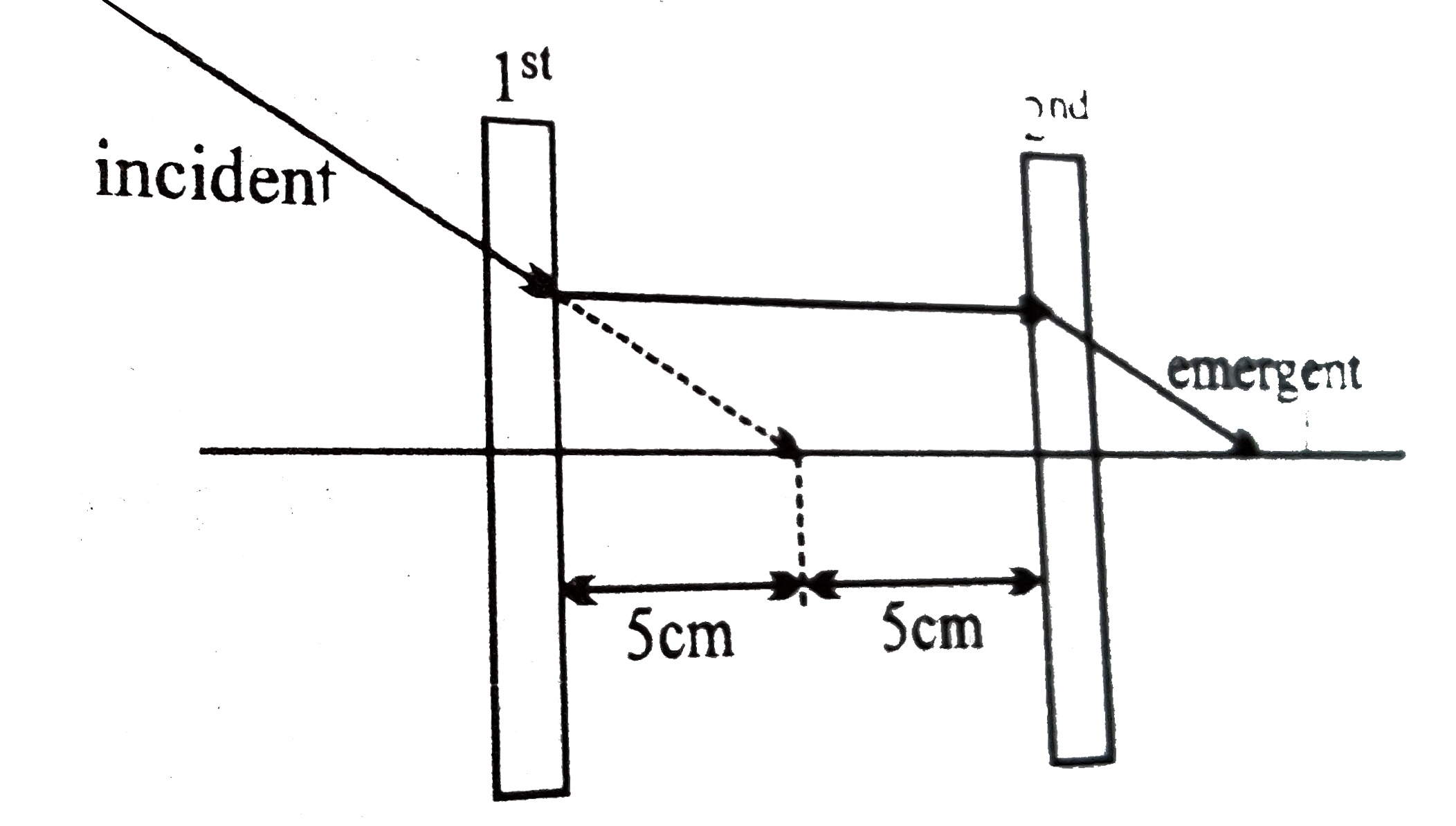
Look at the ray diagram shown ,what will be th focal length of th e`1^(st)`and the `2^(nd)`lens,if the incident light ray passes without any deviation?

Text Solution

Verified by Experts

The correct Answer is:

C

From figure `1^(st)` behave as diverging and `2^(nd)` behave converging
In `1st` incident ray appear to pass at 5 cm distance point and after refraction it becomes parallel to principal axis i.e. the focal length = -5cm and for second f=5 cm
Promotional Banner

Topper's Solved these Questions

  • GEOMETRICAL OPTICS

    ALLEN |Exercise EXERCISE-2|44 Videos
  • GEOMETRICAL OPTICS

    ALLEN |Exercise EXERCISE-3|12 Videos
  • GEOMETRICAL OPTICS

    ALLEN |Exercise EXERCISE - 05 (B) (ASSERTION & REASON )|9 Videos
  • CURRENT ELECTRICITY

    ALLEN |Exercise EX.II|66 Videos
  • GRAVITATION

    ALLEN |Exercise EXERCISE 4|9 Videos

Similar Questions

Explore conceptually related problems

A prism of refractive index n_(1) & another prism of reactive index n_(2) are stuck together without a gap as shown in the figure.The angle of the prisms are as shown. n_(1)&n_(2) depend on lambda ,the wavelength of light according to n_(1)=1.20+(10.8xx10^(4))/(lambda^(2)) & n_(2)=1.45+(1.80xx10^(4))/(lambda^(2)) where lambda is in nm. (i)Calculate the wavelength lambda_(0) for which rays incident at any angle on the interface BC pass through without bending at that interface. (ii) for light of wavelength lambda_(0) ,find the angle of incidencei on face AC such that the deviation produced by the combination of prism is minimum.

Thin films, including soap bubbles and oil show patterns of alternative dark and bright regions resulting from interference among the reflected light waves. If two waves are in phase, their crests and troughs will coincide. The interference will be constructive and the amplitude of resultant wave will be greater then either of constituent waves. If the two wave are not of phase by half a wavelength (180^(@)) , the crests of one wave will coincide width the troughs of the other wave. The interference will be destructive and the amplitude of the resultant wave will be less than that of either constiuent wave. 1. When incident light I, reaches the surface at point a, some of the light is reflected as ray R_(a) and some is refracted following the path ab to the back of the film. 2. At point b, some of the light is refracted out of the film and part is reflected back through the film along path bc. At point c, some of the light is reflected back into the film and part is reflected out of the film as ray R_(c) . R_(a) and R_(c) are parallel. However, R_(c) has traveled the extra distance within the film of abc. If the angle of incidence is small, then abc is approximately twice the film's thickness . If R_(a) and R_(c) are in phase, they will undergo constructive interference and the region ac will be bright. If R_(a) and R_(c) are out of phase, they will undergo destructive interference and the region ac will be dark. I. Refraction at an interface never changes the phase of the wave. II. For reflection at the interfere between two media 1 and 2, if n_(1) gt n_(2) , the reflected wave will change phase. If n_(1) lt n_(2) , the reflected wave will not undergo a phase change. For reference, n_(air) = 1.00 . III. If the waves are in phase after reflection at all intensities, then the effects of path length in the film are: Constrictive interference occurs when 2 t = m lambda // n, m = 0, 1,2,3 ,... Destructive interference occurs when 2 t = (m + (1)/(2)) (lambda)/(n) , m = 0, 1, 2, 3 ,... If the waves are 180^(@) out of the phase after reflection at all interference, then the effects of path length in the film area: Constructive interference occurs when 2 t = (m + (1)/(2)) (lambda)/(n), m = 0, 1, 2, 3 ,... Destructive interference occurs when 2 t = (m lambda)/(n) , m = 0, 1, 2, 3 ,... 72. A film with index of refraction 1.50 coats a glass lens with index of refraction 1.80. What is the minimum thickness of the thin film that will strongly reflect light with wavelength 600 nm?

Draw the ray diagrams showing incident ray and reflected ray for (1) a ray parallel to the principal axis and (2) a ray passing through the principal focus of a concave mirror.

Draw the ray diagrams showing incident ray and reflected ray for (1) a ray parallel to the principal axis and (2) a ray passing through the principal focus of a concave mirror.

A ray of light is incident on a concave mirror . It is parallel to the principal axis and its height from principal axis is equal to the focal length of the mirror. The ratio of the distance of point B to the distance of the focus from the centre of curvature is (AB is the reflected ray)

In a specially designed vernier calipers, 10 divisions of the vernier scale are equal to 4 divisions of the main scale. In the following figure, the zero error and a measurement are shown. In the zero error, the 5^(th) and the 10^(th) divisions of the vernier coincides with 1 mm and 3 mm mark on the main scale respectively and in the measurement, the 2^(nd) and the 7^(th) divisions of the vernier scale coincide with the 23 mm and 25 mm mark on the main scale respectively as shown in the figure. Report the length measured with due regards to the error.

A direct-vision prism is made out of three prisms, each with a refracting angle of phi=60^(@) , attached to each other as shown in Figure. Light of a certain wavelength is incident on the first prism. The angle of incidence is 30^(@) and the ray leaves the third prism parallel to the direction of incidence. The refractive index of the glass of the first and third prisms, is 1.5. Find the refractive index of the material of the middle prism. (sqrt(6)=2.45)

(a) Figure 9.32 shows a cross-section of a 'light pipe' made of a glass fibre of refractive index 1.68. The outer covering of the pipe is made of a material of refractive index 1.44. What is the range of the angles of the incident rays with the axis of the pipe for which total reflections inside the pipe take place, as shown in the figure. (b) What is the answer if there is no outer covering of the pipe?

If the focal length of a lens for red and violet light rays respectively are f_R and f_V then which of the following is true relationship ?

A ray of light is incident on a prism ABC of mu = sqrt(3) as shown in Fig. Find the angle of incidence for which the deviation of light by the prism ABC is minimum. By what angle should the second prism be rotated so that final ray suffers net minimum deviation ?

ALLEN -GEOMETRICAL OPTICS-EXERCISE- 01
  1. A paraxial beam is incident on a glass (n=1.5) hemisphere of radius R=...

    Text Solution

    |

  2. A concave spherical surface of radius of curvature 10 cm separates two...

    Text Solution

    |

  3. A double convex lens, lens made of a material of refractive index mu(1...

    Text Solution

    |

  4. Optic axis of a thin equiconvex lens is the x-axis. The co-rodinates o...

    Text Solution

    |

  5. A converging lens of focal length 20 cm and diameter 5 cm is cut along...

    Text Solution

    |

  6. Look at the ray diagram shown ,what will be th focal length of th e1^(...

    Text Solution

    |

  7. A diverging lens of focal length 10cm is placed 10cm in front of a pla...

    Text Solution

    |

  8. A point object O moves from the principal axis of a converging lens in...

    Text Solution

    |

  9. A point object O is placed at a distance of 20 cm from a convex lens o...

    Text Solution

    |

  10. A point source of light is placed on the principal axis between F and ...

    Text Solution

    |

  11. A man washign to get a picture of a Zebra photographed a white donkey ...

    Text Solution

    |

  12. A lens if placed between a source of light and a wall. It forms images...

    Text Solution

    |

  13. In the displacement method , a convex lens is placed in between an obj...

    Text Solution

    |

  14. A beam of light consisting of red, green and blue colours is incident ...

    Text Solution

    |

  15. A ray of light is incident normally on the first refracting face of th...

    Text Solution

    |

  16. A horizontal ray of light passes through a prism of index 1.50 and ape...

    Text Solution

    |

  17. The curve of angle of incidence versus angle of deviaton wshown has be...

    Text Solution

    |

  18. A beam of monochromatic light is incident at i= 50^(@) on one face of ...

    Text Solution

    |

  19. A parallel of white light falls on a concave lens , Image of blue , re...

    Text Solution

    |

  20. Which of the following quantities related to a lens does not depend on...

    Text Solution

    |
