Home
Class 12
PHYSICS
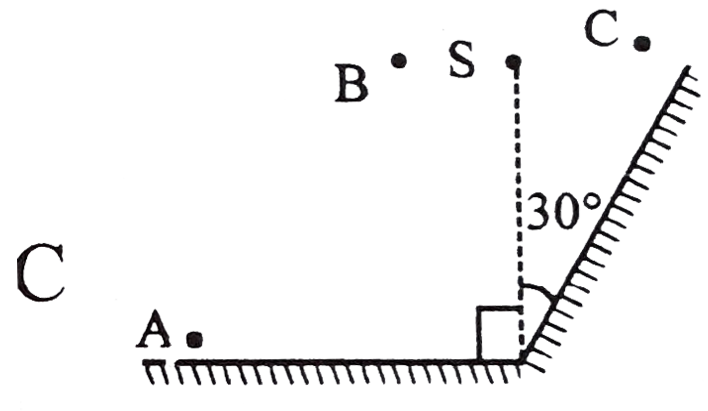
A point source of lightS is placed in fr...

A point source of light`S` is placed in front of two large mirros as shown .Which of the following observes will see only one image of S?

A

Only A

B

Only C

C

Both A and C

D

Both B and C

Text Solution

Verified by Experts

The correct Answer is:
B

Hence we can see from the images velocity in mirror `1` & `II^(nd) v_(12) = 2 "vsin"beta`
Promotional Banner

Topper's Solved these Questions

  • GEOMETRICAL OPTICS

    ALLEN |Exercise EXERCISE-3|12 Videos
  • GEOMETRICAL OPTICS

    ALLEN |Exercise EXERCISE-04[A]|23 Videos
  • GEOMETRICAL OPTICS

    ALLEN |Exercise EXERCISE- 01|45 Videos
  • CURRENT ELECTRICITY

    ALLEN |Exercise EX.II|66 Videos
  • GRAVITATION

    ALLEN |Exercise EXERCISE 4|9 Videos

Similar Questions

Explore conceptually related problems

A point source of light ,S is placed at a distance L in front of the centre of plane mirror of width d which is a hanging vertically on wall ,A man walks in front of the mirror , at a distance 2L as shown below . The distance over which the man can see the image of the light source in the mirror is :

A diverging lens of focal length 10cm is placed 10cm in front of a plane mirror as shown in Fig. Light from a very far away source falls on the lens. What is the distance of final image?

Through a point P (-2,0), tangerts PQ and PR are drawn to the parabola y^2 = 8x. Two circles each passing through the focus of the parabola and one touching at Q and other at R are drawn. Which of the following point(s) with respect to the triangle PQR lie(s) on the radical axis of the two circles?

Two identical glass rods S_(1) and S_(2) (refractive index=1.5) have one convex end of radius of curvature 10 cm. They are placed with the curved surfaces at a distance d as shown in the figure, with their axes (shown by the dashed line) aligned. When a point source of light P is placed inside rod S_(1) on its axis at a distance of 50 cm from the curved face, the light rays emenating from it are found to be parallel to the axis inside S_(2) . The distance d is

Two identical incandescent light bulbs are connected as shown in figure. When the circuit is connected with an A.C. voltage source of frequency f, which of the following observation will be correct ?

A point source S is placed at the bottom of different layers as shown is figure,the refractive index of bottommost layer is mu_(0) The refractive index of any other upper layer is mu(n)=mu_(0)-(mu_(0))/(4pi-18) where n=1,2,..... A ray of light starts form the source S as shown. Total internal reflection takes place at the upper surface of a layer haing n equal to

The following objects are placed one after each other in given order onto a central axis with a separation of 40 cm each. A point source of light O. a diverging lens of focal length 40 cm. a converging lens of focal length 40 cm and converging mirror of focal length 80 cm. The aperture diameter of lenses and mirror is d=20 cm . If a point source of light is placed at a perpendicular distance of x from central axis then. (You have to consider single optical event at any optical element) Mark the CORRECT statement(s):-

The following objects are placed one after each other in given order onto a central axis with a separation of 40 cm each. A point source of light O. a diverging lens of focal length 40 cm. a converging lens of focal length 40 cm and converging mirror of focal length 80 cm. The aperture diameter of lenses and mirror is d=20 cm. If a point source of light is placed at a perpendicular distance of x from central axis then. (You have to consider single optical event at any optical element) Mark the CORRECT statement(s):-

In a young's double slit experiment, green light is incident on the two slits. The interference pattern is observed on a screen. Which of the following changes would cause the observed fringes to be more closely spaced?

If the B-H curves of two samples of P and Q of iron are as shown below, then which one of the following statements is CORRECT?

ALLEN -GEOMETRICAL OPTICS-EXERCISE-2
  1. There are two plane mirror with reflecting suface faciing each other.T...

    Text Solution

    |

  2. In the diagram shown, all the velocities are given with respect to ear...

    Text Solution

    |

  3. A point source of lightS is placed in front of two large mirros as sh...

    Text Solution

    |

  4. A ray reflected successively from two plane mirrors inclined at a cert...

    Text Solution

    |

  5. A ray of light is incident on a concave mirror . It is parallel to the...

    Text Solution

    |

  6. An infinitely long rod lies along the axis of a concave mirror of foca...

    Text Solution

    |

  7. A short linear object of length b lies along the axis of a concave mir...

    Text Solution

    |

  8. What is the length of the image of the rod in mirror, according to the...

    Text Solution

    |

  9. Two thin slabs of refractive indices mu(1) and mu(2) are placed parall...

    Text Solution

    |

  10. A point source S is placed at the bottom of different layers as shown ...

    Text Solution

    |

  11. A ray of light of refractive index 1.4approaches the boundary surface ...

    Text Solution

    |

  12. A ray of light strikes a cubical slab surrounded by air as shown in th...

    Text Solution

    |

  13. A cubical block of glass of refractive index n1 is in contact with the...

    Text Solution

    |

  14. A beam of diameter 'd' is incident on a glass hemisphere. If the radiu...

    Text Solution

    |

  15. When the object is at distance u(1)andu(2)the images formed by the sa...

    Text Solution

    |

  16. A light ray hits the pole of a thin biconvex lens as shown in fig. The...

    Text Solution

    |

  17. A ray of light passes through a prism in a principle plane the deviati...

    Text Solution

    |

  18. The diagram shows five isosceles right angled prisms.A light ray incid...

    Text Solution

    |

  19. A certain prism is found to produce a minimum of38^(@).It produces a d...

    Text Solution

    |

  20. A ray incident at an angle 53^(@) on a prism emerges at an angle 37^(@...

    Text Solution

    |

