Home
Class 12
PHYSICS
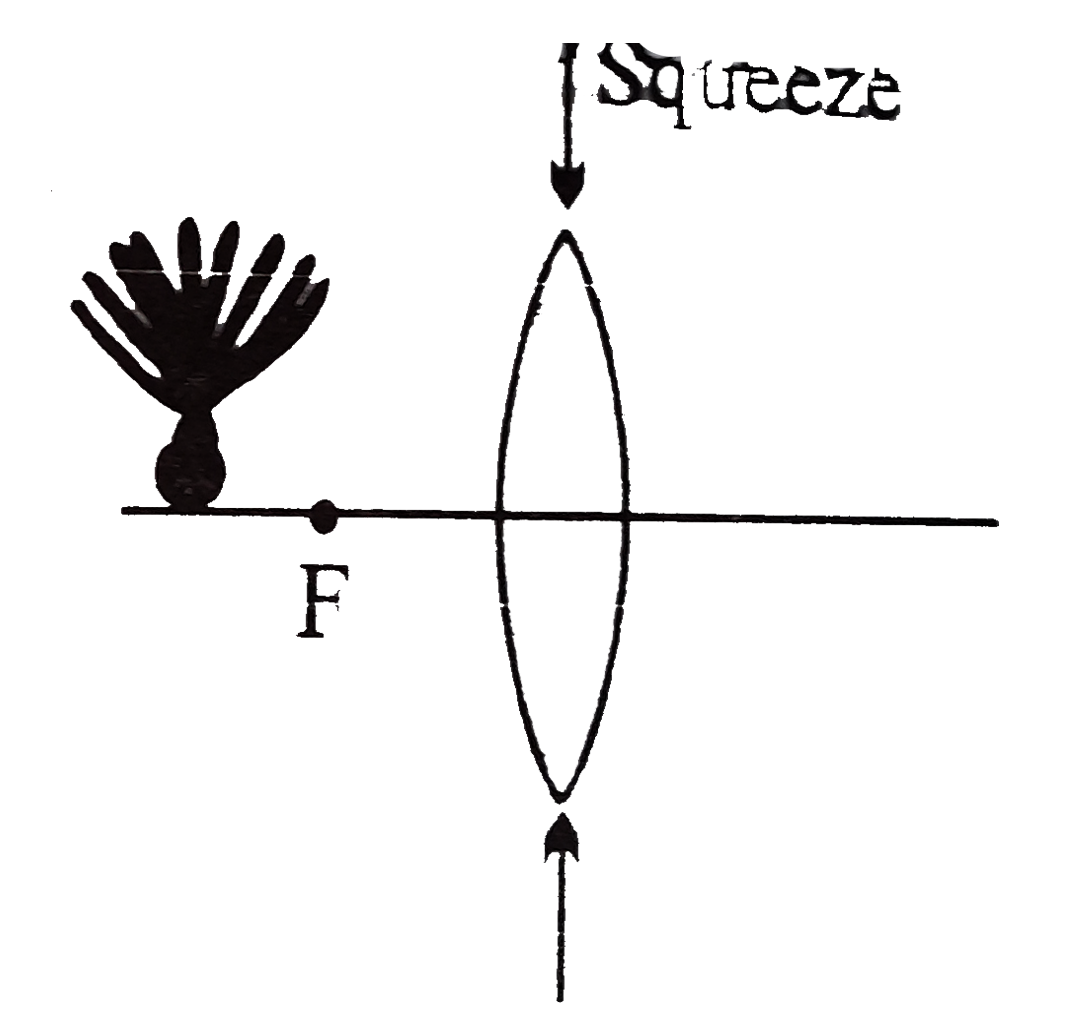
A turnips sits before a thin coverging l...

A turnips sits before a thin coverging lens,outside the focal point of the lens.Then lens is filled with a transparent gel so that it is flexible by,by squeezing its ends towards its center [as indicated in figure(a)],you can change the curvature of its front and rear sides

When you squeeze the lens,the lateral height of image.

A

(a)increase

B

(b)decrease

C

(c)remains same

D

(d)data sufficient

Text Solution

Verified by Experts

The correct Answer is:

B

As v decreases, the magnification is also decreases.
Promotional Banner

Topper's Solved these Questions

  • GEOMETRICAL OPTICS

    ALLEN |Exercise EXERCISE - 04 (A)|48 Videos
  • GEOMETRICAL OPTICS

    ALLEN |Exercise EXERCISE - 04 (B)|15 Videos
  • GEOMETRICAL OPTICS

    ALLEN |Exercise ASSERTION-REASON|40 Videos
  • CURRENT ELECTRICITY

    ALLEN |Exercise EX.II|66 Videos
  • GRAVITATION

    ALLEN |Exercise EXERCISE 4|9 Videos

Similar Questions

Explore conceptually related problems

A turnips sits before a thin coverging lens,outside the focal point of the lens.Teh lens is filled with a transparent gel so that it is flexible by,by squeezing its ends towards its center [as indicated in figure(a)],you can change the curvature of its front and rear sides When you squeeze the lens,the lateral height of image.

For a thin convex lens when the heights of the object is double than its image, its object distance is equal to ....... Focal length of a lens is f.

An unsymmetrical double convex thin lens forms the image of a point object on its axis will the position of the image change if the lens is reversed ?

The redius of curvature of the convex face of a plano-convex lens is 12cm and its refractive index is 1.5. a. Find the focal length of this lens. The plane surface of the lens is now silvered. b. At what distance form the lans will parallel rays incident on the convex face converge? c. Sketch the ray diagram to locate the image, when a point object is places on the axis 20cm from the lens. d. Calculate the image distance when the object is placed as in (c).

The ciliary muscles of eye control the curvature of the lens in the eye and hence can alter the effective focal length of the system. When the muscles are fully relaxed, the focal length is maximum. When the muscles are strained, the curvature of lens increases. That means radius of curvature decreases and focal length decreases. For a clear vision, the image must be on the retina. The image distance is therefore fixed for clear vision and it equals the distance of retina from eye lens. It is about 2.5cm for a grown up person. A perosn can theoretically have clear vision of an object situated at any large distance from the eye. The smallest distance at which a person can clearly see is related to minimum possible focal length. The ciliary muscles are most strained in this position. For an average grown up person, minimum distance of the object should be around 25cm. A person suffering from eye defects uses spectacles (eye glass). The function of lens of spectacles is to form the image of the objects within the range in which the person can see clearly. The image o the spectacle lens becomes object for the eye lens and whose image is formed on the retina. The number of spectacle lens used for th eremedy of eye defect is decided by the power fo the lens required and the number of spectacle lens is equal to the numerical value of the power of lens with sign. For example, if power of the lens required is +3D (converging lens of focal length 100//3cm ), then number of lens will be +3 . For all the calculations required, you can use the lens formula and lensmaker's formula. Assume that the eye lens is equiconvex lens. Neglect the distance between the eye lens and the spectacle lens. Q. Maximum focal length of a eye lens of a normal person is

The ciliary muscles of eye control the curvature of the lens in the eye and hence can alter the effective focal length of the system. When the muscles are fully relaxed, the focal length is maximum. When the muscles are strained, the curvature of lens increases. That means radius of curvature decreases and focal length decreases. For a clear vision, the image must be on the retina. The image distance is therefore fixed for clear vision and it equals the distance of retina from eye lens. It is about 2.5cm for a grown up person. A perosn can theoretically have clear vision of an object situated at any large distance from the eye. The smallest distance at which a person can clearly see is related to minimum possible focal length. The ciliary muscles are most strained in this position. For an average grown up person, minimum distance of the object should be around 25cm. A person suffering from eye defects uses spectacles (eye glass). The function of lens of spectacles is to form the image of the objects within the range in which the person can see clearly. The image o the spectacle lens becomes object for the eye lens and whose image is formed on the retina. The number of spectacle lens used for th eremedy of eye defect is decided by the power fo the lens required and the number of spectacle lens is equal to the numerical value of the power of lens with sign. For example, if power of the lens required is +3D (converging lens of focal length 100//3cm ), then number of lens will be +3 . For all the calculations required, you can use the lens formula and lensmaker's formula. Assume that the eye lens is equiconvex lens. Neglect the distance between the eye lens and the spectacle lens. Q. Maximum focal length of a eye lens of a normal person is

The ciliary muscles of eye control the curvature of the lens in the eye and hence can alter the effective focal length of the system. When the muscles are fully relaxed, the focal length is maximum. When the muscles are strained, the curvature of lens increases. That means radius of curvature decreases and focal length decreases. For a clear vision, the image must be on the retina. The image distance is therefore fixed for clear vision and it equals the distance of retina from eye lens. It is about 2.5cm for a grown up person. A perosn can theoretically have clear vision of an object situated at any large distance from the eye. The smallest distance at which a person can clearly see is related to minimum possible focal length. The ciliary muscles are most strained in this position. For an average grown up person, minimum distance of the object should be around 25cm. A person suffering from eye defects uses spectacles (eye glass). The function of lens of spectacles is to form the image of the objects within the range in which the person can see clearly. The image o the spectacle lens becomes object for the eye lens and whose image is formed on the retina. The number of spectacle lens used for th eremedy of eye defect is decided by the power fo the lens required and the number of spectacle lens is equal to the numerical value of the power of lens with sign. For example, if power of the lens required is +3D (converging lens of focal length 100//3cm ), then number of lens will be +3 . For all the calculations required, you can use the lens formula and lensmaker's formula. Assume that the eye lens is equiconvex lens. Neglect the distance between the eye lens and the spectacle lens. Q. Maximum focal length of a eye lens of a normal person is

A glass wedge with a small angle of refraction theta is placed at a certain distance from a converging lens with a focal length f ,one surface of the wedge being perpendicular to the optical axis of the lens. A point sources S of light is on the other side of the lens at its focus. The rays reflected from the wedge (not from base) produce, after refraction in the lens , two images of the source displaced with respect to each other by d. Find the refractive index of the wedge glass. [Consider only paraxial rays.]

A thin equiconvex lens of glass of refractive index mu=3//2 & of focal length 0.3m in air is sealed into an opening at one end of a tank filled with water (mu=4//3) .On the opposite side of the lens ,a mirror is placed inside the tank on the tank wall perpendicular to the lens axis ,as shown in figure .the separation between the lens and the mirror is 0.8m A small object is placed outside the tank in front of the lens at a distance of 0.9 m form the lens along its axis .Find the position (relative to the lens)of the image of the object fromed by the stsyem.

A thin convex lens of focal length 'f' is put on a plane mirror as shown in the figure. When an object is kept at a distance 'a' from the lens - mirror combination,its image is formed at a distance (a)/(3) in front of the combination . The value of 'a' is :-

ALLEN -GEOMETRICAL OPTICS-Comprehension Based Questions
  1. The efficiency of a heat engine is defined as the ratio of the mechani...

    Text Solution

    |

  2. The efficiency of a heat engine is defined as the ratio of the mechani...

    Text Solution

    |

  3. A potato gun first a potato horizontally down a half-open cylinder of ...

    Text Solution

    |

  4. A potato gun first a potato horizontally down a half-open cylinder of ...

    Text Solution

    |

  5. When two plane mirrors subtend an angle theta between them, then a ray...

    Text Solution

    |

  6. When two plane mirrors subtend an angle theta between them, then a ray...

    Text Solution

    |

  7. When two plane mirrors subtend an angle theta between them, then a ray...

    Text Solution

    |

  8. A man of height H is standing in front of an inclined plane mirror at...

    Text Solution

    |

  9. A man of height H is standing in front of an inclined plane mirror at...

    Text Solution

    |

  10. A man of height H is standing in front of an inclined plane mirror at...

    Text Solution

    |

  11. A turnips sits before a thin coverging lens,outside the focal point of...

    Text Solution

    |

  12. A turnips sits before a thin coverging lens,outside the focal point of...

    Text Solution

    |

  13. A turnips sits before a thin coverging lens,outside the focal point of...

    Text Solution

    |

  14. The ciliary muscles of eye control the curvature of the lens in the ey...

    Text Solution

    |

  15. The ciliary muscles of eye control the curvature of the lens in the ey...

    Text Solution

    |

  16. The ciliary muscles of eye control the curvature of the lens in the ey...

    Text Solution

    |

  17. The ciliary muscles of eye control the curvature of the lens in the ey...

    Text Solution

    |

  18. The ciliary muscles of eye control the curvature of the lens in the ey...

    Text Solution

    |

  19. Light guidance in an optical fiber can be understood by considering a ...

    Text Solution

    |

  20. Light guidance in an optical fiber can be understood by considering a ...

    Text Solution

    |
