Home
Class 12
PHYSICS
A thin equiconvex lens of glass of refra...

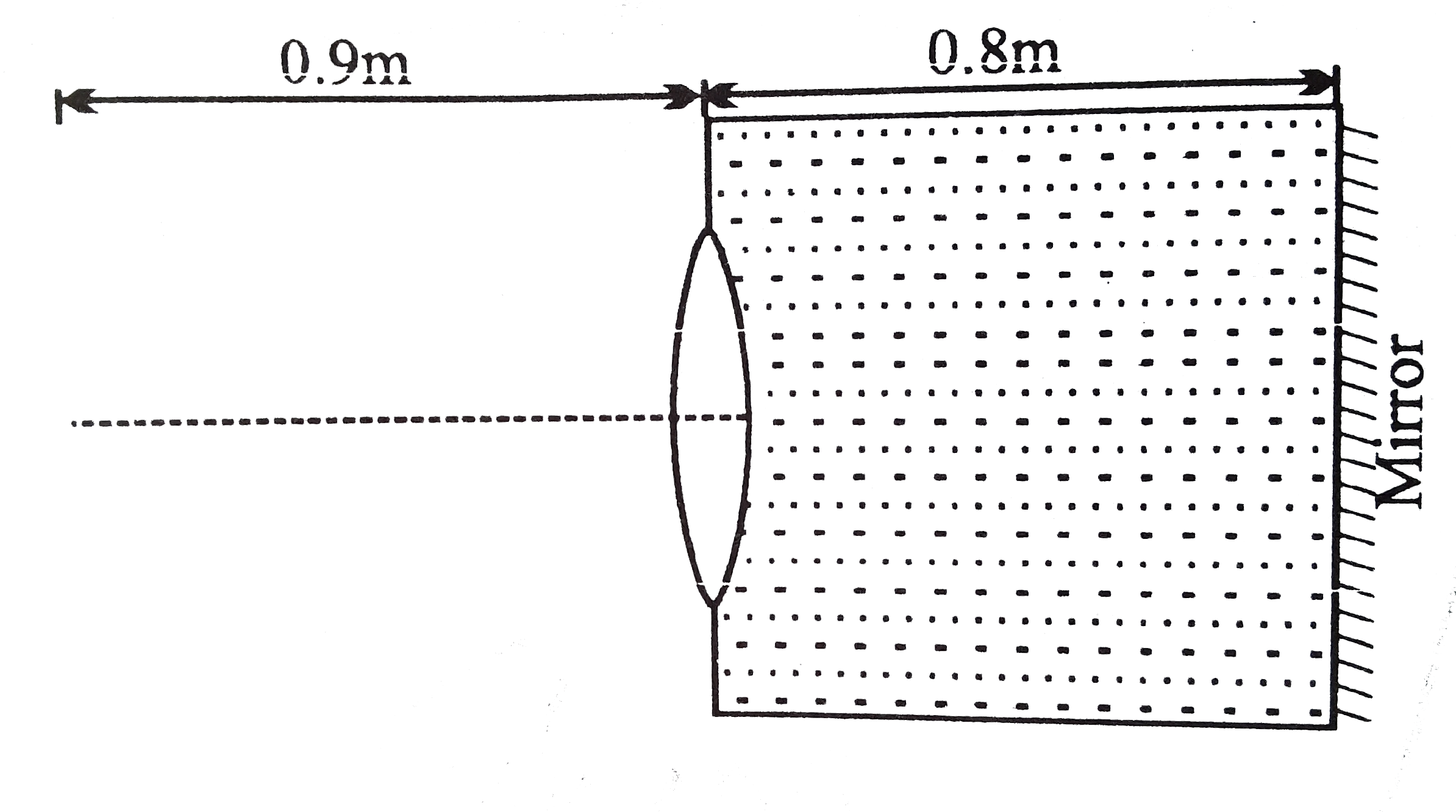
A thin equiconvex lens of glass of refractive index `mu=3//2` & of focal length `0.3m`in air is sealed into an opening at one end of a tank filled with water `(mu=4//3)` .On the opposite side of the lens ,a mirror is placed inside the tank on the tank wall perpendicular to the lens axis ,as shown in figure .the separation between the lens and the mirror is `0.8m`A small object is placed outside the tank in front of the lens at a distance of `0.9`m form the lens along its axis .Find the position (relative to the lens)of the image of the object fromed by the stsyem.

Text Solution

Verified by Experts

The correct Answer is:

0.9 m from the lens (rightwards)

From the lens maker's formula
`(1)/(f) = (mu-1)((1)/(R_(1)) - (1)/(R_(2)))`
we have `(1)/(0.3) = ((3)/(2)-1)((1)/(R) - (1)/(-R))`
(Here `R_(1) = R "and" R_(2) = -R`) `" " therefore R = 0.3`
Now applying `(mu_(2))/(v) - (mu_(1))/(u) = (mu_(2)- mu_(1))/(R) ` at air glass surface , we get `(3//2)/(v_(1))- (1)/(-(09)) = (3//2 - 1)/(0.3)`
`therefore v_(1) = 2.7 "m"`
i.e., first image `I_(1)` will be formed at 2.7 m from the lens. This will act as the virtual object for glass water surface.
Therefore, applying `(mu_(2))/(v) - (mu_(1))/(u) = (mu_(2) - mu_(1))/(R)` at glass water surface.
we have `(4//3)/(v_(2)) - (3//2)/(2.7) = (4//3 - 3//2)/(-0.3)`
`therefore v_(2) = 1.2 m`
i.e, second image `I_(2)` is formed at 1.2 m from the lens or 0.4 m from the plane mirror. This will act as a virtual object for mirror. Therefore , third real image `I_(3)` will be formed at a distance of 0.4 m in front of the mirror after reflection from it. Now this will work as a real object for water glass interface.
Hence applying `(mu_(2))/(v)- (mu_(1))/(u) = (mu_(2)- mu_(1))/(R)`
we get `(3//2)/(v_(4)) - (4//3)/(-(0.8 - 0.4)) = (3//2-4//3)/(0.3)`
`therefore v_(4) = 0.54m` i.e. fourth image is formed to the right of the lens at a distance of 0.54 m from it. Now finally applying the same formula for glass air surface.
`(1)/(v_(2)) - (3//2)/(0.54) - (1-3//2)/(-0.3) " " therefore v_(theta) = 0.9 m`
i.e., position of final image is 0.9 m relative to the lens frightwards or the image is formed 0.1 m behind the mirror.
Promotional Banner

Topper's Solved these Questions

  • GEOMETRICAL OPTICS

    ALLEN |Exercise EXERCISE-04[B]|18 Videos
  • GEOMETRICAL OPTICS

    ALLEN |Exercise EXERCISE-05 (A)|35 Videos
  • GEOMETRICAL OPTICS

    ALLEN |Exercise EXERCISE-3|12 Videos
  • CURRENT ELECTRICITY

    ALLEN |Exercise EX.II|66 Videos
  • GRAVITATION

    ALLEN |Exercise EXERCISE 4|9 Videos

Similar Questions

Explore conceptually related problems

A biconvex lens of focal length 15 cm is in front of a plane mirror. The distance between the lens and the mirror is 10 cm. A small object is kept at a distance of 30 cm from the lens. The final image is

A concave mirror and convex lens (both of refractive index 1.5) have focal length 3 cm in air. When they are placed in water ofrefractive index 4/3 , then their new focal lengths will be ......

A concave lens has focal length of 15 cm. At what distance should the object from the lens be placed so that it forms an image at 10 cm from the lens ? Also find the magnification produced by the lens.

A concave lens has focal length of 15 cm. At what distance should the object from the lens be placed so that it forms an image at 10 cm from the lens ? Also find the magnification produced by the lens.

Focal length of thin lens ......

In a displacement method the distance between the object and the screen is 70 cm and the focal length of the lens is 16 cm, find the separations of the magnified and diminished image position of the lens.

An unsymmetrical double convex thin lens forms the image of a point object on its axis will the position of the image change if the lens is reversed ?

Two point objects are placed on principal axis of a thin converging lens. One is 20cm from the lens and other is on the other side of lens at a distance of 40 cm from the lens. The images of both objects coincide. The magnitude of focal length of lens is :-

An object of size 3.0cm is placed 14cm in front of a concave lens of focal length 21cm. Describe the image produced by the lens. What happens if the object is moved further away from the lens?

ALLEN -GEOMETRICAL OPTICS-EXERCISE-04[A]
  1. A balloon is rising up along the axis of a concave mirror of radius of...

    Text Solution

    |

  2. A fly F is sitting on a glass slab A , 45 cm thick and of refractive i...

    Text Solution

    |

  3. An air bubble inside a glass slab (µ=1.5) appears 6 cm when viewed fro...

    Text Solution

    |

  4. A slab of glass, of thickness 6 cm and refractive index mu=1.5 is plac...

    Text Solution

    |

  5. A point object is placed 33cm from a convex mirror of curvature radiu...

    Text Solution

    |

  6. A long solid cylindrical glass rod of refractive index 3/2 is immersed...

    Text Solution

    |

  7. Light from a luminious point on the lower face of a rectangular glass ...

    Text Solution

    |

  8. A rod made of glass (mu = 1.5) and of square cross-section is equal is...

    Text Solution

    |

  9. A fish is rising up vertically inside a pond with velocity 4 cm/s and ...

    Text Solution

    |

  10. A ray of light falls on a transparent sphere with centre at C as shown...

    Text Solution

    |

  11. A narrow parallel beam of light is incident on a transparent sphere of...

    Text Solution

    |

  12. A thin equiconvex lens of glass of refractive index mu=3//2 & of focal...

    Text Solution

    |

  13. In the figure shown L is converging lens of focal length 10 cm and M i...

    Text Solution

    |

  14. An object is kept at a distance of 16 cm from a thin lens and the imag...

    Text Solution

    |

  15. A point source of light is kept at a distance of 15cm from a convergi...

    Text Solution

    |

  16. A lens placed between a candle and a fixed screen forms a real tr...

    Text Solution

    |

  17. Consider a 'beam expander' which consists of two converging lenses of ...

    Text Solution

    |

  18. A prism of refractive index sqrt(2) has refractive angle 60^(@) . Find...

    Text Solution

    |

  19. An equilateral prism deviates a ray through23^(@)for two angles of inc...

    Text Solution

    |

  20. The figure shows the path of a ray passing through an equiangular pris...

    Text Solution

    |
