Home
Class 12
PHYSICS
Figure shows an irregular block of mater...

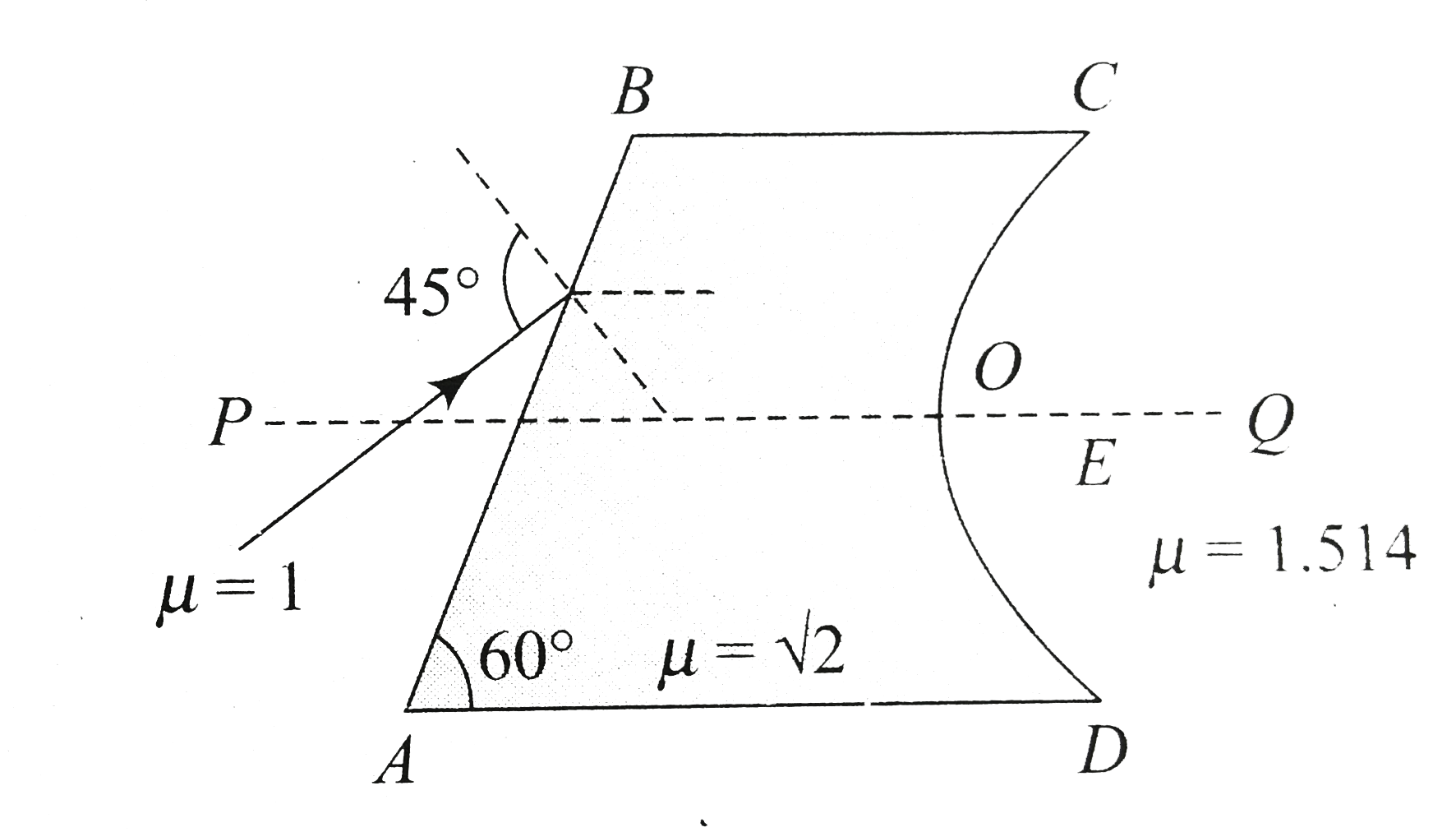
Figure shows an irregular block of material of refractive indec `sqrt(2)`. A ray of light strikes the face AB as shown. After refraction, it is incident on a spherical surface CD of radius of curvature 0.4 m and enters a medium of refractive index 1.514 to meet PQ at E. Find the distance OE up to two places of decimal.

Text Solution

Verified by Experts

The correct Answer is:

6.06 m

Applying Snell's law on face AB ,
`(1)"sin"45^(@)= (sqrt2)"sinr" therefore "sinr" = (1)/(2) "or" r = 30^(@)`
i.e., ray becomes parallel to AD inside the block .
Now applying , `(mu_(2))/(v) - (mu_(1))/(u) = (mu_(2) - mu_(1))/(R)` on face CD ,
`(1.514)/(OE) - (sqrt2)/(oo) = (1.514 - sqrt2)/(0.4)`
Solving this equation , we get `OE = 6.06` m
Promotional Banner

Topper's Solved these Questions

Similar Questions

Explore conceptually related problems

A concave spherical surface of radius of curvature 10 cm separates two mediums X and Y of refractive indices 4//3 and 3//2 respectively. Centre of curvature of the surfaces lies in the medium X . An object is placed in medium X .

The adjacent figure shows a thin plano-convex lens of refractive index mu_1 and a thin plano-concave lens of refractive index mu_2 , both having same radius of curvature R of their curved surfaces. The thin lens of refractive index mu_3 has radius of curvature R of both its surfaces. This lens is so placed in between the plano-convex and plano-concave lenses that the plane surfaces are parallel to each other. The focal length of the combination is

A cubical block of glass of refractive index n_1 is in contact with the surface of water of refractive index n_2. A beam of light is incident on vertical face of the block. After refraction a total internal reflection at the base and refraction at the opposite face take place. The ray emerges at angle theta as shown. The value of theta is given by

A ray OP of monochromatic light is incident on the face AB of prism ABCD mear vertex B at an incident angle of 60degree (see figure). If the refractive index of the material of the prism is sqrt3 , which of the following is (are) are correct?

Refractive index of a glass cube is sqrt(2) . A ray of light is incident on left face of the cube as shown. Right face of a glass cube is silvered. If the total deviation suffered by the ray when it comes out of the glass cube is 45n (in degree) then find n :

(a) Figure 9.32 shows a cross-section of a 'light pipe' made of a glass fibre of refractive index 1.68. The outer covering of the pipe is made of a material of refractive index 1.44. What is the range of the angles of the incident rays with the axis of the pipe for which total reflections inside the pipe take place, as shown in the figure. (b) What is the answer if there is no outer covering of the pipe?

A ray of light is incident on the surface of a sphere of refractive index sqrt(7)/(2) other half of sphere is silvered. After refraction it is reflected and then refracted out of sphere again such that the total deviation is minimum then total deviation of the ray will be (sin41_(0)-sqrt((3)/(7)))

A transparent thin film of uniform thickness and refractive index n_(1) =1.4 is coated on the convex spherical surface of radius R at one end of a long solid glass cylinder of refractive index n_(2) =1.5 , as shown in the figure. Rays of light parallel to the axis of the cylinder traversing through the film from air to glass get focused at distance f_(1) from the film, while rays of light traversing from glass to air get focused at distance f_(2) from the film, Then

The optical properties of a medium are governed by the relative permitivity (epsi_(r)) and relative permeability (mu_(r)) . The refractive index is defined as sqrt(mu_(r)epsi_(r))=n . For ordinary material epsi_(r)gt0 and mu_(r)gt0 and the positive sign is taken for the square root. In 1964, a Russian scientist V. Veselago postulated the existence of material with epsi_(r)lt0andmu_(r)lt0 . Since then such 'metamaterials' have been produced in the laboratories and their optical properties studied. For such materials n=-sqrt(mu_(r)epsi_(r)) . As light enters a medium of such refractive index the phases travel away from the direction of propagation. (i) According to the description above show that if rays of light enter such a medium from air (refractive index = 1) at an angle theta in 2^(nd) quadrant, then the refracted beam is in the 3^(rd) quadrant. (ii) Prove that Snell's law holds for such a medium.
