Home
Class 12
PHYSICS
A 2 kg block moving with 10m//s strikes ...

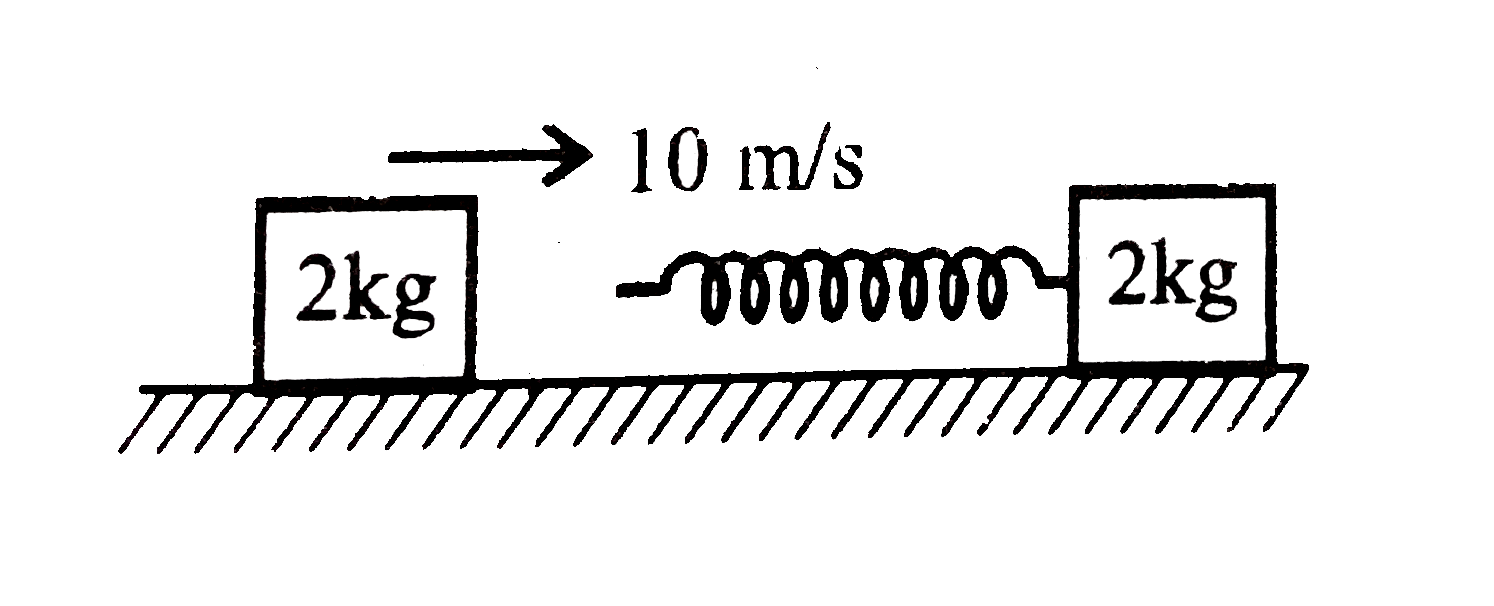
A `2 kg` block moving with `10m//s` strikes a spring of constant `pi^(2)N//m` attached to `2Kg` block at rest kept on a smooth floor. The velocity for which rear moving block remain in contact with spring will be-

A

`0 m//s`

B

`5 m//s`

C

`10 m//s`

D

`7.5 m//s`

Text Solution

Verified by Experts

The correct Answer is:
A


Let velocity of rear `2kg` be `v_(1)` and front `2kg` be `v_(2)` then `20 = 2v_(2) - 2v_(1) rArr v_(2) - v_(1) = 10`
Now by conservation of mechanical energy
`1/2(2)(10)^(2) = 1/2(2)v^(1^(2)) + 1/2(2)v_(2^(2))`
`rArr v_(1^(2)) + v_(2^(2)) = 100`
But `v_(2^(2)) + v_(1^(2)) - 2v_(1)v_(2) = 100`
`rArr v_(1)v_(2) = 0 rArr v_(1) = 0` as `v_(2) ne 0`
Promotional Banner

Topper's Solved these Questions

  • SIMPLE HARMONIC MOTION

    ALLEN |Exercise Comprehension Base Questions (4)|2 Videos
  • SIMPLE HARMONIC MOTION

    ALLEN |Exercise Comprehension Base Questions (5)|3 Videos
  • SIMPLE HARMONIC MOTION

    ALLEN |Exercise Comprehension Base Questions (2)|2 Videos
  • RACE

    ALLEN |Exercise Basic Maths (Wave Motion & Dopplers Effect) (Stationary waves & doppler effect, beats)|25 Videos
  • TEST PAPER

    ALLEN |Exercise PHYSICS|4 Videos

Similar Questions

Explore conceptually related problems

A 2 kg block moving with 10m//s strikes a spring of constant pi^(2)N//m attached to 2Kg block at rest kept on a smooth floor. The time for which rear moving block remain in contact with spring will be-

A block of mass m suspended from a spring of spring constant k . Find the amplitude of S.H.M.

A 2kg block slides on a horizontal floor with the a speed of 4m//s it strikes a uncompressed spring , and compresses it till the block is motionless . The kinetic friction force is compresses is 15 N and spring constant is 10000 N//m . The spring by

Two blocks A and B, each of mass m, are connected by a masslesss spring of natural length L and spring constant K. The blocks are initially resting on a smooth horizontal floor with the spring at its natural length, as shown in fig. A third identical block C, also of mass m, moves on the floor with a speed v along the line joining A and B, and collides elastically with A. Then

Two blocks A and B of mass m and 2m respectively are connected by a massless spring of spring constant K . This system lies over a smooth horizontal surface. At t=0 the bolck A has velocity u towards right as shown while the speed of block B is zero, and the length of spring is equal to its natural length at that at that instant. {:(,"Column I",,"Column II"),((A),"The velocity of block A",(P),"can never be zero"),((B),"The velocity of block B",(Q),"may be zero at certain instants of time"),((C),"The kinetic energy of system of two block",(R),"is minimum at maximum compression of spring"),((D),"The potential energy of spring",(S),"is maximum at maximum extension of spring"):}

Two blocks A(3 kg) and B(2 kg) resting on a smooth horizontal surface is connected by a spring of stiffness 480N//m . Initially the spring is underformed and a velocity of 2 m//s is imparted to A along the line of the spring away from B. The maximum extension in meters of the spring during subsequent motion is :-

A block of mass 0.50kg is moving with a speed of 2.00m//s on a smooth surface. It strikes another mass of 1 kg at rest and they move as a single body. The energy loss during the collision is

As shown in fig. a block of mass m = 0.40 kg is moving on a frictionless surface at a speed of v = 0.50 m//s .A block of force constant k = 750 N /m comprised the spring and becomes rest for a instant . How much spring will be compressed ?

As shown in the figure, initially both th springs are in normal length (L_(0)) . At t=0, the block is given a rightward velocity v_(0)=2 m//s . The mass of the block is (14//3)kg . How much distance does th block cover before it comes to rest for the first time? (The spring constant of the left spring is K_(0)=2N//m and that of the right spring is not constant and varies as k=k_(0)x , where x is the compression in the spring)

A spring of spring constant 500 N/m is attached on a rough surface at one side . Coefficient of friction for rough surface is 0.75 . A block of mass 100 kg collide with the free end of spring at a speed of 10sqrt(2) ms^(-1) , then how much will spring be compressed ? (g =10 ms^(-2))

