Home
Class 12
PHYSICS
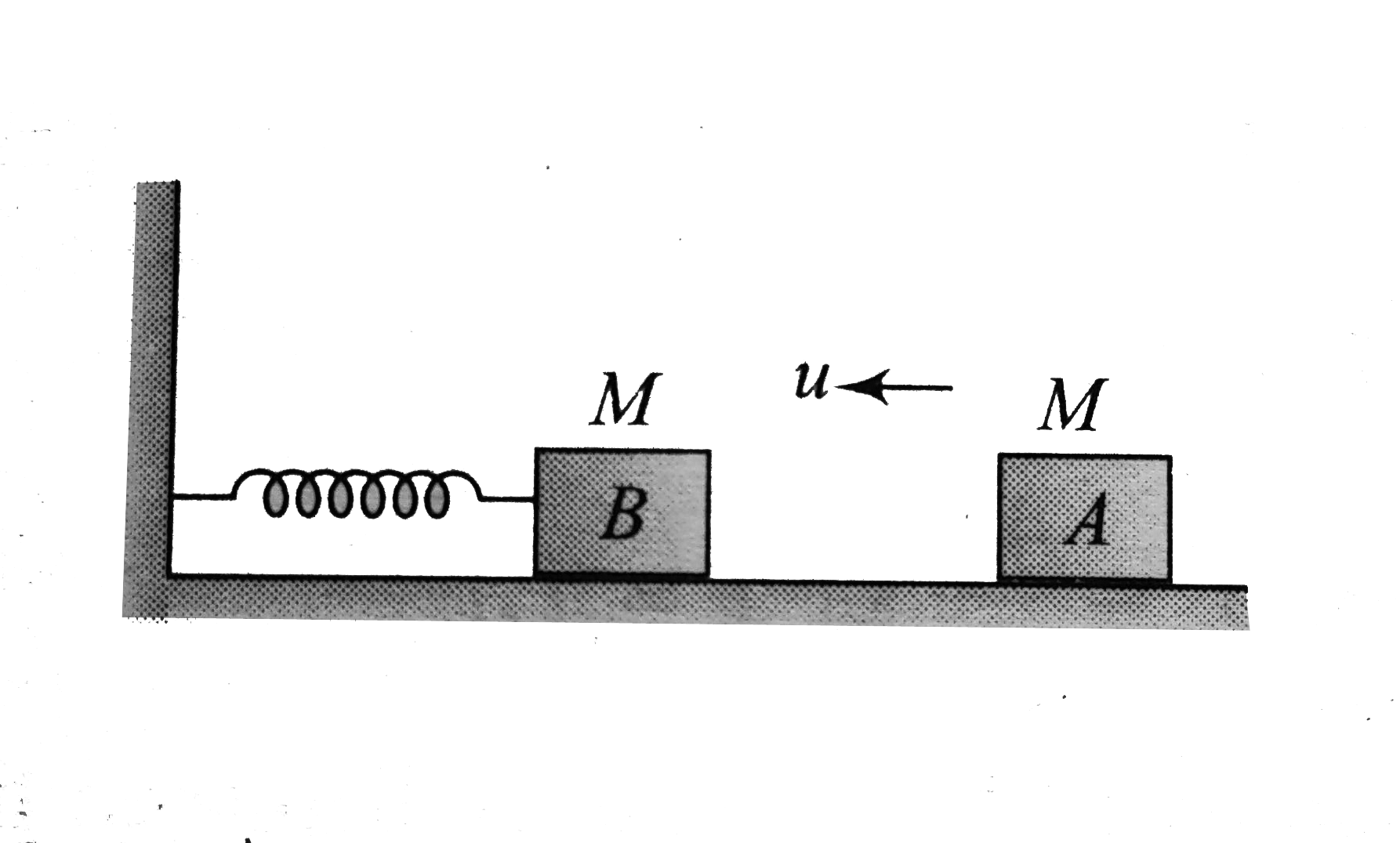
In the figure shown, the block A of mass...

In the figure shown, the block A of mass m collides with the identical block B and after collision they stick together. Calculate the amplitude of resulatant vibration.

Text Solution

Verified by Experts

The correct Answer is:

B

Common velocity after collision be v than by COLM
`2Mv = Mu rArr v = (u)/(2)`
Hence, kinetic energy
`= 1/2` energy
`= 1/2(2M)(u/2)^(2) = 1/4Mu^(2)`
It is also the total energy of vibration because the spring is unstretched at this moment, hence if A is the amplitude, then
`1/2 KA^(2) = 1/4 Mu^(2) rArr A = (sqrt((M)/(2K)))u`
Promotional Banner

Topper's Solved these Questions

  • SIMPLE HARMONIC MOTION

    ALLEN |Exercise Exercise-04 [B]|104 Videos
  • SIMPLE HARMONIC MOTION

    ALLEN |Exercise Exercise-05 [A]|39 Videos
  • SIMPLE HARMONIC MOTION

    ALLEN |Exercise Comprehension Base Questions (5)|3 Videos
  • RACE

    ALLEN |Exercise Basic Maths (Wave Motion & Dopplers Effect) (Stationary waves & doppler effect, beats)|25 Videos
  • TEST PAPER

    ALLEN |Exercise PHYSICS|4 Videos

Similar Questions

Explore conceptually related problems

In the figure, what should be mass m so that block A slides up with a constant velocity ?

Consider the figure shown here of a moving cart C. if the coefficient of friction between the block A and the cart is mu , then calculate the minimum acceleration a of the cart C so that the block A does not fall.

In arrangement shown the block A of mass 15 kg supported in equilibrium by the block B. Mass of the block B is closest to

A ball moving with a velocity of 12ms^(-1) collides with another identical stationary ball . After the collision they move as shown in figure . Find the speed of the balls after the collision . Also , decide whether the condition is elastic or not .

On a frictionless surface , a block of mass . M moving at speed v collides elastically with another block of same mass M which is intially at rest /After collision the first block moes at an angle theta to its initial direction and has a speed v/3 The second block's speed after the collision is :

A body of mass 2 kg moving with a velocity of 3 m/sec collides head on with a body of mass 1 kg moving in opposite direction with a velocity of 4 m/sec. After collision, two bodies stick together and move with a common velocity which in m/sec is equal to

A mass 'm' moves with a velocity 'v' and collides inelastieally with another identical mass . After collision the 1^(st) mass moves with velocity v/sqrt3 in a direction perpendicular to the initial direction of motion. Find the speed of the 2^(nd) mass after collision. undersetunderset ((before),(collision))(m)(*rarr) underset(m)* uparrow v//sqrt3 underset((after),(collision):)

A moving block having mass m , collides with another stationary block having mass 4m , The lighter block comes to rest after collision . When the intial velocity of the lighter block is v, then the value of coefficient of restitution (e ) will be

Two blocks of masses 2kg and M are at rest on an inclined plane and are separated by a distance of 6.0m as shown. The coefficient of friction between each block and the inclined plane is 0.25 . The 2kg block is given a velocity of 10.0m//s up the inclined plane. It collides with M, comes back and has a velocity of 1.0m//s when it reaches its initial position. The other block M after the collision moves 0.5m up and comes to rest. Calculate the coefficient of restitution between the blocks and the mass of the block M. [Take sintheta=tantheta=0.05 and g=10m//s^2 ]

For the damped oscillator, the mass m of the block is 400g, k = 120 Nm^(-1) and the damping constant b is 50 gs^(-1) . Calculate time taken for its amplitude of vibration to drop to half of the initial value.

ALLEN -SIMPLE HARMONIC MOTION-Exercise-04 [A]
  1. A particle simple harmonic motion completes 1200 oscillations per minu...

    Text Solution

    |

  2. Find the resulting amplitude A' and the phase of the vibrations delta ...

    Text Solution

    |

  3. A particle is executing SHM given by x = A sin (pit + phi). The initia...

    Text Solution

    |

  4. The shortest distance travelled by a particle executing SHM from mean ...

    Text Solution

    |

  5. Two particle A and B execute SHM along the same line with the same amp...

    Text Solution

    |

  6. A body executing S.H.M. has its velocity 10cm//s and 7 cm//s when its ...

    Text Solution

    |

  7. A particle executing a linear SHM has velocities of 8 m/s, 7 m/s and 4...

    Text Solution

    |

  8. A particle is oscillating in a stright line about a centre of force O,...

    Text Solution

    |

  9. The displacement of a particle varies with time as x = 12 sin omega t ...

    Text Solution

    |

  10. A point particle if mass 0.1 kg is executing SHM of amplitude 0.1 m. W...

    Text Solution

    |

  11. A body of mass 1 kg suspended an ideal spring oscillates up and down. ...

    Text Solution

    |

  12. The potential energy (U) of a body of unit mass moving in a one-di...

    Text Solution

    |

  13. A body of mass 1.0 kg is suspended from a weightless spring having for...

    Text Solution

    |

  14. In the figure shown, the block A of mass m collides with the identical...

    Text Solution

    |

  15. A block of mass 1kg hangs without vibrations at the end of a spring wi...

    Text Solution

    |

  16. A small ring of mass m(1) is connected by a string of length l to a sm...

    Text Solution

    |

  17. Calculate the time period of a uniform square plate of side 'a' if it ...

    Text Solution

    |

  18. Two identical rods each of mass m and length L, are tigidly joined and...

    Text Solution

    |

  19. A half ring of mass m, radius R is hanged at its one end its one end i...

    Text Solution

    |

  20. The two torsion pendula differ only by the addition of cylindrical mas...

    Text Solution

    |
