Home
Class 12
PHYSICS
Consider radioactive decay of A to B wit...

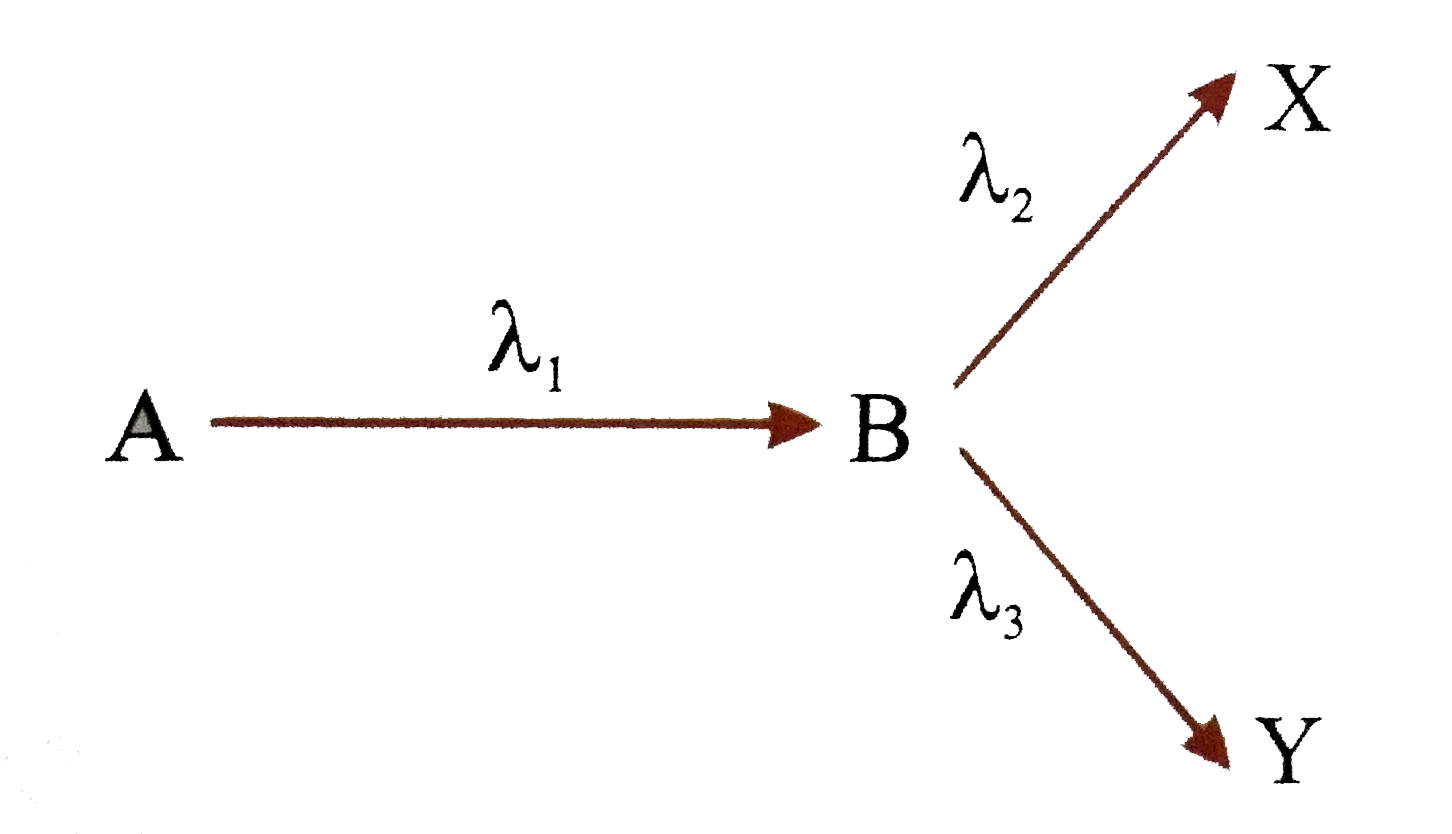
Consider radioactive decay of `A` to `B` with which further decays either to `X` or `Y`, `lambda_(1), lambda_(2)` and `lambda_(3)` are decay constant for `A` to `B` decay, `B` to `X` decay and Bto `Y` decay respectively. At `t=0`, the number of nuclei of `A,B,X` and `Y` are `N_(0), N_(0)` zero and zero respectively.
`N_(1),N_(2),N_(3)` and `N_(4)` are the number of nuclei of `A,B,X` and `Y` at any instant `t`.

The net rate of accumulation of `B` at any instant is

A

`N_(1)lambda_(1) + N_(2)lambda_(2) + N_(3)lambda_(3)`

B

`N_(1)lambda_(1) - N_(3)lambda_(2) - N_(4)lambda_(3)`

C

`N_(1)lambda_(1) - N_(2)lambda_(2) - N_(2)lambda_(3)`

D

`N_(1)lambda_(1) + N_(2)lambda_(2) - N_(3)lambda_(3)`

Text Solution

Verified by Experts

The correct Answer is:

C

Rate of production of B depends on the decaying rate (A) : `d_(N_(A))/(dt)= -lambdaN_(A)=lambdaN_(1)`
B is decaying simultaneously with two rates `d_(N_(B))/(dt)= -lambda_(2)N_(B)= -lambda_(2)N_(2)`
`d_(N_(B))/(dt) = -lambda_(3)N_(B)= -lambda_(3)N_(2)`
Number of nuclei of 'B' is `=lambda_(1)N_(1)-lambda_(2)N_(2)-lambda_(3)N_(2)`
Promotional Banner

Topper's Solved these Questions

  • SIMPLE HARMONIC MOTION

    ALLEN |Exercise Exercise - 37|2 Videos
  • SIMPLE HARMONIC MOTION

    ALLEN |Exercise Exercise - 38|2 Videos
  • SIMPLE HARMONIC MOTION

    ALLEN |Exercise Exercise - 35|2 Videos
  • RACE

    ALLEN |Exercise Basic Maths (Wave Motion & Dopplers Effect) (Stationary waves & doppler effect, beats)|25 Videos
  • TEST PAPER

    ALLEN |Exercise PHYSICS|4 Videos

Similar Questions

Explore conceptually related problems

Consider radioactive decay of A to B with which further decays either to X or Y , lambda_(1), lambda_(2) and lambda_(3) are decay constant for A to B decay, B to X decay and Bto Y decay respectively. At t=0 , the number of nuclei of A,B,X and Y are N_(0), N_(0) zero and zero respectively. N_(1),N_(2),N_(3) and N_(4) are the number of nuclei of A,B,X and Y at any instant t . The number of nuclei of B will first increase and then after a maximum value, it decreases for

The rate at which a particular decay process occurs in a radio active sample, is proportional to the number of radio active nuclei present. If N is the number of radio active nuclei present at some instant, the rate of change of N is (dN)/(dt) = - lambdaN . Consider radioavtive decay of A to B which may further decay, either to X or to Y, lambda_(1),lambda_(2) and lambda_(3) are decay constants for A to B decay, B to X decay and B of Y decay respectively. If at t = 0 number of nuclei of A, B, X and Y are N_(0), N_(0) , zero and zero respectively and N_(1),N_(2),N_(3),N_(4) are number of nuclei A,B,X and Y at any intant. At t = oo , which of the following is incorrect ?

Two radioactive materials X_(1) and X_(2) have decay constant 11 lambda and lambda respectively. If initially they have same number of nuclei, then ratio of number of nuclei of X_(1) to X_(2) will be (1)/(e^(2)) after a time

The half life of a radioactive substance is T_(0) . At t=0 ,the number of active nuclei are N_(0) . Select the correct alternative.

The decay constant of the end product of a radioactive series is

Decay constant of two radioactive samples is lambda and 3lambda respectively. At t = 0 they have equal number of active nuclei. Calculate t , when will be the ratio of active nuclei becomes e : 1 .

At time t=0 N_(1) nuclei of decay constant lambda_(1)& N_(2) nuclei of decay constant lambda_(2) are mixed. The decay rate of the mixture at time 't' is:

If the system of equation x+lambday+1=0,\ lambdax+y+1=0\ &\ x+y+lambda=0.\ is consistent the find the value of lambda

If A= {1,2,3...,n} and B ={ a,b} Then , the number of subjection from A into B is .........

Two radiactive material A_(1) and A_(2) have decay constants of 10 lambda_(0) and lambda_(0) . If initially they have same number of nyclei, the ratio of number of their undecayed nuclei will be (1/e) after a time
