Home
Class 12
PHYSICS
Binding energy per nucleons vs mass curv...

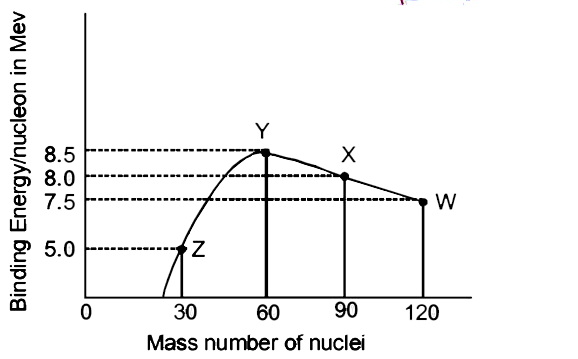
Binding energy per nucleons vs mass curve for nucleus is shown in the figure `W,X,Y`and `Z` are four nuclei indicated on the curve . The process that would release energy is

A

`Y rarr 2Z`

B

`W rarr X + Z`

C

`W rarr 2Y`

D

`X rarr Y + Z`

Text Solution

Verified by Experts

The correct Answer is:

C

Energy is released in process when total binding energy of the nucleus (=binding energy per nucleon `xx` number of nucleons) is increased or we can say, when total binding energy of products is more than the reactants. By calculation we can see that only in case of option (c), this happens.
Given : `W rarr 2Y`
Binding energy of reactants `=120xx7.5`
`=900 MeV` and binding energy of products
`=2(60xx8.5)=1020 MeV gt 900 MeV`.
Promotional Banner

Topper's Solved these Questions

  • SIMPLE HARMONIC MOTION

    ALLEN |Exercise MCQ s|8 Videos
  • SIMPLE HARMONIC MOTION

    ALLEN |Exercise Match The Column|9 Videos
  • SIMPLE HARMONIC MOTION

    ALLEN |Exercise Exercise - 04[A]|25 Videos
  • RACE

    ALLEN |Exercise Basic Maths (Wave Motion & Dopplers Effect) (Stationary waves & doppler effect, beats)|25 Videos
  • TEST PAPER

    ALLEN |Exercise PHYSICS|4 Videos

Similar Questions

Explore conceptually related problems

The binding energy per nucleon is almost constant for the nuclei having atomic mass number……….

A potential energy curve U(x) is shown in the figure. What value must the mechanical energy E_(mec) of the particle not exceed, if the particle is to be trapped within the region shown in graph? .

A satellite is orbiting earth at a distance r. Variations of its kinetic energy, potential energy and total energy, is shown in the figure. Of the three curves shown in figure, identify the type of mechanical energy they represent. ltimg src="https://d10lpgp6xz60nq.cloudfront.net/physics_images/ALN_PHY_2_C05_E05_095_Q01.png" width="80%"gt

Consider the decay of a free neutron at rest : n to p +e^(-) Show that the two body decay of this type must necessary give an electron of fixed energy and therefore cannot account distribution in the beta - decay of a neutron or a nucleous as shown in figure . [ Note : The simple result of this exercise was one among the several arguments advanced by W . Pauli to perdict the existence of a third particle in the decay products of beta - decay . This particle is known as neutrino spin 1/2 ( like e^(-) p or n ) but is neutral ad either massless or having an extremely small mass (compared to the mass of electron) and which interacts very weakly with matter . The correct decay process of neutron is : n to p+e(-)+v)

This question contains Statement - 1 and Statement -2 Of the four choice given after the Statements , choose the one that best decribes the two Statements Statement- 1: Energy is released when heavy undergo fission or light nuclei undergo fusion and Statement- 2: for nuclei , Binding energy nucleon increases with increasing Z while for light nuclei it decreases with increasing Z

The binding energies per nucleon for deuteron ( ._1H^2 ) and helium ( ._2He^4) are 1.1 MeV and 7.0 MeV respectively. The energy released when two deutrons fuse to form a helium nucleus ( ._2He^4 ) is……..

The binding energies per nucleon for deuteron ( ._1H^2 ) and helium ( ._2He^4) are 1.1 MeV and 7.0 MeV respectively. The energy released when two deutrons fuse to form a helium nucleus ( ._2He^4 ) is……..

Two positrons (e+) and two protons (p) are kept on four corners of a square of side a as shown in figure. The mass of proton is much larger than the mass of positron. Let q denotes the charge on the proton as well as the position then the kinetic energies of one of the positrons and one of the protons respectively after a very long time will be-

The bob of mass 50 gm of a pendulum is released from a horizontal position A as shown in the figure . .If the length of the pendulum is 1.5 m , what is its kinetic energy at the lower most point B ? (g = 10 m/(s^(2)))

Two masses A and B of mass M and 2M respectively are connected by a compressed ideal spring. The system in placed on a horizontal frictionless table and given a velocity uhat(k) in the z-direction as shown in the figure. The spring is then released. In the subsequent motion the line from B to A alwyas points along the hat(i) unit vector. All some instant of time mass B has a x-component of velocity as v_(x)hat(i) . The velocity vec(v)_(A) of mass A at that instant is :-

ALLEN -SIMPLE HARMONIC MOTION-Exercise-05(B)
  1. The half-life period of a radioactive element X is same s the mean lif...

    Text Solution

    |

  2. Order of magnitude of density of uranium nucleus is , [m = 1.67 xx 10^...

    Text Solution

    |

  3. Binding energy per nucleons vs mass curve for nucleus is shown in the ...

    Text Solution

    |

  4. Imagine an atom made of a proton and a hypothetical particle of double...

    Text Solution

    |

  5. In an atom when electrons transition from excited state to ground stat...

    Text Solution

    |

  6. Electrons with energy 80 keV are incident on the tungsten target of an...

    Text Solution

    |

  7. Two radioactive materials X(1) and X(2) have decay constant 11 lambda ...

    Text Solution

    |

  8. The transistion from the state n = 4 to n = 3 in a hydrogen like atom ...

    Text Solution

    |

  9. Graph shows relation between intensity (I),wavelength for X-rays emitt...

    Text Solution

    |

  10. The electron emitted in beta radiation originates from

    Text Solution

    |

  11. A radioactive sample consists of two distinct species having equal num...

    Text Solution

    |

  12. A Hydrogen atom and Li^(++) ion are both in the second excited state....

    Text Solution

    |

  13. The potential difference applied to an X-ray tube is 5 kV and the curr...

    Text Solution

    |

  14. The half life of .^(215)At is 100mu s. The time taken for the radioact...

    Text Solution

    |

  15. Which of the following process represents a gamma- decay?

    Text Solution

    |

  16. The electric potential between a proton and as electron is given by V=...

    Text Solution

    |

  17. If the atom(100)Fm^(257) follows the Bohr model the radius of (100)Fm^...

    Text Solution

    |

  18. For uranium nucleus how does its mass vary with volume?

    Text Solution

    |

  19. A nucleus with mass number 220 initially at rest emits an alpha-partic...

    Text Solution

    |

  20. The fig. shows the variation of photon current with anode potential fo...

    Text Solution

    |
