Home
Class 12
PHYSICS
To determine the half life of a radioact...

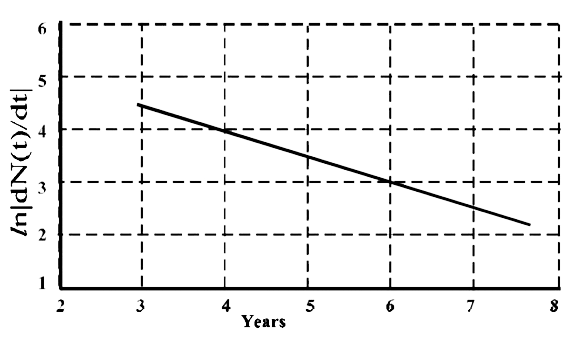
To determine the half life of a radioactive element , a student plote a graph of in `|(dN(t))/(dt)| versus t , Here |(dN(t))/(dt)|` is the rate of radioatuion decay at time t , if the number of radoactive nuclei of this element decreases by a factor of p after `4.16 ` year the value of p is

Text Solution

Verified by Experts

The correct Answer is:

`8`

`|(dN)/(dt)|=lambdaN_(0)e^(-lambdat) :. ln |(dN)/(dt)|=ln(N_(0)lambda)-lambdat`
`:. ln |(dN)/(dt)|=ln (N_(0)lambda)-lambdatimplies -lambda=` slope `=-1/2year^(-1)`
`implies lambda=1/2 yr^(-1)`
`:. t_(1//2)=0.693/lambda=1.386` given time is `3` times of `t_(1//2)`
`:.` value of p is 8.
Promotional Banner

Topper's Solved these Questions

  • SIMPLE HARMONIC MOTION

    ALLEN |Exercise Solved Example|3 Videos
  • SIMPLE HARMONIC MOTION

    ALLEN |Exercise X Rays : Solved Example|2 Videos
  • SIMPLE HARMONIC MOTION

    ALLEN |Exercise Paragraph|3 Videos
  • RACE

    ALLEN |Exercise Basic Maths (Wave Motion & Dopplers Effect) (Stationary waves & doppler effect, beats)|25 Videos
  • TEST PAPER

    ALLEN |Exercise PHYSICS|4 Videos

Similar Questions

Explore conceptually related problems

Nuclei of radioactive element A are being produced at a constant rate. alpha . The element has a decay constant lambda . At time t=0 , there are N_(0) nuclei of the element. Calculate the number N of nuclei of A at time t.

Radioactive element decays to form a stable nuclide, then the rate of decay of reactant ((d N)/(d t)) will vary with time (t) as shown in figure.

The rate at which a particular decay process occurs in a radio active sample, is proportional to the number of radio active nuclei present. If N is the number of radio active nuclei present at some instant, the rate of change of N is (dN)/(dt) = - lambdaN . Consider radioavtive decay of A to B which may further decay, either to X or to Y, lambda_(1),lambda_(2) and lambda_(3) are decay constants for A to B decay, B to X decay and B of Y decay respectively. If at t = 0 number of nuclei of A, B, X and Y are N_(0), N_(0) , zero and zero respectively and N_(1),N_(2),N_(3),N_(4) are number of nuclei A,B,X and Y at any intant. At t = oo , which of the following is incorrect ?

For a radioactive meterial , its activity A and rate of charge of its activity R are defined as A = - (dN)/(dt) and R = -(dA)/(dt) where N(t) is the number of nuclei at time t .Two radioactive source P (mean life tau ) and Q(mean life 2 tau ) have the same activity at t = 2 tau R_(p) and R_(Q) respectively , if (R_(p))/(R_(Q)) = (n)/(e)

Consider radioactive decay of A to B with which further decays either to X or Y , lambda_(1), lambda_(2) and lambda_(3) are decay constant for A to B decay, B to X decay and Bto Y decay respectively. At t=0 , the number of nuclei of A,B,X and Y are N_(0), N_(0) zero and zero respectively. N_(1),N_(2),N_(3) and N_(4) are the number of nuclei of A,B,X and Y at any instant t . The number of nuclei of B will first increase and then after a maximum value, it decreases for

The graph represents the decay of a newly-prepared sample of radioactive nuclide X to a stable nuclide Y. The half-life of X is t. The growth curve for Y intersects the decay curve for X after time T. What is the time T ?

The half life of I""^(131) is 8 day . Given a sample of I""^(131) at t=0, we can assert that a)No nucleus will decay at t=4day b)No nucleus will decay before t=8day c)All nucleus will decay before t=16day d)A given nucleus may decay before at any time after t=0

A nuclear power supplying electrical power to a villages uses a radioactive material of half life T year as the fuel . The amount of fuel at the beginning is such that the total power requirement of the village is 12.5% of the electrical power available from the plant at that time. If the plant is able to meet the total power needs of the village for a maximum period of n T years , then the value of n is

Two metallic plate A and B , each of area 5 xx 10^(-4)m^(2) , are placed parallel to each at a separation of 1 cm plate B carries a positive charge of 33.7 xx 10^(-12) C A monocharonatic beam of light , with photoes of energy 5 eV each , starts falling on plate A at t = 0 so that 10^(16) photons fall on it per square meter per second. Assume that one photoelectron is emitted for every 10^(6) incident photons fall on it per square meter per second. Also assume that all the emitted photoelectrons are collected by plate B and the work function of plate A remain constant at the value 2 eV Determine (a) the number of photoelectrons emitted up to i = 10s, (b) the magnitude of the electron field between the plate A and B at i = 10 s, and (c ) the kinetic energy of the most energotic photoelectrons emitted at i = 10 s whenit reaches plate B Negilect the time taken by the photoelectrons to reach plate B Take epsilon_(0) = 8.85 xx 10^(-12)C^(2)N- m^(2)

An electromagnetic wave can be represented by E = A sin (kx- omega t + phi) , where E is electric field associated with wave, According this equation, for any value of x, E remains sinusoidal for -oolt t lt oo . Obviously this corresponds to an idealised situation because radiation from ordinary sources consists of finite size wavetrains. In general, electric field remains sinusoidal only for times of order tau_(c) ' which is called coherence time. In simpler language it means that for times of order tau_(c)' a wave will have a definite phase. The finite value of coherence time could be due to many factors, for example if radiating atom undergoes collision with another atom then wave train undergoes an abrupt phase change or due to the fact that an atom responsible for emitting radiation has a finite life time in the energy level from which it drops to lower energy level, while radiating. Concept of coherence time can be easily understood using young's double slit experiment. Let interference patten is observed around point P at time t , due to superposition of waves emanting from S_(1) and S_(2) at times t =(r_(1))/(c) and (r_(2))/(c) respectively, where r_(1) and r_(2) are the distances S_(1) P & S_(2)P . Obviously if (r_(2)-r_(1))/(c) lt lt tau_(e),{"where" " "c = 3xx10^(8)m//s} then, wavetrain arriving at point P from S_(1) & S_(2) will have a definite phase relationship and an interference pattern of good contranst will be obtained. If coherence time is of order 10^(-10) second and screen is placed at a very large distance from slits in the given figure, then:-

ALLEN -SIMPLE HARMONIC MOTION-Subjective
  1. A hydrogen - like atom (described by the Bohr model) is observed to em...

    Text Solution

    |

  2. Two metallic plate A and B , each of area 5 xx 10^(-4)m^(2), are place...

    Text Solution

    |

  3. Characteristic X-rays of frequency 4.2xx10^18 Hz are produced when tr...

    Text Solution

    |

  4. In a photoelectric experiment set up, photons of energy 5 eV falls on ...

    Text Solution

    |

  5. A radioactive element decays by beta-emission. A detector records n be...

    Text Solution

    |

  6. The photons from the Balmer series in Hydrogen spectrum having wavele...

    Text Solution

    |

  7. A rock is 1.5 xx 10^(9) years old. The rock contains .^(238)U which di...

    Text Solution

    |

  8. Highly energetic electron are bombarded in a target of an element cont...

    Text Solution

    |

  9. The potential energy of a partical varies as . U(x) = E0 for 0 le x...

    Text Solution

    |

  10. An alpha- particle and a proton are accelerated from rest by a potenti...

    Text Solution

    |

  11. To determine the half life of a radioactive element , a student plote ...

    Text Solution

    |

  12. The work function of Silver and sodium are 4.6 and 2.3 eV, respective...

    Text Solution

    |

  13. A freshly prepared sample of a radioisotope of half - life 1386 s has...

    Text Solution

    |

  14. Two spherical starts A and B emit black body radiation. The radius of ...

    Text Solution

    |

  15. A nuclear power supplying electrical power to a villages uses a radioa...

    Text Solution

    |

  16. Consider a hydrogen atom with its electron in the n^(th) orbital An el...

    Text Solution

    |

  17. For a radioactive meterial , its activity A and rate of charge of its ...

    Text Solution

    |

  18. An electron is an excited state of Li^(2 + )ion has angular momentum 3...

    Text Solution

    |

  19. The isotope (5)^(12) B having a mass 12.014 uundergoes beta - decay to...

    Text Solution

    |

  20. A hydrogen atom in its ground state is irradiated by light of waveleng...

    Text Solution

    |
