Home
Class 12
PHYSICS
Two moving particles P and Q are 10cm ap...

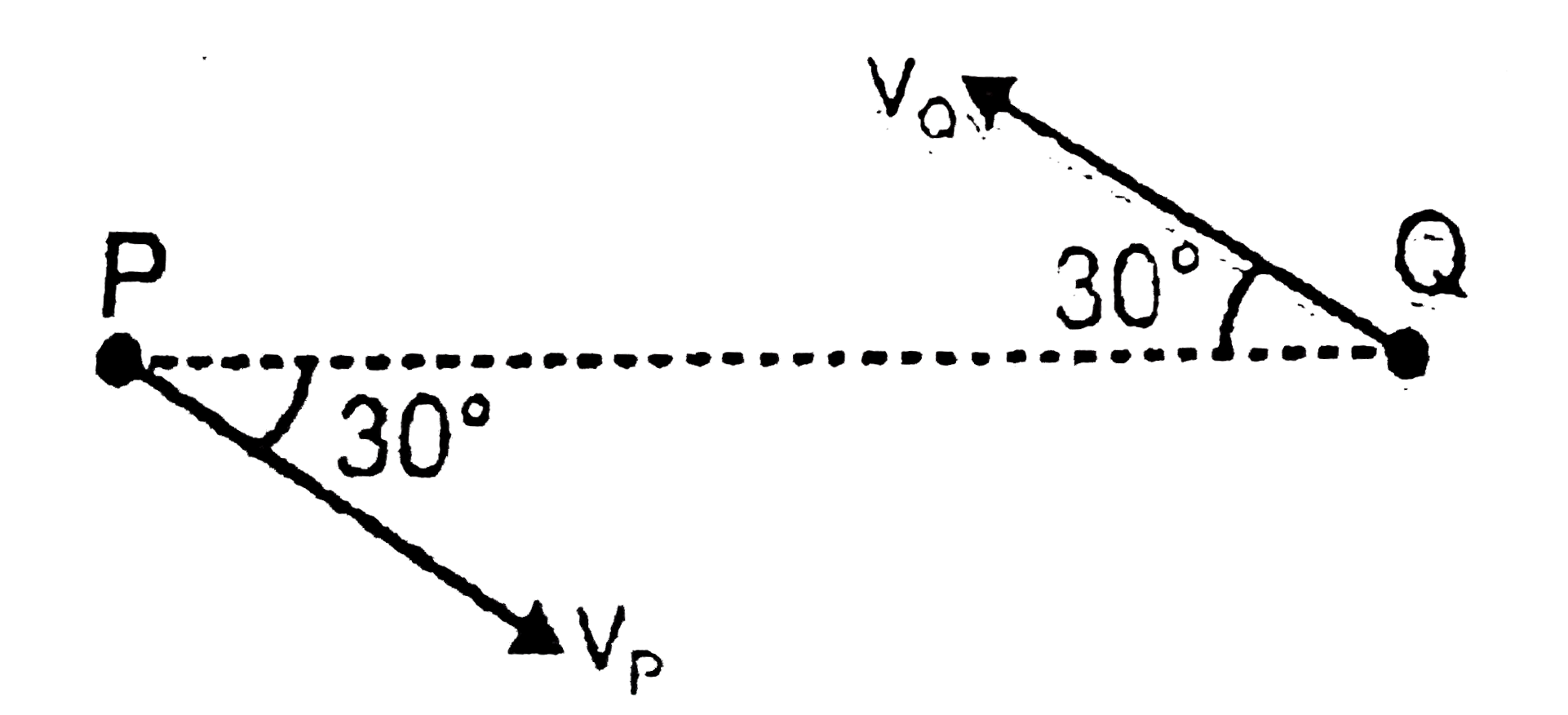
Two moving particles `P` and `Q` are 10cm apart at any instant. Velocity of P is `8 m//s` at `30^(@)`, from line joining the P and Q and velocity of Q is `6m//s` at `30^(@)`. Calculate the angular velocity of P w.r.t. Q

Text Solution

Verified by Experts

`omega_(PQ)=(8sin30^(@)-(-6sin30^(@)))/(10)=0.7rad//s`
Promotional Banner

Topper's Solved these Questions

  • CIRCULAR MOTION

    ALLEN |Exercise EXERCISE (S-1)|10 Videos
  • CIRCULAR MOTION

    ALLEN |Exercise Dynamics of circular motion|8 Videos
  • BASIC MATHS

    ALLEN |Exercise Question|1 Videos
  • CURRENT ELECTRICITY

    ALLEN |Exercise EX.II|66 Videos

Similar Questions

Explore conceptually related problems

Two moving particles P and Q are apart at any instant. Velocity of P is 8 m//s at 30^(@) , from line joining the P and Q and velocity of Q is 6m//s at 30^(@) . Calculate the angular velocity of P w.r.t. Q

A man 'A' moves in north direction with speed 10m/s and another man B moves in E-30^(@)-N with 10 m//s . Find the relative velocity of B w.r.t. A.

A and B are moving with the same speed 10m/s in the direction E-30^(@)-N and E-30^(@)-S respectively. Find the relative velocity of A w.r.t. B.

The velocity of a particle moving with constant acceleration at an instant t_(0) is 10m//s After 5 seconds of that instant the velocity of the particle is 20m/s. The velocity at 3 second before t_(0) is:-

Two particle A and B projected along different directions from the same point P on the ground with the same velocity of 70 m/s in the same vertical plane. They hit the ground at the same point Q such that PQ = 480,. Then [g=9.8 m//s^(2)]

A particle is moving in a circle of radius r with speed v as shown in the figure. The magnitude of change in velocity in moving from P to Q is

If angular velocity of a rIgId body at 10 cm distance from rotational axis is 10 rad/s, then the linear velocity of particle is …... .

A particle moves in straight line in same direction for 20 seconds with velocity 3 m//s and the moves with velocity 4 m//s for another 20 sec and finally moves with velocity 5 m//s for next 20 seconds. What is the average velocity of the particle?

At points P and Q, two identical charges each q are placed. When we move from P to Q (oa - the line joining them), electrostatic potential

Two cars P and Q start from a point at the same time in a straight line and their positions are represented by x_(p) (t) = at + bt ^(2) and x _(Q) (t) = f t - t ^(2). At what time do the cars have the same velocity?
