Home
Class 12
PHYSICS
A particle starts moving in a non-unifor...

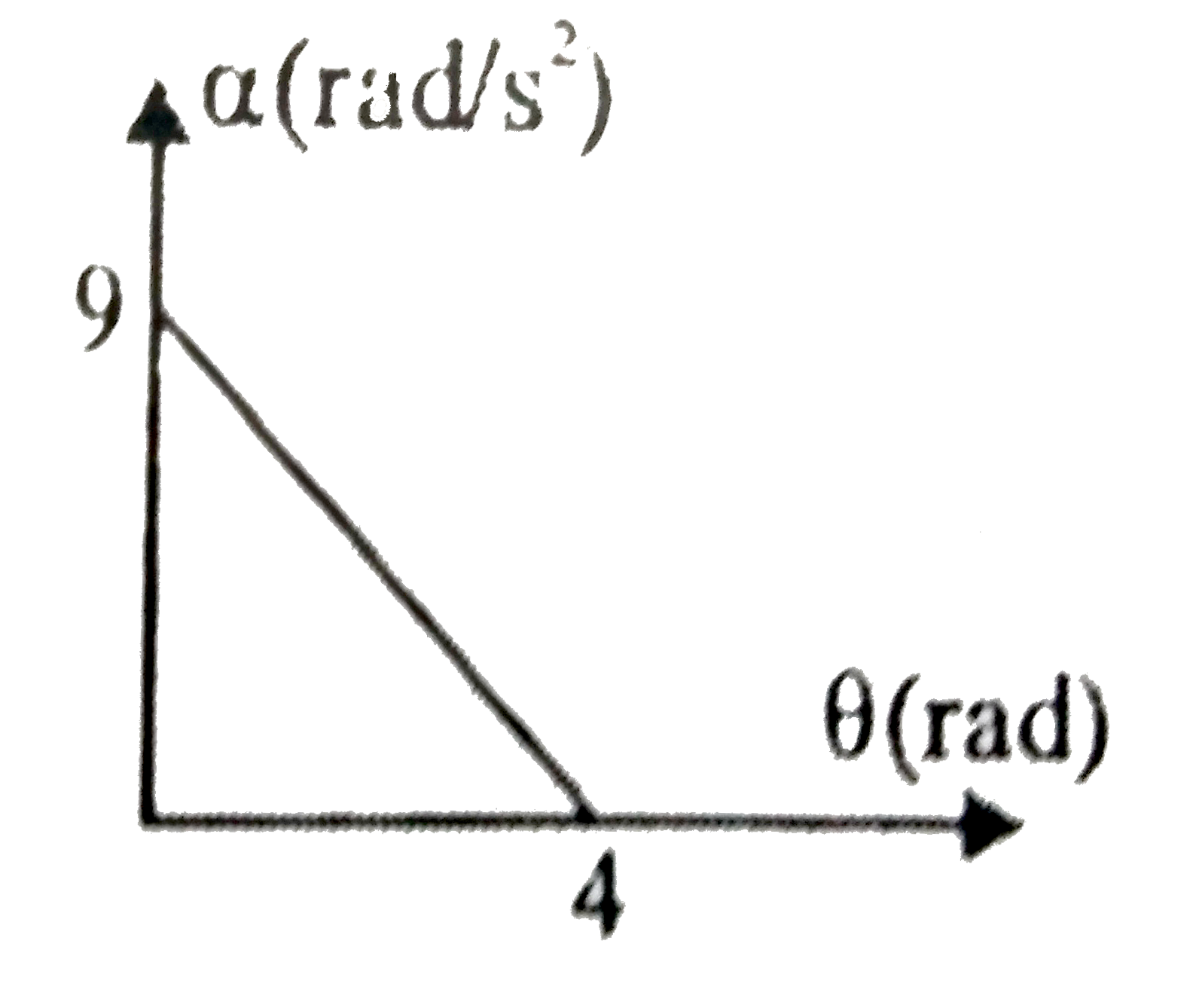
A particle starts moving in a non-uniform circular motion, lies angular acceleration as shown in figure. The angular velocity at the end of 4 radian is given by `omega` rad/s then find the value of `omega`.

Text Solution

Verified by Experts

The correct Answer is:

6
Promotional Banner

Topper's Solved these Questions

  • CIRCULAR MOTION

    ALLEN |Exercise Dynamics of circular motion|8 Videos
  • CIRCULAR MOTION

    ALLEN |Exercise EXERCISE(S-2)|6 Videos
  • CIRCULAR MOTION

    ALLEN |Exercise EXERCISE (J-A)|6 Videos
  • BASIC MATHS

    ALLEN |Exercise Question|1 Videos
  • CURRENT ELECTRICITY

    ALLEN |Exercise EX.II|66 Videos

Similar Questions

Explore conceptually related problems

A body rotating with uniform angular acceleration covers 100 pi (radian) in the first 5 s after the start. Its angular speed at the end of 5 s (in rad/s) is

A particle starts motion from rest and moves along a straight line. Its acceleration-time graph is shown. Find out speed of particle at t=2s and at t=3s.

A Body intially at rest, starts moving along x- axis in such a way so that its acceleration vs displacement plot is as shown in figure. The maximum velocity of particle is :-

A particle is moving in a circular orbit with a constant tangential acceleration. After a certain time t has elapsed after the beginning of motion, the between the total acceleration a and the direction along the radius r becomes equal to 45^(@) . What is the angular acceleration of the particle.

What is the linear velocity of a particle of a uniform circular motionk of radius A and angular velocity omega ?

Two particles move on a circular path (one just inside and the other just outside) with the angular velocities omega and 5omega starting from the same point. Then

The angular velocity of a particle is given by omega=1.5t-3t^(2)+2 , Find the time when its angular acceleration becomes zero.

A particle is moving in a circular orbit when a constant tangential acceleration. After 2s from the beginning of motion, angle between the total acceleration vector and the radius E becomes 45^(@) . What is the angular acceleration of the particle?

A particles is moving on circular path of radius R with constant angular velocity omega . Its centripetal acceleration will be …... .

A particle A moves along a circle of radius R=50cm so that its radius vector r relative to the point O(figure) rotates with the constant angular velocity omega=0.40rad//s . Find the modulus of the velocity of the particle, and the modulus and direction of its total acceleration.
