Home
Class 12
PHYSICS
A circular platform rotates around a ver...

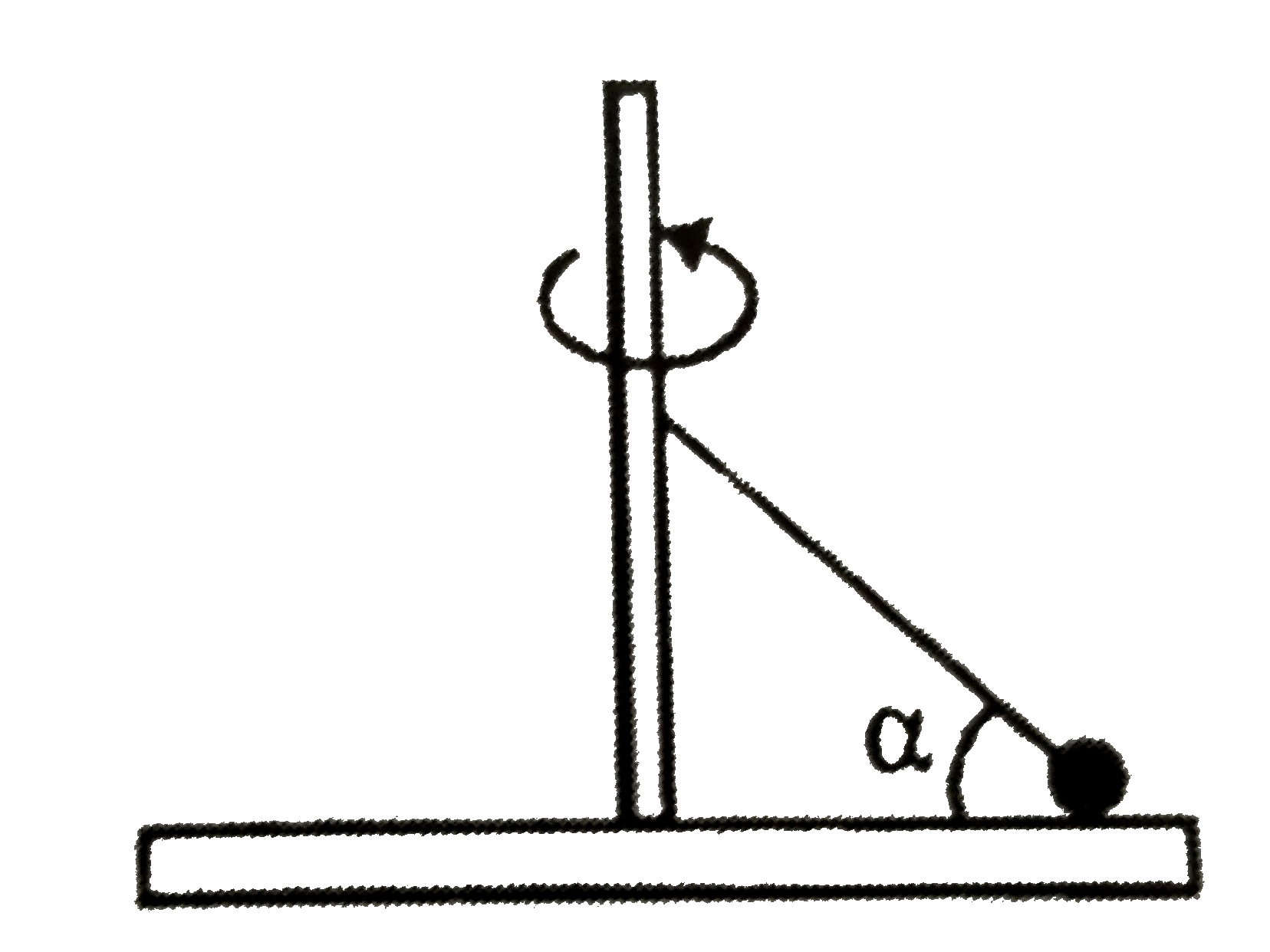
A circular platform rotates around a vertical axis with angular velocity `omega=10rad//s`. On the platform is a ball of mass 1kg, attached to the long axis of the platform by a thin of length of 10cm `(alpha=30^(@))`. Find normal force exerted by the ball on the platform (in newton). Friction is absent.

Text Solution

Verified by Experts

The correct Answer is:

5
Promotional Banner

Topper's Solved these Questions

Similar Questions

Explore conceptually related problems

Two spherical balls of mass 10 kg each are placed with their centers 10 cm apart. Find the gravitational force of attraction between them. (AS_(1))

A frame of reference that is accelerated with respect to an inertial frame of reference is called a non-inertial frame of reference. A coordinate system fixed on a circular disc rotating about a fixed axis with a constant angular velocity omega is an example of non=inertial frame of reference. The relationship between the force vecF_(rot) experienced by a particle of mass m moving on the rotating disc and the force vecF_(in) experienced by the particle in an inertial frame of reference is vecF_(rot)=vecF_(i n)+2m(vecv_(rot)xxvec omega)+m(vec omegaxx vec r)xxvec omega . where vecv_(rot) is the velocity of the particle in the rotating frame of reference and vecr is the position vector of the particle with respect to the centre of the disc. Now consider a smooth slot along a diameter fo a disc of radius R rotating counter-clockwise with a constant angular speed omega about its vertical axis through its center. We assign a coordinate system with the origin at the center of the disc, the x-axis along the slot, the y-axis perpendicular to the slot and the z-axis along the rotation axis (vecomega=omegahatk) . A small block of mass m is gently placed in the slot at vecr(R//2)hati at t=0 and is constrained to move only along the slot. The distance r of the block at time is

A frame of reference that is accelerated with respect to an inertial frame of reference is called a non-inertial frame of reference. A coordinate system fixed on a circular disc rotating about a fixed axis with a constant angular velocity omega is an example of non=inertial frame of reference. The relationship between the force vecF_(rot) experienced by a particle of mass m moving on the rotating disc and the force vecF_(in) experienced by the particle in an inertial frame of reference is vecF_(rot)=vecF_(i n)+2m(vecv_(rot)xxvec omega)+m(vec omegaxx vec r)xxvec omega . where vecv_(rot) is the velocity of the particle in the rotating frame of reference and vecr is the position vector of the particle with respect to the centre of the disc. Now consider a smooth slot along a diameter fo a disc of radius R rotating counter-clockwise with a constant angular speed omega about its vertical axis through its center. We assign a coordinate system with the origin at the center of the disc, the x-axis along the slot, the y-axis perpendicular to the slot and the z-axis along the rotation axis (vecomega=omegahatk) . A small block of mass m is gently placed in the slot at vecr(R//2)hati at t=0 and is constrained to move only along the slot. The distance r of the block at time is

If angular velocity of a rIgId body at 10 cm distance from rotational axis is 10 rad/s, then the linear velocity of particle is …... .

On a circular turn, table rotating about its center horizontally with uniform angular velocity rad/s placed two blocks of mass 1kg and 2kg, on a diameter symmetrically about center. Their separation is 1m and friction is sufficient to avoid slipping. The spring between them as shown is stretched and applied force of SN. lf f_(1) and f_(2) are values of friction on 1 kg & 2kg block respectively:-

A thin circular ring of mass M and radius R is rotating in a horizontal plane about an axis vertical to its plane with a constant angular velocity omega . If two objects each mass m be attached gently to the opposite ends of a diameter of the ring, the ring will then rotate with an angular velocity ...........

A ball of mass 1 kg drops vertically on to the floor wit a speed of 25 m//s . It rebounds with an initial velocity of 10 m//s . What impulse acts on the ball during contact ?

An almost inertia-less rod of length l3.5 m can rotate freely around a horizontal axis passing through its top end. At the bottom end of the roa a small ball of mass m andat the mid-point another small ball of mass 3m is attached. Find the angular frequency (in SI units) of small oscillations of the system about the equilibrium position. Gravitational acceleration is g=9.8 m//s^(2).

A man stands on a rotating platform, with his arms stretched horizontally holding a 5 kg weight in each hand. The angular speed of the platform is 30 revolutions per minute. The man then brings his arms close to his body with the distance of each weight from the axis changing from 90cm to 20cm. The moment of inertia of the man together with the platform may be taken to be constant and equal to 7.6 kg m^(2) . (a) What is his new angular speed? (Neglect friction.) (b) Is kinetic energy conserved in the process? If not, from where does the change come about?

A man stands on a rotating platform, with his arms stretched horizontally holding a 5 kg weight in each hand. The angular speed of the platform is 30 revolutions per minute. The man then brings his arms close to his body with the distance of each weight from the axis changing from 90cm to 20cm. The moment of inertia of the man together with the platform may be taken to be constant and equal to 7.6 kg m^(2) . (a) What is his new angular speed? (Neglect friction.) (b) Is kinetic energy conserved in the process? If not, from where does the change come about?
