Home
Class 12
PHYSICS
A particle 'P' is moving on a circular p...

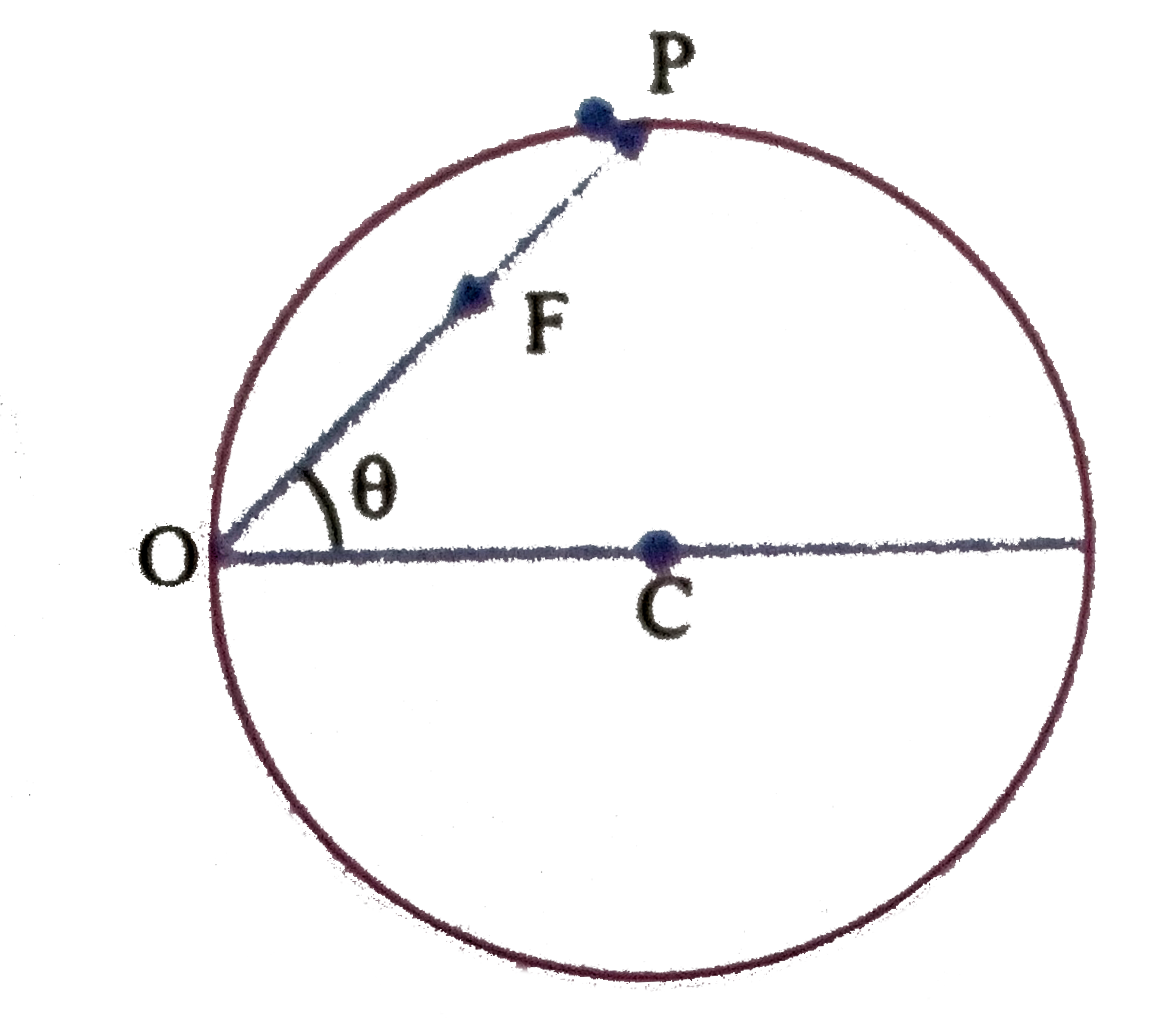
A particle `'P'` is moving on a circular path under the action of only one force action always toward the fixed point `'O'` on the circumference. Find the ratio of `(d^(2)theta)/(dt^(2))` & `(("d"theta)/(dt))^(2)`

Text Solution

Verified by Experts

The correct Answer is:

`2 tan theta`
Promotional Banner

Topper's Solved these Questions

Similar Questions

Explore conceptually related problems

A particle is moving in a circular path of radius a under the action of an attractive potential U = -k/(2r^(2)) .Its energy is

A particle moves on a circular path of radius 'r'. It completes one revolution in 40s. Calculate distances displacement in 2 min 20 s.

The displacement x of particle moving in one dimension, under the action of a constant force is related to the time t by the equation t = sqrt(x) +3 where x is in meters and t in seconds . Find (i) The displacement of the particle when its velocity is zero , and (ii) The work done by the force in the first 6 seconds .

The distance x of a particle moving in one dimensions, under the action of a constant force is related to time t by the equation, t=sqrt(x)+3 , where x is in metres and t in seconds. Find the displacement of the particle when its velocity is zero.

A particle is moving in a circular path. The acceleration and moment of the particle at a certain moment are a=(4 hat(i)+3hat(j))m//s^(2) and p=(8 hat(i)-6hat(j))"kg-m/s" . The motion of the particle is

A particle is moving under the influence of a force which is fixed in magnitude and acting at an angle theta in the direction of motion. The path described by the particle is

A particle of mass 2kg is moving on a straight line under the action of force F = (8-2x) N . The particle is released at rest from x = 6 m . For the subsequnent motion(All the value in the right column are in their S.I. units)

AB is a quarter of a smooth horizontal circular track of radius R,A particle P of mass m moves along the track from A to B under the action of following forces: vec(F_(1) =F (always towards y-axis) vec(F_(2)) =F (always towards point B) vec(F_(3)) =F (always along the tangent to path AB) vec(F_(4)) =F (always towards x-axis) {:(ColumnI," ",ColumnII),((A) "Work done by" vec(F_(1))," ",(P) sqrt(2)FR),((B) "Work done by" vec(F_(2))," ",(Q)FR),((C) "Work done by" vec(F_(3))," ",(R) (piFR)/(2)),((D) "Work done by" vec(F_(4))," ",(S) (2FR)/(pi)):} Select correct alternative :-

A particle moves in the x-y plane under the action of a force vecF such that the value of its linear momentum vecP at any time t is P_(x) = 2 cos t, P_(y) = 2 sin t . The angle theta between vecF and vecP at a given time t will be:

Find Order and Degree of given differential equation ((ds)/(dt))^(4) + 3s(d^(2)s)/(dt^(2)) = 0
