Home
Class 12
PHYSICS
An insect crawls up a hemispherical surf...

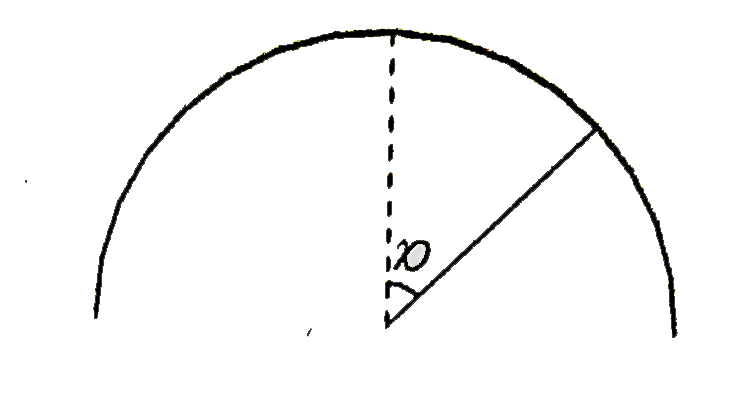
An insect crawls up a hemispherical surface very slowly (see the figure). The coefficient of friction between the insect and the surface is 1/3. If the line joining the centre of the hemispherical surface to the insect makes an angle `alpha` with the vertical, the maximum possible value of `alpha` is given by

A

`cos alpha=3`

B

`tan alpha=3`

C

`sec alpha=3`

D

`"cosec" alpha=3`

Text Solution

Verified by Experts

The correct Answer is:

A
Promotional Banner

Topper's Solved these Questions

Similar Questions

Explore conceptually related problems

A block of mass 1 kg is pushed up a surface inclined to horizontal at an angle of 30^(@) by a force of 10 N parallel to the inclined surface (figure) . The coefficient of friction between block and the incline is 0.1 .If the block is pushed up by 10 m along teh inclined calculate (a) work done against gravity (b) work done against force of friction (c ) increases in potential energy (d) increases in kinetic energy (e) work done by applied force

A rectangular box lies on a rough inclined surface. The coefficient of friction between the surface and the box is mu . Let the mass of the box be m. (a) At what angle of inclination 0 of the plane to the horizontal will the box just start to slide down the plane ? (b) What is the force acting on the box down the plane, if the angle of inclination of the plane is increased to a gt theta (c) What is the force needed to be applied upwards along the plane to make the box either remain stationary or just move up with uniform speed ? (d) What is the force needed to be applied upwards along the plane to make the box move up the plane with acceleration a ?

A block of mass is placed on a surface with a vertical cross section given by y=x^3/6 . If the coefficient of friction is 0.5, the maximum height above the ground at which the block can be placed without slipping is:

On a frictionless horizontal surface , assumed to be the x-y plane , a small trolley A is moving along a straight line parallel to the y-axis ( see figure) with a constant velocity of (sqrt(3)-1) m//s . At a particular instant , when the line OA makes an angle of 45(@) with the x - axis , a ball is thrown along the surface from the origin O . Its velocity makes an angle phi with the x -axis and it hits the trolley . (a) The motion of the ball is observed from the frame of the trolley . Calculate the angle theta made by the velocity vector of the ball with the x-axis in this frame . (b) Find the speed of the ball with respect to the surface , if phi = (4 theta )//(4) .

A block of mass m1 = 1 kg another mass m2 = 2 kg, are placed together (see figure) on an inclined plane with angle of inclination theta . Various values of theta are given in List I. The coefficient of friction between the block m_(1) and the plane is always zero. The coefficient of static and dynamic friction between the block m_(2) and the plane are equal to mu = 0.3 . In List II expressions for the friction on block m_(2) are given. Match the correct expression of the friction in List II with the angles given in List I, and choose the correct option. The acceleration due to gravity is denoted by g [Useful information : tan (5.5^(@)) ~~ 0.1, tan (11.5^(@)) ~~ 0.2 , tan (16.5^(@))~~ 0.3 ].

A circus wishes to develop a new clown act. Fig. (1) shows a diagram of the proposed setup. A clown will be shot out of a cannot with velocity v_(0) at a trajectory that makes an angle theta=45^(@) with the ground. At this angile, the clown will travell a maximum horizontal distance. The cannot will accelerate the clown by applying a constant force of 10, 000N over a very short time of 0.24s . The height above the ground at which the clown begins his trajectory is 10m . A large hoop is to be suspended from the celling by a massless cable at just the right place so that the clown will be able to dive through it when he reaches a maximum height above the ground. After passing through the hoop he will then continue on his trajectory until arriving at the safety net. Fig (2) shows a graph of the vertical component of the clown's velocity as a function of time between the cannon and the hoop. Since the velocity depends on the mass of the particular clown performing the act, the graph shows data for serveral different masses. The slope of the line segments plotted in figure 2 is a figure constant. Which one of the following physical quantities does this slope represent?

A large , heavy box is sliding without friction down a smooth plane of inclination theta . From a point P on the bottom of the box , a particle is projected inside the box . The initial speed of the particle with respect to the box is u , and the direction of projection makes an angle alpha with the bottom as shown in Figure . (a) Find the distance along the bottom of the box between the point of projection p and the point Q where the particle lands . ( Assume that the particle does not hit any other surface of the box . Neglect air resistance .) (b) If the horizontal displacement of the particle as seen by an observer on the ground is zero , find the speed of the box with respect to the ground at the instant when particle was projected .

Thin films, including soap bubbles and oil slicks, show patterns of alternating dark and bright regions resulting from interference among the reflected light waves. If two waves are in phase their crest and troughs will coincide. The interference will be constructive and the aplitude of the resultant wave will be greater than the amplitude of either constituent wave. if the two waves are out of phase, the crests of one wave will coincide with the troughs of the other wave. The interference will be destructive and the amplitude of the resultant wave will be less than that of either constituent wave. at the interface between two transparent media some light is reflected and some light is refracted. * When incident light, reaches the surface at point a, some of the light is reflected as ray R_(a) and and some is refracted following the path ab to the back of the film. *At point b some of the light is refracted out of the film and part is reflected back refracted out of the fiml as ray R_(c) . R_(a) and R_(c) are parallel. However, R_(c) has travelled the extra distance within the film of abc. if the angle of incidence is small then abc is approximately twice the film's thickness. if R_(a) and R_(c) are in phase they will undergo constructive interference and the region ac will be bright if R_(a) and R_(c) are out of phase, they will undergo destructive interference. * Refraction at an interface never changes the phase of the wave. * For reflection at the interface between two media 1 and 2, if n_(1)ltn_(2) the reflected wave will change phase by pi . if n_(1)gtn_(2) the reflected wave will not undergo a phase change. for reference n_(air)=1.00 * if the waves are in phase after refection at all interfaces, then the effects of path length in the film are Constructive interference occur when (n= refractive index) 2t=mlamda//n" "m=0,1,2,3... .. Destructive interference occurs when 2t=(m+1//2)lamda//n" "m=0,1,2,3... Q. The average human eye sees colors with wavelengths between 430 nm to 680 nm. For what visible wavelength will a 350 nm thick n=1.35 soap film produce maximum destructive interference?

A block is released on the slant face of a wedge of equal mass placed on a horizontal floor. The slant face of the wedge makes an angle of 45^(@) with the floor. Coefficient of friction between all surfaces in contact is the same. Different value/ range of coefficient of friction is given in column I and corresponding consequences in column II and III (wedge is fress to move) {:(,"Column-I",,"Column-II",,"Column-III",),((I),mu=0,(i),"Work done by friction on block and wedge is negative (on each)",(P),"Centre of mass of system (block+wedge) moves rightward and downward",),((II),mu gt 1,(ii),"Work done by friction on block is negative but on wedge it is zero",(Q),"Centre of mass of system (block+wedge) moves leftward and downward",),((III),sqrt(5)-2 lt mu lt 1,(iii),"Work done by friction on block and wedge is zero (on each)",(R ),"Centre of mass of system (block+wedge) remains at rest",),((IV),mu lt sqrt(5) - 2,(iv),"Friction between the block and wedge is static and between the wedge and ground it is kinetic in nature.",(S),"Centre of mass of system (block+wedge) moves vertically downward",):} Which of the following options is the correct representation of the case that the wedge remains motionless and the block slides down

A wedge as shown in figure has a rough curved surface of coefficient of kinetic friction (1)/sqrt(3) whose shape can be given by equation y=x^(2) , where the horizontal direction is x-axis, vertical direction as y axis and the end of surface O as origin and x & y are measured in meter. A small block is released, from a certain point on the surface. The maximum height of the point from where block should be released so that it does not slip.

ALLEN -CIRCULAR MOTION-EXERCISE(O-1)
  1. The value of n so that vectors 2hati+3hatj-2hatk, 5hati+nhatj+hatk and...

    Text Solution

    |

  2. If a and b are two vectors.then the value of (a+b)xx(a-b) is

    Text Solution

    |

  3. "|"oversetrightarrow(a).oversetrightarrow(b)"|"=sqrt3"|"oversetrightar...

    Text Solution

    |

  4. A body is executing circular motion in the vertical plane containing d...

    Text Solution

    |

  5. If the magnitude of velocity in the previous question is decreasing wi...

    Text Solution

    |

  6. The direction of angular acceleration of a body moving in a circle in ...

    Text Solution

    |

  7. The second's hand of a watch has length 6 cm. Speed of end point and m...

    Text Solution

    |

  8. A point P moves in counter clockwise direction on a circular path as s...

    Text Solution

    |

  9. A spot light S rotates in a horizontal plane with a constant angular v...

    Text Solution

    |

  10. Which of the following statements is FALSE for a paricle moving in a...

    Text Solution

    |

  11. A particle is moving in a circle:

    Text Solution

    |

  12. A particle of mass m is tied to light string and rotated with a speed ...

    Text Solution

    |

  13. Which vector in the figures best represents the acceleration of a pend...

    Text Solution

    |

  14. A conical pendulum is moving in a circle with angular velocity omega. ...

    Text Solution

    |

  15. A point mass m is suspended from a light thread of length l, fixed at ...

    Text Solution

    |

  16. A long horizontal rod has a bead which can slide along its length and ...

    Text Solution

    |

  17. An insect crawls up a hemispherical surface very slowly (see the figur...

    Text Solution

    |

  18. The maximum velocity (in ms^(-1)) with which a car driver must travers...

    Text Solution

    |

  19. A particle is acted upon by a force of constant magnitude which is alw...

    Text Solution

    |

  20. A car runs around a curve of radius 10m at a constant speed of 10ms^(-...

    Text Solution

    |
