Home
Class 12
PHYSICS
In the shown figure inside a fixed hollo...

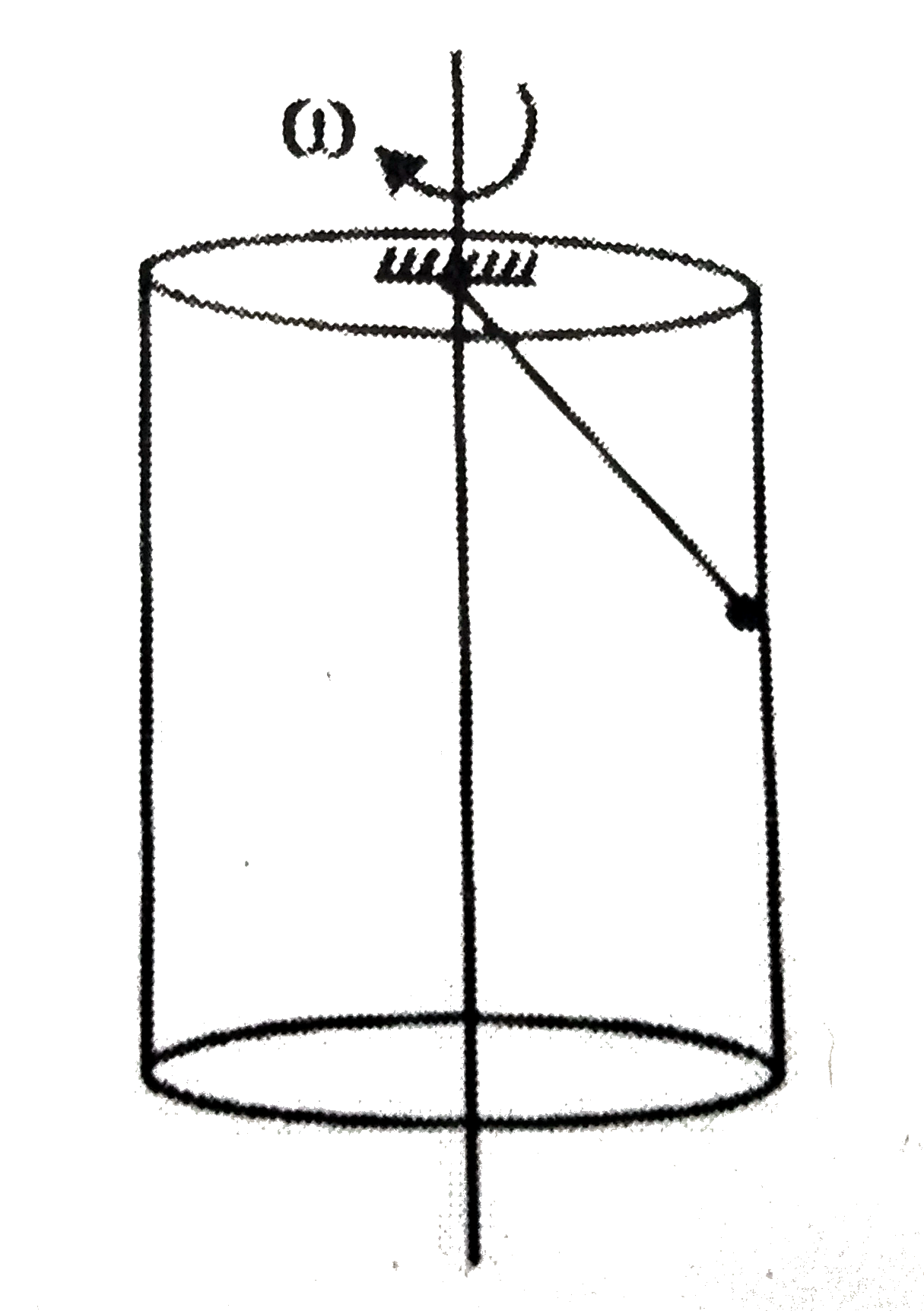
In the shown figure inside a fixed hollow cylinder with vetical axis a pendulumm is rotating in a conical path with its axis same as that of the cylinder with uniform angular velocity. Radius of culinder is 30cm, length of string is 50cm and mass of bob is 400gm. The bob makes contact with the inner fricitonless wall of the cylinder while moving

A

The minimum value of angular velocity of the bob so that it does not leave contact is s 5 rad/s

B

Tension in the string is 5N for all values of angular velocity

C

For angular velocity of 10 rad/s the bob pushes the cylinder with a force of 9N

D

For angular velocity of 10 rad/s, tension in the string is 20N

Text Solution

Verified by Experts

The correct Answer is:

A, B, C
Promotional Banner

Topper's Solved these Questions

Similar Questions

Explore conceptually related problems

A 70 kg man stands in contact against the inner wall of a hollow cylindrical drum of radius 3 m rotating about its vertical axis with 200 rev/min. The coefficient of friction between the wall and his clothing is 0.15. What is the minimum rotational speed of the cylinder to enable the man to remain stuck to the wall (without falling) when the floor is suddenly removed ?

Torques of equal magnitude are applied to a hollow cylinder and a solid sphere, both having the same mass and radius. The cylinder is free to rotate about its standard axis of symmetry, and the sphere is free to rotate about an axis passing through its centre. Which of the two will acquire a greater angular speed after a given time.

An electric field is uniform and in the positive x direction for postive x and uniform with the same magnitude but in the negative x direction x it is given that E=200 I N/C length 20 cm and radius 5 cm has its centre at the origin and its axis x =-10 cm (a) what is the net ioutward flux through each flate face (b) what is the flux through the side of the cylinder (C ) what is the net outward flux thoght the cylinder (d) what is the net charge inside the cylinder

A uniform thin cylindrical disk of mass M and radius R is attaached to two identical massless springs of spring constatn k which are fixed to the wall as shown in the figure. The springs are attached to the axle of the disk symmetrically on either side at a distance d from its centre. The axle is massless and both the springs and the axle are in horizontal plane. the unstretched length of each spring is L. The disk is initially at its equilibrium position with its centre of mass (CM) at a distance L from the wall. The disk rolls without slipping with velocity vecV_0 = vacV_0hati. The coefficinet of friction is mu. The centre of mass of the disk undergoes simple harmonic motion with angular frequency omega equal to -

A uniform thin cylindrical disk of mass M and radius R is attaached to two identical massless springs of spring constatn k which are fixed to the wall as shown in the figure. The springs are attached to the axle of the disk symmetrically on either side at a distance d from its centre. The axle is massless and both the springs and the axle are in horizontal plane. the unstretched length of each spring is L. The disk is initially at its equilibrium position with its centre of mass (CM) at a distance L from the wall. The disk rolls without slipping with velocity vecV_0 = vacV_0hati. The coefficinet of friction is mu. The maximum value of V_0 for whic the disk will roll without slipping is-

A uniform thin cylindrical disk of mass M and radius R is attaached to two identical massless springs of spring constatn k which are fixed to the wall as shown in the figure. The springs are attached to the axle of the disk symmetrically on either side at a distance d from its centre. The axle is massless and both the springs and the axle are in horizontal plane. the unstretched length of each spring is L. The disk is initially at its equilibrium position with its centre of mass (CM) at a distance L from the wall. The disk rolls without slipping with velocity vecV_0 = vacV_0hati. The coefficinet of friction is mu. The net external force acting on the disk when its centre of mass is at displacement x with respect to its equilibrium position is.

An electric field is uniform and in the positive x direction for positive x and uniform with the same magnitude but in the negative x direction for negative x. It is given that E = 200 hati N//C and E = - 200 hati N/C for x lt 0 . A right circular cylinder of length 20 cm and radius 5 cm has its centre at the origin and its axis along the *-axis so that one face is at jc = + 10 cm and the other is at x = - 10 cm as shown in figure, (a) What is the net outward flux through each flat face ? (b) What is the flux through the side of the cylinder ? (c) What is the net outward flux through the cylinder ? (d) What is the net charge inside the cylinder ?

A non-uniform rod of mass m , length l and radius r is having its centre of mass at a distance l//4 from the centre and lying on the axis of the cylinder. The cylinder is kept in a liquid of uniform density rho . The moment of inertia of the rod about the centre of mass is I . The angular acceleration of point A relative to point B just after the rod is released from the position as shown in the figure is
