Home
Class 12
PHYSICS
A particle P of mass m is attached to a ...

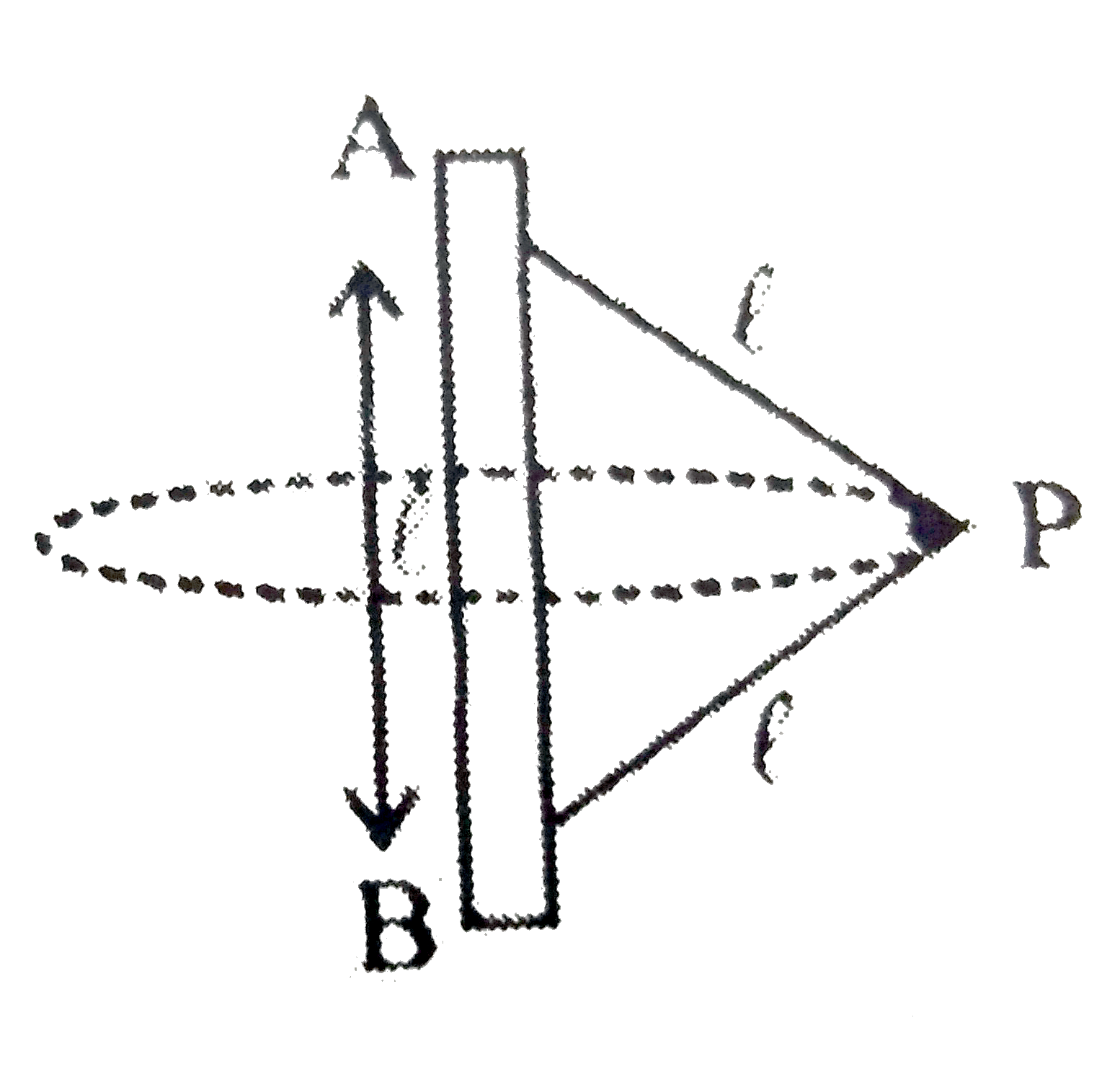
A particle P of mass m is attached to a vertical axis by two strings AP and BP of length l each. The separation AB=l. P rotates around the axis with an angular velocity `omega`. The tensions in the two strings are `T_(1) and T_(2)`

A

`T_(1)=T_(2)`

B

`T_(1)+T_(2)=momega^(2)l`

C

`T_(1)-T_(2)=2mg`

D

BP will remain taut only if `omega ge sqrt((2g)/(l))`

Text Solution

Verified by Experts

The correct Answer is:

B, C, D
Promotional Banner

Topper's Solved these Questions

Similar Questions

Explore conceptually related problems

A bead can slide on asmooth straight wire and a particle of mass m attached to the bead by a light string of length L. The particle is held in contact with the wire and with the string taut and is then let fall. If the bead has mass 2m then when the string makes an angle theta with the wire, the bead will have slipped a dsitance.

A uniform thin rod AB of mass M and length l attached to a string OA of length (l)/(2) is placed on a smooth horizontal plane and rotates with angular velocity omega around a vertical axis through O. A peg P is inserted in the plane in order that on striking it the bar will come exactly to rest

A ball of mass (m) 0.5 kg is attached to the end of a string having length (L) 0.5 m . The ball is rotated on a horizontal circular path about vertical axis. The maximum tension that the string can bear is 324 N . The maximum possible value of angular velocity of ball ( radian//s) is - .

A uniform rod of mass m and length l rotates in a horizontal plane with an angular velocity omega about a vertical axis passing through one end. The tension in the rod at a distance x from the axis is

Consider a conical pendulum having bob is mass m is suspended from a ceiling through a string of length L. The bob moves in a horizontal circle of radius r. Find (a) the angular speed of the bob and (b) the tension in the string.

Two bodies of mass 4kg and 6kg are attached to the ends of a string passing over a pulley. The 4kg mass is attached to the table top by another string. The tension in this string T_(1) is equal to: Take

A particle of mass m is tied to light string and rotated with a speed v along a circular path of radius r. If T=tension in the string and mg= gravitational force on the particle then actual forces acting on the particle are

Three solids of masses m_(1),m_(2) and m_(3) are connected with weightless string in succession and are placed on a frictionless table. If the mass m_(3) is dragged with a force T , the tension in the string between m_(2) and m_(3) is

Two particles each of mass m are connected by a light inextensible string and a particle of mass M is attached to the midpoint of the string. The system is at rest on a smooth horizontal table with string just taut and in a straight line. The particle M is given a velocity v along the table perpendicular to the string. Prove that when the two particles are about to collide : (i) The velocity of M is (Mv)/((M + 2m)) (ii) The speed of each of the other particles is ((sqrt2M (M + m))/((M + 2m)))v .

Two particles, each of mass m, are connected by a light inextensible string of lenthe 2l . Initially they lie on a smooth horizontal table at points A and B distant l apart. The particle at A is projected across the table with velocity u. Find the speed with which the second particle begins to move if the direction of u is :- (i) along BA. (ii) at an angle of 120^(@) with AB (iii) perpendicular to AB. In each case calculate (in teerms of m and u) the impulsive tension in the string.
