Home
Class 12
PHYSICS
A point p moves in counter - clockwise ...

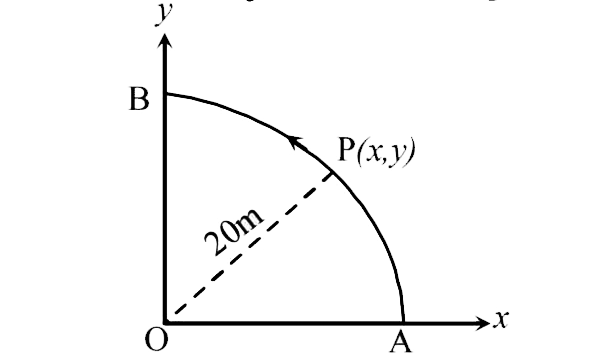
A point `p` moves in counter - clockwise direction on a circular path as shown in the figure . The movement of 'p' is such that it sweeps out in the figure . The movement of 'p' is such that it sweeps out a length `s = t^(3) + 5 ` , where `s` is in metres and ` t` is in seconds . The radius of the path is `20 m` . The acceleration of 'P' when ` t = 2 s` is nearly .

A

`14m//s^(2)`

B

`13m/s^(2)`

C

`12m//s^(2)`

D

`7.2m//s^(2)`

Text Solution

Verified by Experts

The correct Answer is:

A
Promotional Banner

Topper's Solved these Questions

Similar Questions

Explore conceptually related problems

A point P moves in counter clockwise direction on a circular path as shown in the figure. The movement of 'P' is such that it sweeps out a length s=t^(2)+5 , wheres is in metres and t is in seconds. The radius of the path is 20m. The acceleration of 'P' when t=5sqrt((3)/(10)) seconds is nearly:

The displacement of particle with respect to time is s = 3^(t3) - 7t^(2) + 5t + 8 where s is in m and t is in s, then acceleration of particle at t = ls is

A car moves along a straight line whose equation of motion is given by s=12t+3t^(2)-2t^(3) where s is in metres and t is in seconds. The velocity of the car at start will be :-

An object moves counter - clockwise along the circular path shown below. As it moves along the path its acceleration vector continuously points towards point S . The object

The displacment of a particle is represented by the following equation : s=3t^(3)+7t^(2)+4t+8 where s is in metre and t in second. The acceleration of the particle at t=1:-

A particle is moving in a circle of radius r with speed v as shown in the figure. The magnitude of change in velocity in moving from P to Q is

A body moves in anticlockwise direction on a circular path in the x-y plane. The radius of the circular path is 5m and its centre is at the origin. In a certain interval of time, displacement of the body is obesrved to be 6m in the positive y-direction. Which of the following is true ?
