Home
Class 12
PHYSICS
Consider a disc rotating in the horizont...

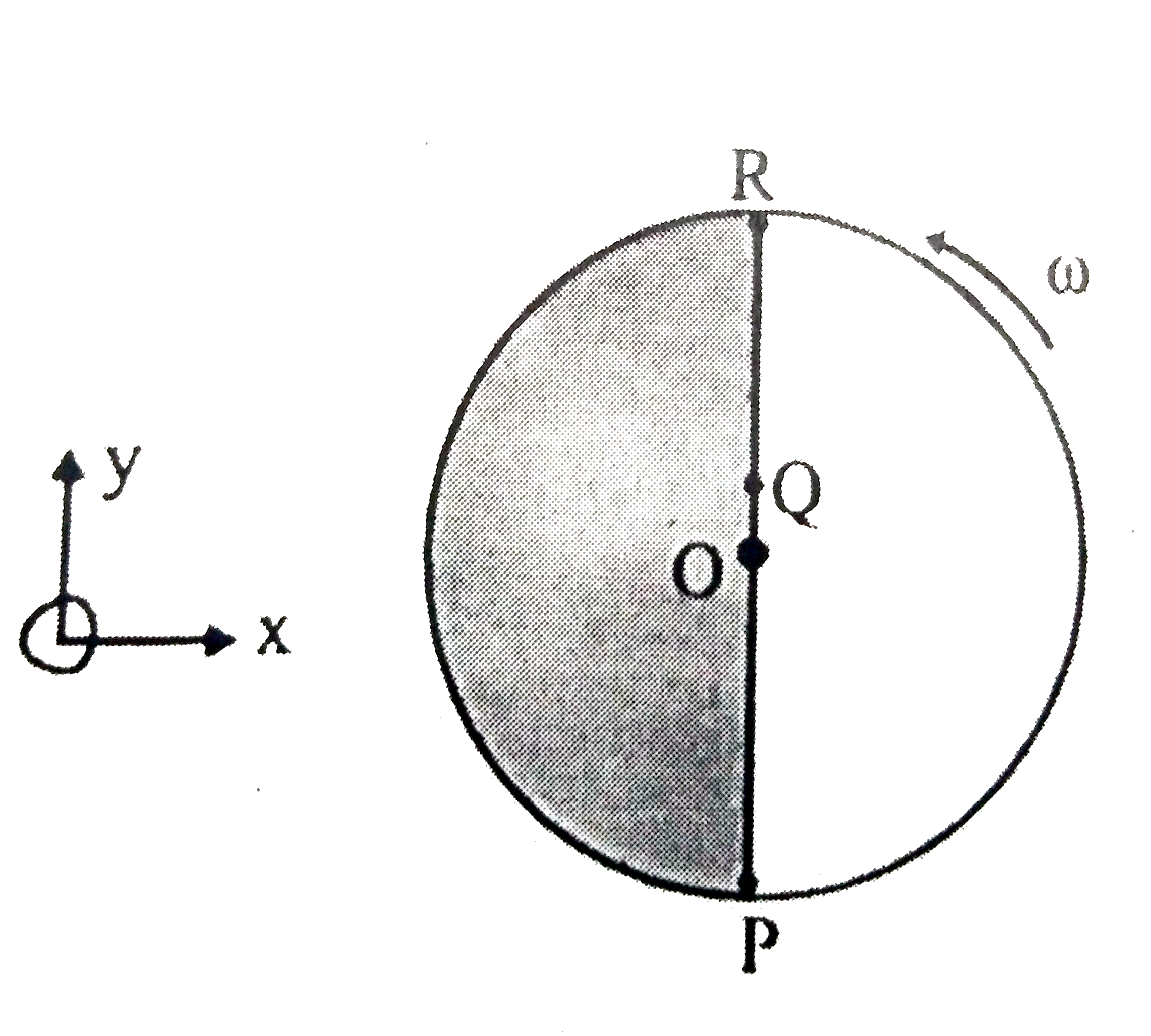
Consider a disc rotating in the horizontal plane with a constant angular speed `omega` about its centre O . The disc has a shaded region on one side of the diameter and an unshaded region on the other side as shown in the figure. When the disc is in the orientation as shown, two pebbles P and Q are simultaneously projected at an angle towards R. The velocity of projection is in the y-z plane and is same for both pebbles with respect to the disc. Assume that (i) they land back on the disc before the disc has completed `(1)/(8)` rotation, (ii) their range is less than half the disc radius, and (iii) w remains constant throughout. Then

A

p lands in the shaded region and Q in the unshaded region.

B

p lands in the unshaded region and Q in the shaded region

C

Both p and Q land in the unshaded region.

D

Both p and Q Jand in the shaded region

Text Solution

Verified by Experts

The correct Answer is:

C, D
Promotional Banner

Topper's Solved these Questions

Similar Questions

Explore conceptually related problems

Two identical discs of same radius R are rotating about their axes in opposite directions with the same constant angular speed omega . The discs are in the same horizontal plane. At time t = 0 , the points P and Q are facing each other as shown in the figure. The relative speed between the two points P and Q is v_(r) . In one time period (T) of rotation of the discs , v_(r) as a function of time is best represented by

A particle is moving in a circle of radius r with speed v as shown in the figure. The magnitude of change in velocity in moving from P to Q is

What is the moment of inertia of a disc about one of its diameter?

Find the area of the shaded region in the given figure, where ABCD is a square of side 14 cm.

For a disc of given density and thickness, its moment of inertia varies with radius of the disc as :

If BC passes through centre of the circle, then the area of the shaded region in the given figure is:

A disc rotating about its axis, from rest it acquires a angular speed 100rev/s in 4 second. The angle rotated by it during these four seconds (in radian) is

Two particles are projected from the two towers simultaneously, as shown in the figure. What should be value of d for their collision.

Find the area of the shaded region in the given figure, if radii of the two concentric circles with centre O are 7 cm and 14 cm respectively and angle AOC = 40^(@) .

A rocket is projected vertically upwards and its time velocity graph is shown in the figure-1.115. The maximum height attained by the rocket is :
