Home
Class 12
PHYSICS
A wire, which passes through the hole in...

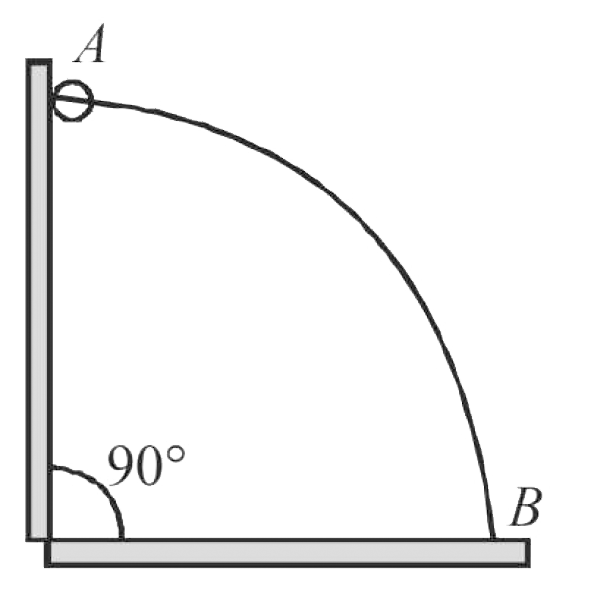
A wire, which passes through the hole in a small bead, is bent in the form of quarter of a circle. The wire is fixed vertically on ground as shown in the figure. The bead is released from near the top of the wire and it slides along the wire without friction. As the bead moves from A to B, the force it applies on the wire is

A

Always radially outwards

B

Always radially inwards

C

Radially outwards initially and radially inwards later.

D

Radially inwards initially and radially outwards later

Text Solution

Verified by Experts

The correct Answer is:

D
Promotional Banner

Topper's Solved these Questions

Similar Questions

Explore conceptually related problems

A wire having resistance 20 Omega is bent in the form of a circle as shown in the following figure: What will be the resistance between two end points A and B located on the diameter?

A wire of resistance 12 Omega m^(-1) is bent to from a complete circle of radius 10 cm . The resistance between its two diametrically opposite points, A and B as shown in the figure, is

A uniform magnetic field of 1.5 T exists in a cylindrical region of radius10.0 cm, its direction parallel to the axis along east to west. A wire carrying current of 7.0 A in the north to south direction passes through this region. What is the magnitude and direction of the force on the wire if, (a) the wire intersects the axis, (b) the wire is turned from N-S to northeast-northwest direction, (c) the wire in the N-S direction is lowered from the axis by a distance of 6.0 cm?

A rod of mass m and resistance R slides smoothly over two parallel conducting wires kept sloping at an angle theta with respect to the horizontal as shown in figure. The circuit is closed through a perfect conductor at the top. There is a constant magnetic field vecB along the vertical direction. If the rod is initially at rest, find the velocity of the rod as a function of time.

A piece of wire is bent in the shape of a parabola y=kx^(2) (y-axis vertical) with a bead of mass m on it. The bead can slide on the wire without friction. It stays at the lowest point of the parabola when the wire is at rest. The wire is now accelerated parallel to the x-axis with a constant acceleration a. The distance of the new equilibrium position of the bead, where the bead can stay at rest with respect to the wire, from the y-axis is:

A bead is free to slide down a smooth wire tightly stretched between points A and on a verticle circle of radius R. if the bead starts from rest at 'A', the highest point on the circle, its velocity when it arrives at B is :-

Two beads of masses m_(1) and m_(2) are closed threaded on a smooth circular loop of wire of radius R. Intially both the beads are in position A and B in vertical plane . Now , the bead A is pushed slightly so that it slide on the wire and collides with B . if B rises to the height of the centre , the centre of the loop O on the wire and becomes stationary after the collision , prove m_(1) : m_(2) = 1 : sqrt(2)

The current flows from A to B in a straight wire as shown in figure and it is decreasing with time. The induced current in loop placed near to it ____

A thin spherical shell of total mass M and radius R is held fixed. There is a small hole in the shell. A mass m is released from rest a distance R from the hole along a line that passes through the hole and also through the centre of the shell. This mass subsequently moves under the gravitational force of the shell. How long does the mass take to travel from the hole to the point diametrically opposite.
