Home
Class 12
PHYSICS
In the system shown in figure all surfac...

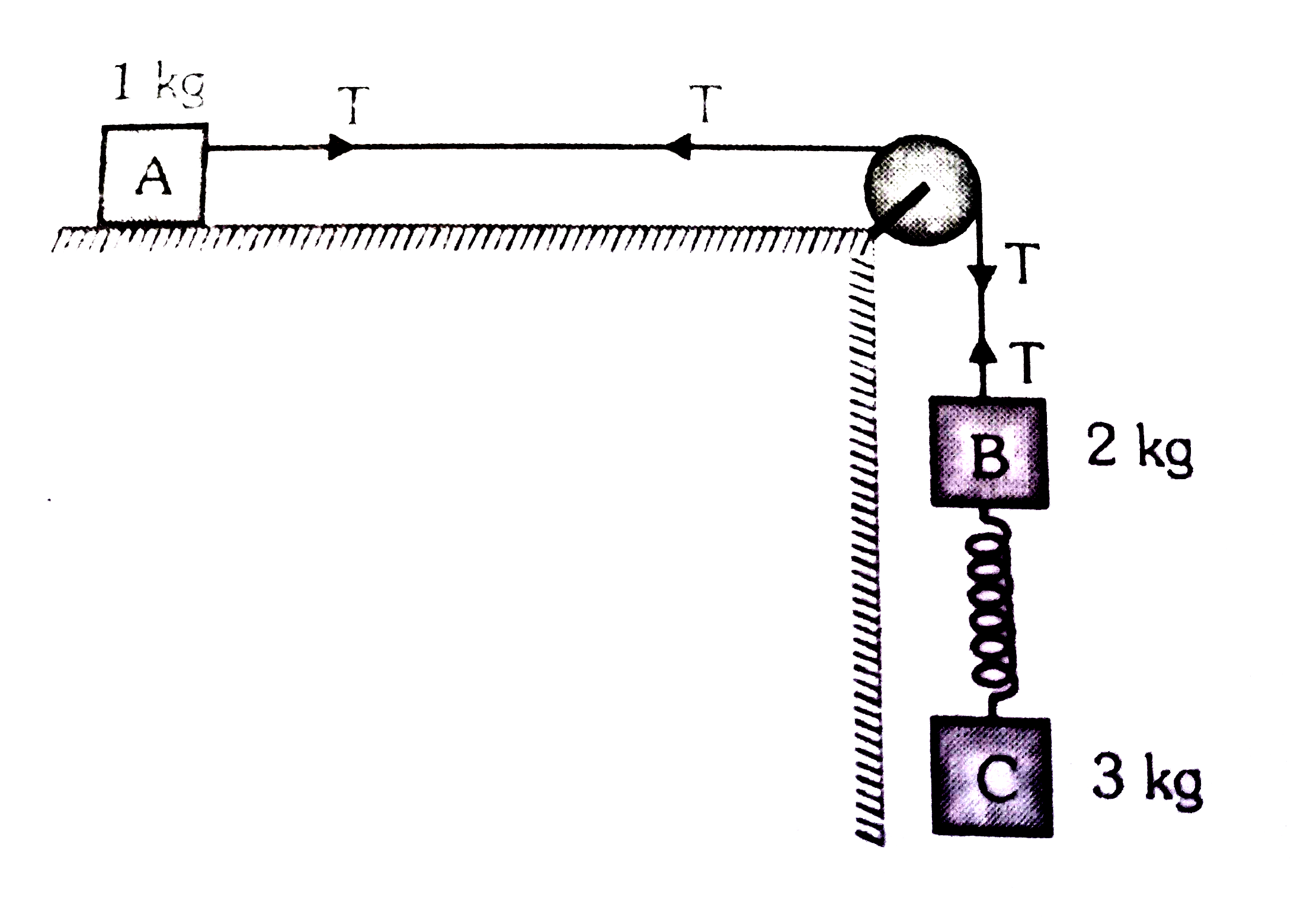
In the system shown in figure all surface are smooth, string is massless and inextensible. Find:
(a) acceleration of the system
(b) tension in the string and
(c) extension in the spring if force constant of spring is
`k=50N/m` (Take `g=10m//s^(2)`)

Text Solution

Verified by Experts
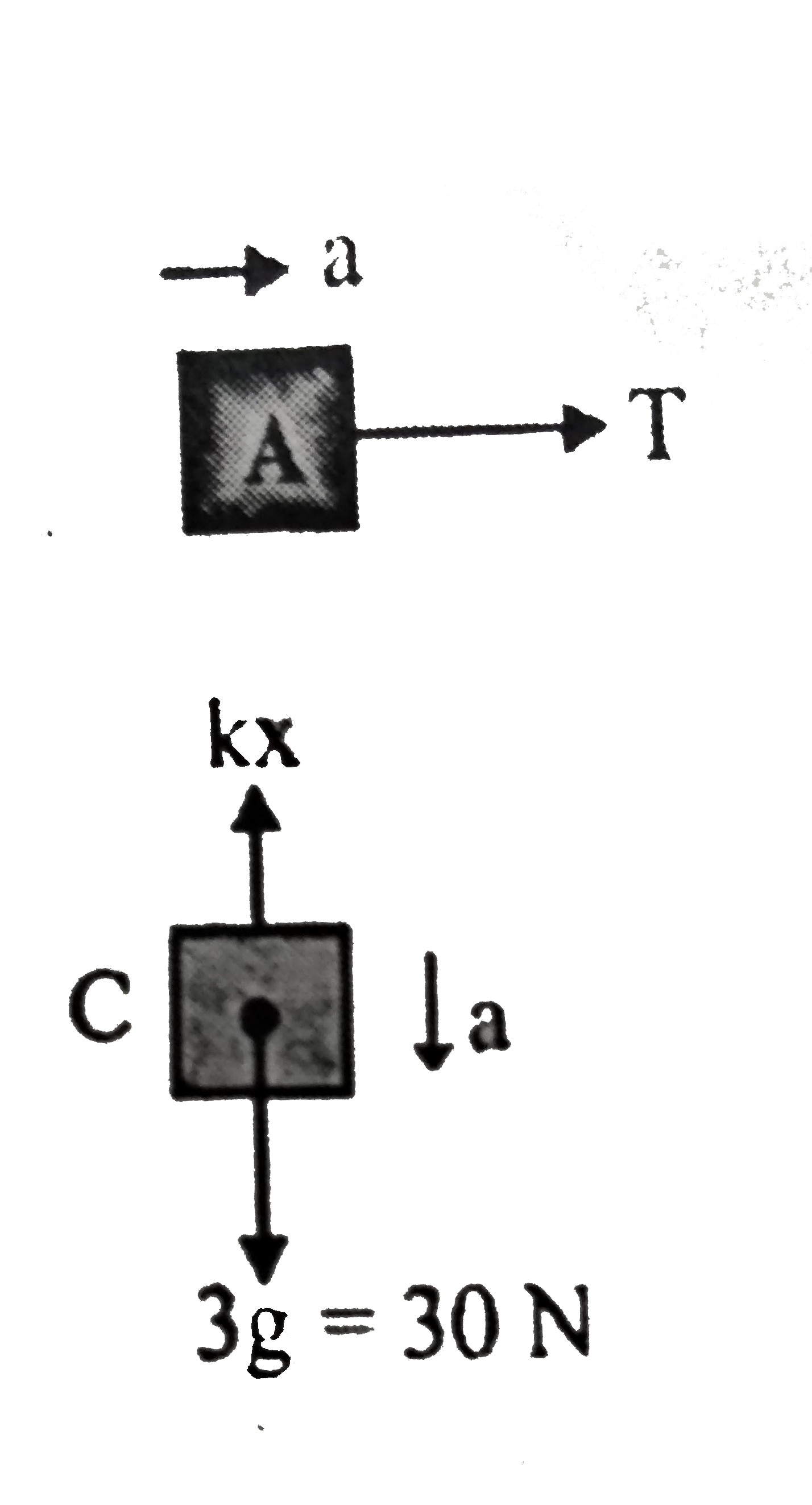
(a) In this case net pulling force `=m_(a)g+m(B)g=50N` and total mass to be pulled is (1+2+3) kg = 6 kg.
`therefore` Acceleration of the system is a `=50/6ms^(-2)`
(b) Free body diagram of 1 kg blick give T `=ma=(1)((50)/(6))N=50/6N`
(c ) Free body diagram of 3 kg block gives
30 - kx = ma but `ma=3xx50/6=25N`
`x=(30-25)/(k)=5/50=0.1m=10cm`
Promotional Banner

Topper's Solved these Questions

  • NEWTON'S LAWS OF MOTION & FRICTION

    ALLEN |Exercise EXERCISE (S-1)|25 Videos
  • NEWTON'S LAWS OF MOTION & FRICTION

    ALLEN |Exercise EXERCISE (S-2)|9 Videos
  • MOTION IN A PALNE

    ALLEN |Exercise SOLVED EXAMPLE|28 Videos
  • NEWTONS LAWS OF MOTION

    ALLEN |Exercise EXERCISE-III|28 Videos

Similar Questions

Explore conceptually related problems

In the system shown in figure all surface are smooth, string in massless and inextensible. Find: (a) acceleration of the system (b) tensionin the string and (c ) ectension in the spring if force constant of spring is k = 50 N/m (Take g = 10 m//s^(2) )

In the adjacent figure, mass of A, B and C are 1 kg , 3 kg and 2 kg, respectively. Find (a) the acceleration of the system, and (b) tensions in the string . Neglect friction. (g =10ms^(-2) )

If coeffiecient of friction between the block of mass 2kg and table is 0.4 then out acceleration of the system and tension in the string. (g=10m//s^(2))

A block of mass 1 kg falls freely on a spring form a height of 20 cm as shown in figure . Find the compression in the spring if its force constant is 10^(3) N/m . ( Take g = 10.0 m//s^(2) )

In the situation shown in figure, both the pulleys and the strings are light and all the surfaces are frictionless. The acceleration of mass M, tension in the string PQ and force exerted by the clamp on the pulley, will respectively be -

The systems shown in are in equilibrium if the spring balance is calibrated in newtons, what does it record in each case? (g=10m//s^(2))

(a) A box of weight 10sqrt(3) N is held n equilibrium with the help of two strings OA and OB as shown in figure-1. the string OA is horizontal. Find the tensions in both the stings. (b) If you can change location of the point A on the wall and hence the orientation of the string OA without altering the orientation of the string OB as shown in figure-II. what angle should the string OA make with the wall so that a minimum tension is developed in it?

The fricition coefficient between the table and block shown in fig. is 0.2 find the acceleration of the system (Take g=10 m//s^(2) )

In the given arrangement shown in figure, surface is frictionless, string is inextensible and massless, pulley B is frictionless. Length of the string is l . At t=0 , AB=l . Find out the velocity of block C , when distance between blocks is minimum, it was released from rest at t=0 .

For a particle rotating in a vertical circle with uniform speed, the maximum and minimum tension in the string are in the ratio 5 : 3. If the radius of vertical circle is 2 m, the speed of revolving body is ( g=10m//s^(2) )

