Home
Class 12
PHYSICS
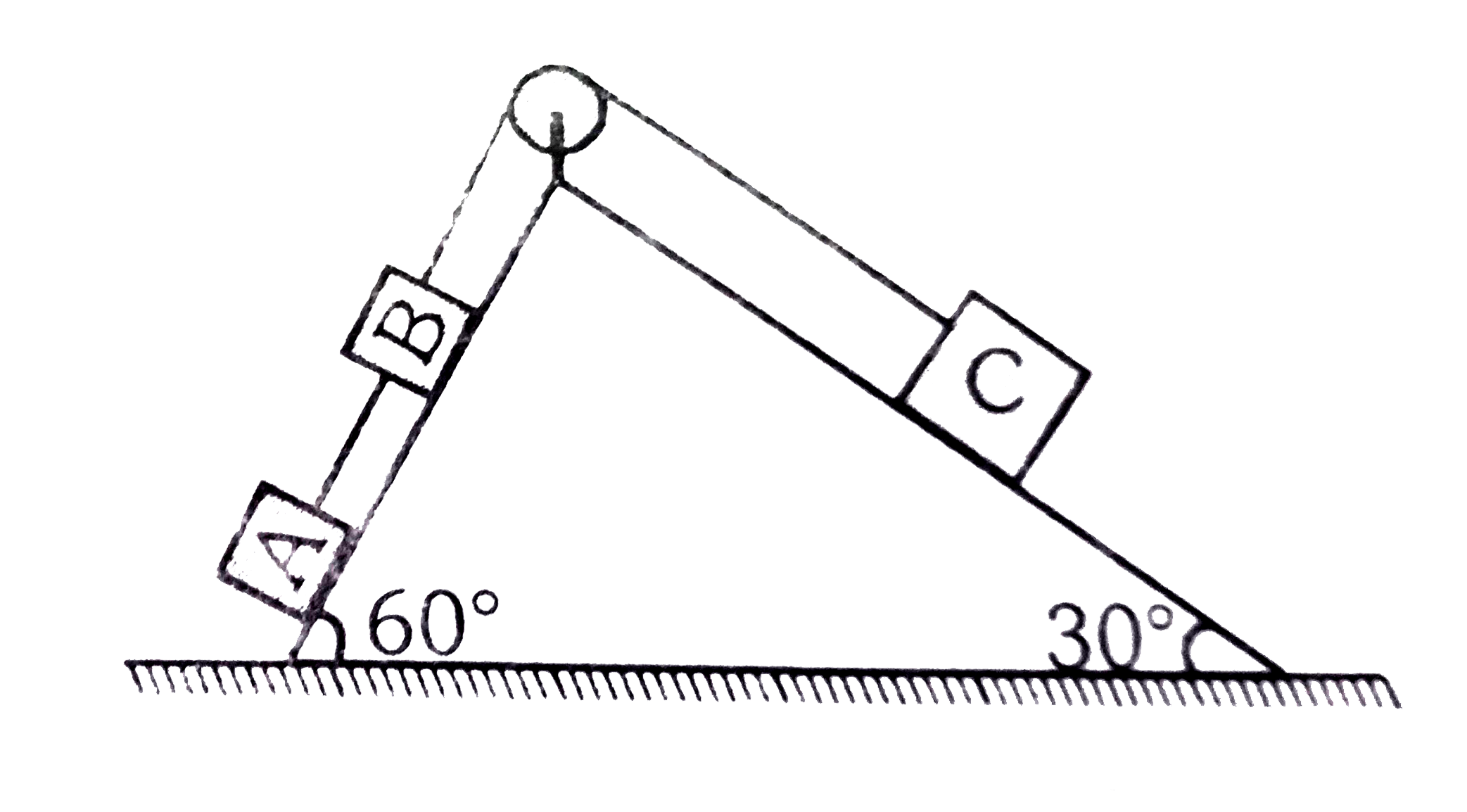
In the adjacent figure, masses of A,B an...

In the adjacent figure, masses of A,B and C are 1kg, 3kg
and 2kg respectively. Find: (a) the acceleration of the system and (b) tensions in the string Neglect friction. `(g=10ms^(-2))`

Text Solution

Verified by Experts
(a) IN this case net pulling force
= `m_(A)g sin 60^(@)+m_(B)g sin60^(@)-m_(C)g sin 30^(@)`
`=(M_(A)+m_(B))g sin 60^(@)-m_(C)g sin30^(@)`
`=(1+3)xx10xx(sqrt3)/(2)-2xx10xx1/2`
`=20sqrt3-10=20xx1.732-10=24.64N`
Total mass being pulled = 1+ 3+2= 6 kg

`therefore` Acceleration of the system a `=(24.64)/(6)=4.1m//s^(2)`
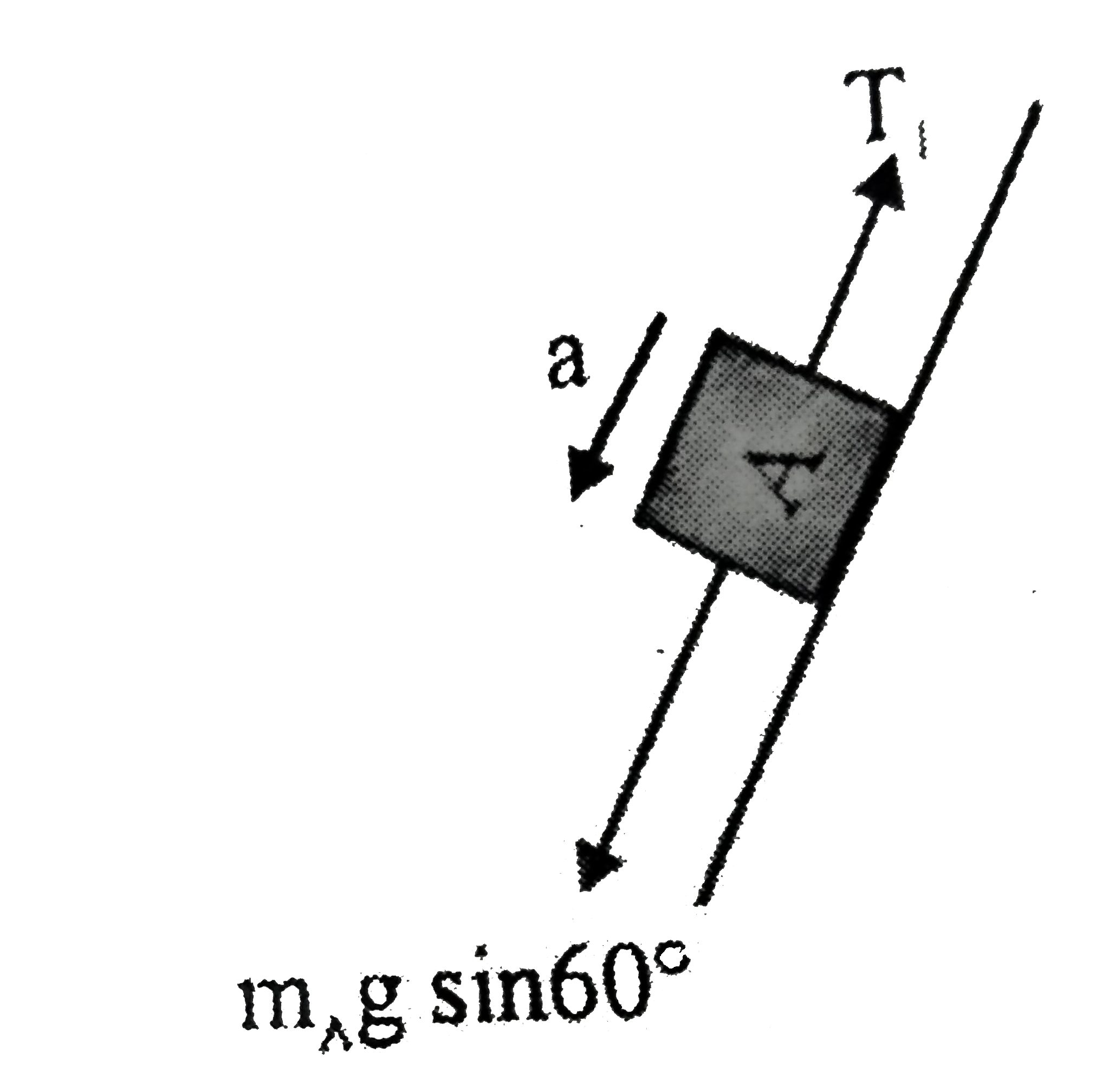
(b) For the tension `T_(1)` in the string between A and B, `m_(A)g sin 60^(@)-T_(1)=(m_(A))(a) therefore T_(1)=m_(A)g sin60^(@)-m_(A)a=m_(A)(g sin60^(@)-a)`
`impliesT_(1)=(1)(10xx(sqrt3)/(2)-4.1)=4.56N`
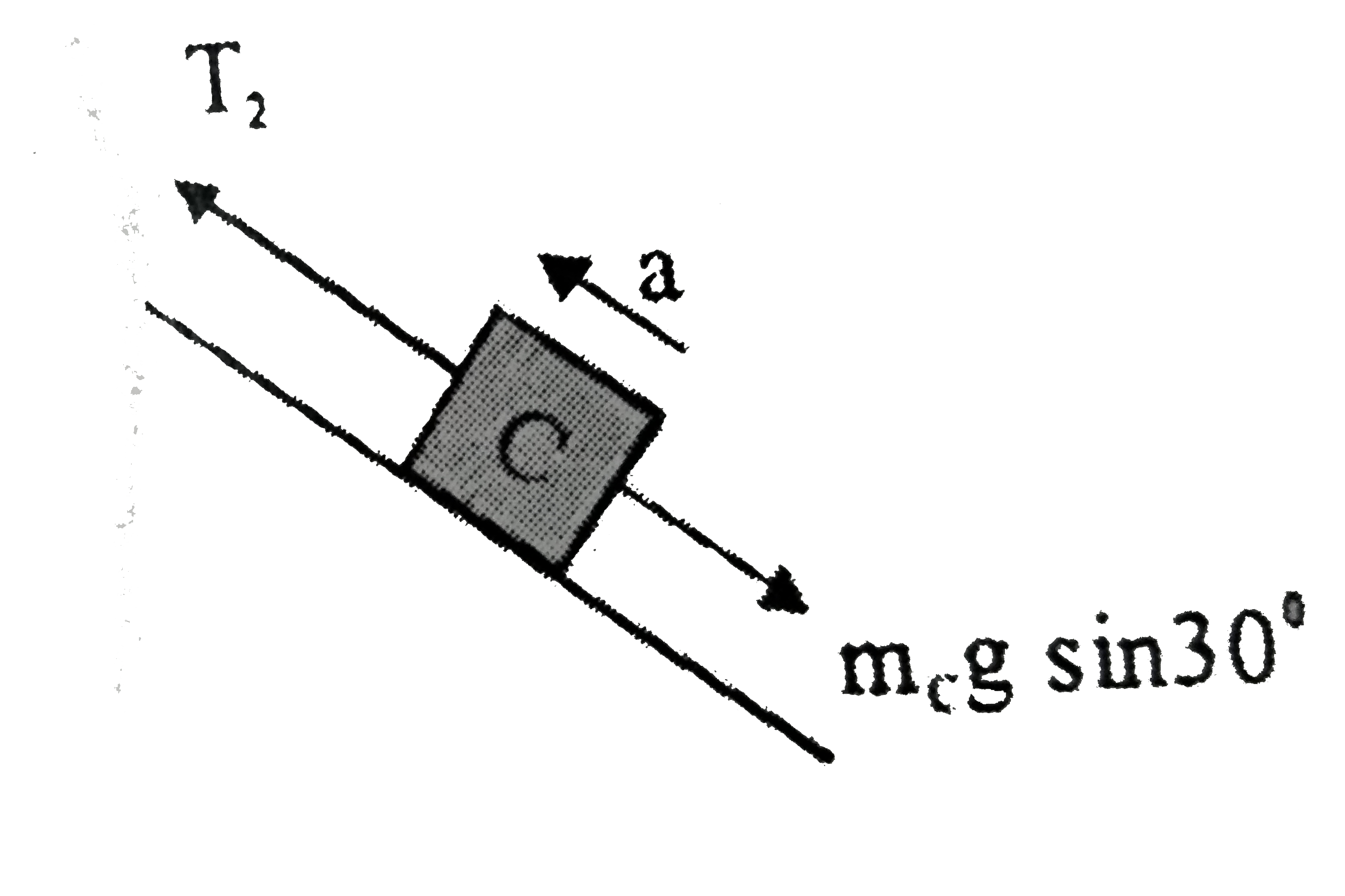
For the tension `T_(2)` in the string between B and C.
`T_(2)-m_(C)g sin30^(@)=m_(C)a`
`impliesT_(2)=m_(C)(a+g sin30^(@))=2[4.1+10((1)/(2))]=18.2N`
Promotional Banner

Topper's Solved these Questions

  • NEWTON'S LAWS OF MOTION & FRICTION

    ALLEN |Exercise EXERCISE (S-1)|25 Videos
  • NEWTON'S LAWS OF MOTION & FRICTION

    ALLEN |Exercise EXERCISE (S-2)|9 Videos
  • MOTION IN A PALNE

    ALLEN |Exercise SOLVED EXAMPLE|28 Videos
  • NEWTONS LAWS OF MOTION

    ALLEN |Exercise EXERCISE-III|28 Videos

Similar Questions

Explore conceptually related problems

In the adjacent figure, mass of A, B and C are 1 kg , 3 kg and 2 kg, respectively. Find (a) the acceleration of the system, and (b) tensions in the string . Neglect friction. (g =10ms^(-2) )

If coeffiecient of friction between the block of mass 2kg and table is 0.4 then out acceleration of the system and tension in the string. (g=10m//s^(2))

In the figure masses m_(1),m_(2) and M are kg. 5 kg and 50 kg respectively. The co-efficient of friction between M and ground is zero. The co-efficient of friction between m_(1) and M and that between m_(2) and ground is 0.3. The pulleys and the string are massless. The string is perfectly horizontal between P_(1) and m_(1) and also between P_(2) and m_(2). The string is perfectly verticle between P_(1) and P_(2). An externam horizontal force F is applied to the mass M. Take g=10m//s^(2). (i) Drew a free-body diagram for mass M, clearly showing all the forces. (ii) Let the magnitude of the force of friction between m_(1) and M be f_(1) and that between m,_(2) and ground be f_(2). For a particular F it is found that f_(1)=2f_(2). Find f_(1) and f_(2). Write down equations of motion of all the masses. Find F, tension in the string and accelerations of the masses.

Two masses 8 kg and 12 kg are connected at the two ends of a light inextensible string that goes over a frictionless pulley. Find the acceleration of the masses, and the tension in the string when the masses are released.

Two masses 8 kg and 12 kg are connected at the two ends of a light inextensible string that goes over a frictionless pulley. Find the acceleration of the masses and the tension in the string when the masses are released.

Masses of two bodies are 1kg and 4kg respectively. If their kinetic energies are in 2:1 proportion, ratio of their speeds is ……………

A 2 kg block A is attached to one end of a light string that passes over an an ideal pulley and a 1 kg sleeve B slides down the other part of the string with an acceleration of 5m//s^(2) with respect to the string. Find the acceleration of the block, acceleration of sleeve and tension in the steing. [g=10m//s^(2)]

USS 150) Two masses of 5 kg and 10 kg are connected to a pulley as shown. What will be the acceleration of the system (g= acceleration due to gravity)

Shown in the figure is a system of three particles of mass 1 kg, 2 kg and 4 kg connected by two springs. The acceleration of A. B and C at any instant are 1 ms^(-2), 2 ms^(-2) and 1//2 ms^(-2) respectively directed as shown in the figure external force acting on the system is