Home
Class 12
PHYSICS
Consider the system of masses and pulley...

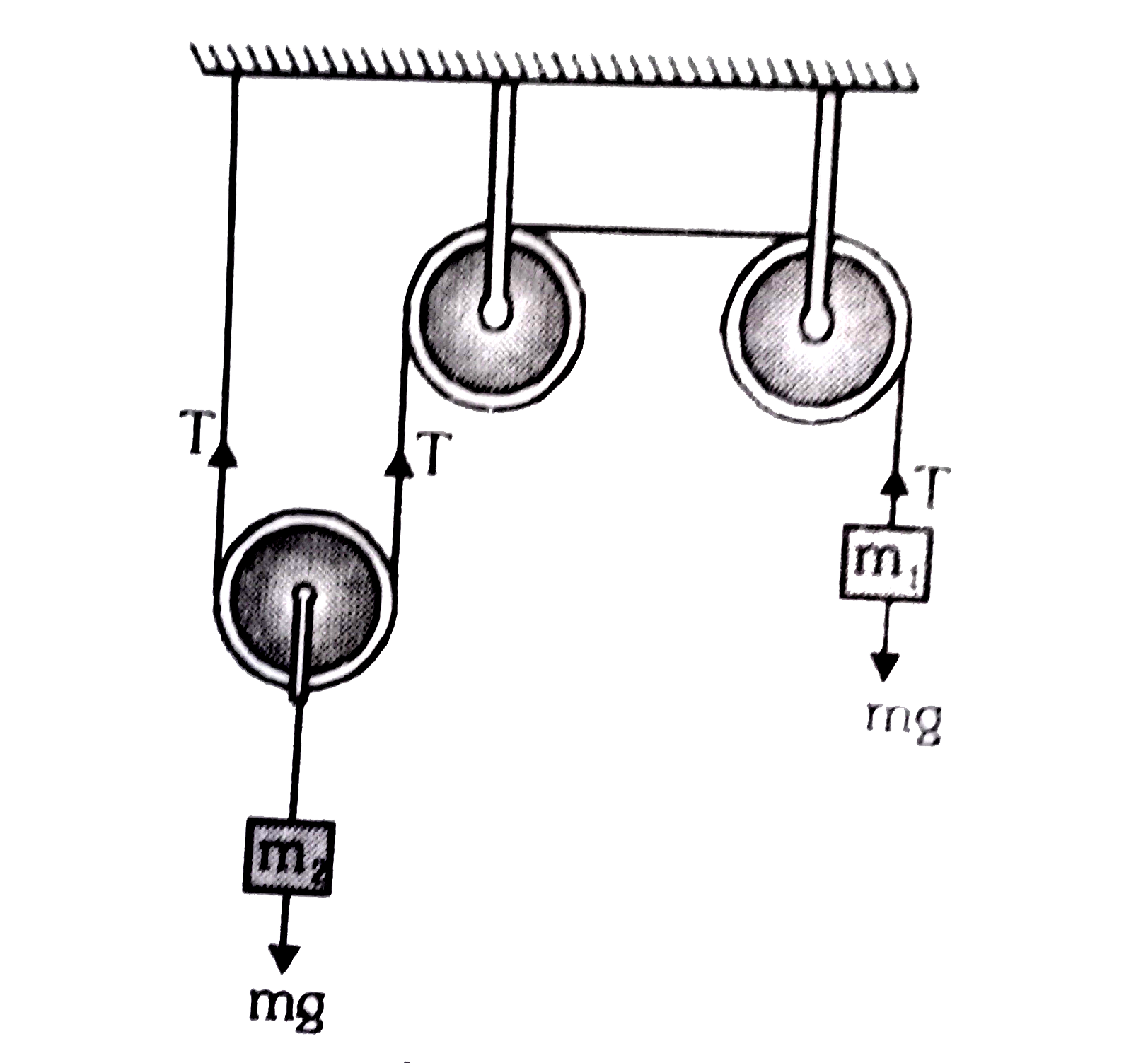
Consider the system of masses and pulleys shown in fig. with massless string and fricitionless pulleys.
(a) Give the necessary relation between masses `m_(1)` and `m_(2)` such that system is in equilibrium and does not move.
(b) If `m_(1)=6kg` and `m_(2)=8kg`, calculate the magnitude and direction of the acceleration of `m_(1)`.

Text Solution

Verified by Experts
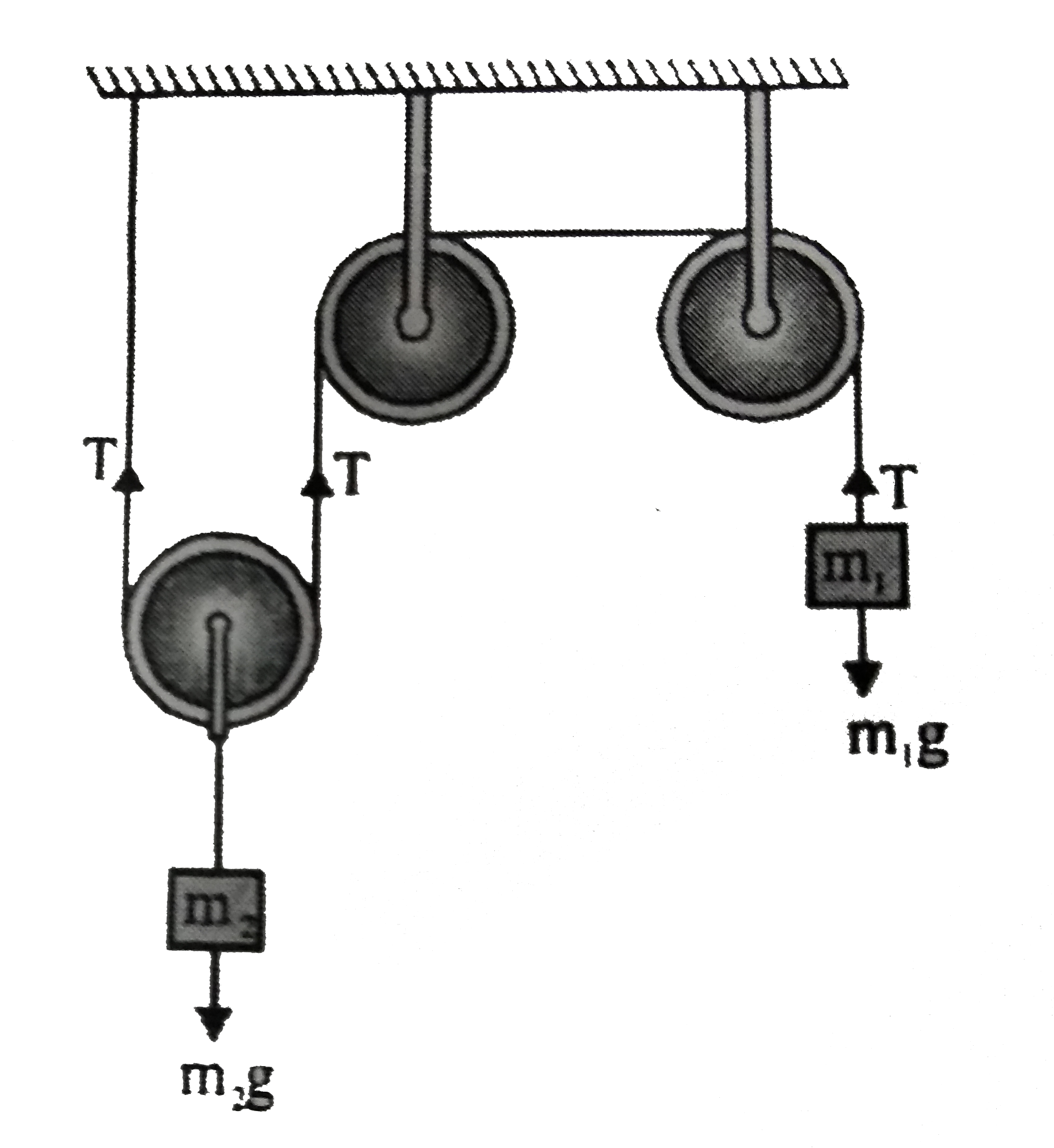
(a) Applying newton's law `m_(2)g-2T=0` (because there is no acceleration) and T - `m_(1)g=0`
`implies(m_(2)-2m_(1))g=oimpliesm_(2)=2m_(1)`
(b) If the upwards acceleration of `m_(1)` is a, then accleration of `m_(2)` is `a/2` downwards for mass `m_(2):m_(2)g-2T=m_(2)((a)/(2))implies2m_(2)g-4T=m_(2)a` for mass `m_(1),T-m_(1)g=m_(1)a`
`impliesa=((2m_(2)-4m_(1))/(m_(2)+4m_(1)))g=(2(8-12))/(8+24)g= -g/4`

Negative sing shows that acceleration is opposite to considered direction i.e. it is downwards for `m_(1)` and upward for `m_(2).`
Promotional Banner

Topper's Solved these Questions

  • NEWTON'S LAWS OF MOTION & FRICTION

    ALLEN |Exercise EXERCISE (S-1)|25 Videos
  • NEWTON'S LAWS OF MOTION & FRICTION

    ALLEN |Exercise EXERCISE (S-2)|9 Videos
  • MOTION IN A PALNE

    ALLEN |Exercise SOLVED EXAMPLE|28 Videos
  • NEWTONS LAWS OF MOTION

    ALLEN |Exercise EXERCISE-III|28 Videos

Similar Questions

Explore conceptually related problems

If system is in equilibrium then find relation between m_(1) and m_(2)

Two masses m_(1) and m_(2) . Which are connected with a light string, are placed over a frictionless pulley. This set up is placed over a weighting machine, as shown. Three combination of masses m_(1) and m_(2) are used, in first case m_(1)=6 kg and m_(2)=2kg in second case m_(1)=5kg and m_(2)=3kg and in third case m_(1)=4kg and m_(2)=4kg .Masses are held stationary initiallly and then released. If the readings of the weighing machine after the release in three cases are W_(1) , W_(2) and W_(3) respectively then :-

Two masses m_(1) = 4.8 kg and m_(2) = 5 kg tied to a string are hanging over a light frictionless pully. What is the acceleration of masses when they are free to move ?

If the string & all the pulleys are ideal, acceleration of mass m is :-

Two blocks of masses M_(1)=4 kg and M_(2)=6kg are connected by a string of negligible mass passing over a frictionless pulley as shown in the figure below. The coefficient of friction between the block M_(1) and the horizontal surface is 0.4. when the system is released, the masses M_(1) and M_(2) start accelrating. What additional mass m should be placed over M_(1) so that the masses (M_(1)+m) slide with a uniform speed?

Two particles of masses m and M(Mgtm) are connected by a cord that passes over a massless, frictionless pulley. The tension T in the string and the acceleration a of the particles is

Tow men of masses m_(1)and m_(2) hold on the opposite ends of a rope passing over a frictionless pulley. The men m_(1) climbs up the pore with an acceleration of 1.2m//s^(2) relative to the rope. The mann m_(2) climbs up the rope with an acceleration of 2m//s^(2) relative to the rope. Find the tension in the rope if m_(1)40 kg and m_(2)=60kg. Also find the time after the time after which they will be at same horizontal level if they start from rest and are initially separted by 5 m.

A man of mass m stands on a frame of mass M. He pulls on a light rope, which passes over a pulley. The other end of the rope is attached to the frame. For the system to be in equilibrium, what force must the man exert on the rope?

Three solids of masses m_(1),m_(2) and m_(3) are connected with weightless string in succession and are placed on a frictionless table. If the mass m_(3) is dragged with a force T , the tension in the string between m_(2) and m_(3) is

Two cars of masses m_(1) and m_(2) are moving in circles of raddii r_(1) and r_(2) respectively. Their speeds are such that they make complete circle in the same time t The ratio of their centripetal acceleration is .

