Home
Class 12
PHYSICS
Length of a chain is L and coefficient o...

Length of a chain is L and coefficient of static fricition is `mu`. Calculate the maximum length of the chain which can be hang from the table without silking.

Text Solution

Verified by Experts
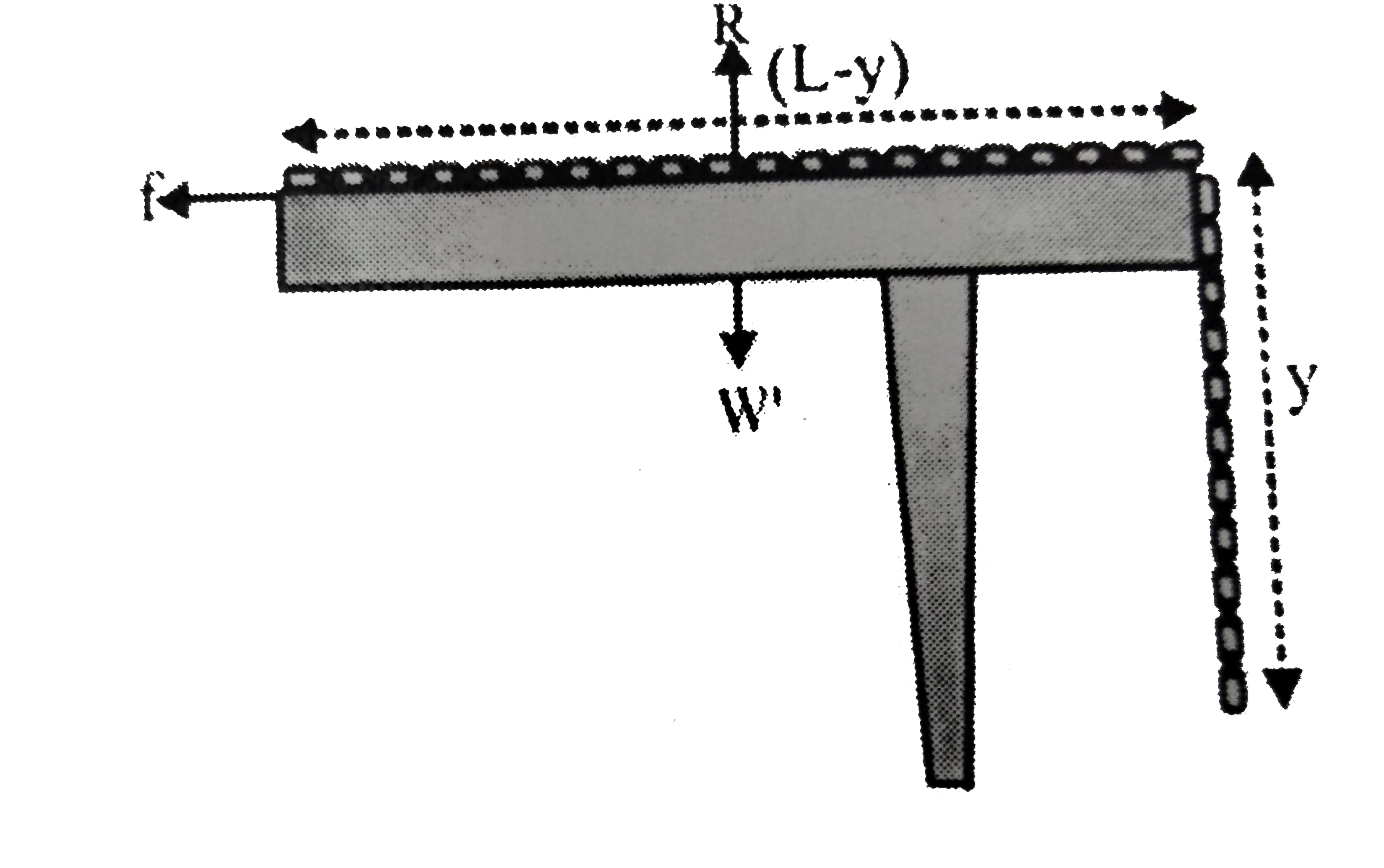
Let y be the maximum length of the chain can be hold out side the table without sliding.
Length of chain of the tabel = (L-y)
Weight of part of the chain on table `W'=M/L(L-y)g`
Weight of hanging part of the chain `W=M/Lyg`

For equlibrium : limiting force of friction = weight of hanging part of the chain
`muR=Wimplies" "muW'=W" "impliesmuM/L(L-y)g=M/LygimpliesmuL-muL-muy=yimpliesy=(muL)/(1+mu)`
Promotional Banner

Topper's Solved these Questions

  • NEWTON'S LAWS OF MOTION & FRICTION

    ALLEN |Exercise EXERCISE (S-1)|25 Videos
  • NEWTON'S LAWS OF MOTION & FRICTION

    ALLEN |Exercise EXERCISE (S-2)|9 Videos
  • MOTION IN A PALNE

    ALLEN |Exercise SOLVED EXAMPLE|28 Videos
  • NEWTONS LAWS OF MOTION

    ALLEN |Exercise EXERCISE-III|28 Videos

Similar Questions

Explore conceptually related problems

Assuming the length of a chain to be L and coefficient of static friction mu . Compute the maximum length of the chain which can be held outside a table without sliding.

A block of mass is placed on a surface with a vertical cross section given by y=x^3/6 . If the coefficient of friction is 0.5, the maximum height above the ground at which the block can be placed without slipping is:

A uniform thin cylindrical disk of mass M and radius R is attaached to two identical massless springs of spring constatn k which are fixed to the wall as shown in the figure. The springs are attached to the axle of the disk symmetrically on either side at a distance d from its centre. The axle is massless and both the springs and the axle are in horizontal plane. the unstretched length of each spring is L. The disk is initially at its equilibrium position with its centre of mass (CM) at a distance L from the wall. The disk rolls without slipping with velocity vecV_0 = vacV_0hati. The coefficinet of friction is mu. The maximum value of V_0 for whic the disk will roll without slipping is-

if rho is the density of the meterial of a wire and sigma is the breaking stress. The greatest length of the wire that can hang freely without breaking is

A disc of radius R is rotating with an angular omega_(0) about a horizontal axis. It is placed on a horizontal table. The coefficient of kinetic friction is mu_(k) . (a) What was the velocity of its centre of mass before being brought in contact with the table? (b) What happens to the linear velocity of a point on its rim when placed in contact with the table? (c) What happens to the linear speed of the centre of mass when disc is placed in contact with the table? (d) Which force is responsible for the effects in (b) and (c )? (e) What condition should be satisfied for rolling to being? (f) Calculate the time taken for the rolling to begin.

A car is moving along a banked road laid out as a circle of radius r . (a) What should be the banking angle theta so that the car travelling at speed v needs no frictional force from tyres to negotiate the turn ? (b) The coefficient of friction between tyres and road are mu_(s) = 0.9 and mu_(k) = 0.8 . At what maximum speed can a car enter the curve without sliding toward the top edge of the banked turn ?

A racing car travels on a track (without banking) ABCDEFA. ABC is a circular arc of radius 2 R. CD and FA are straight paths of length R and DEF is a circular arc of radius R = 100 m. The coefficient of friction on the road is mu = 0.1 . The maximum speed of the car is 50 ms^(-1) . Find the minimum time for completing one round.

A long horizontal rod has a bead which can slide along its length and initially placed at a distance L from one end A of the rod. The rod is set in angular motion about A with constant angular acceleration alpha. if the coefficient of friction between the rod and the bead is mu , and gravity is neglected, then the time after which the bead starts slipping is

A chain of length L and mass m is placed upon a smooth surface. The length of BA is (L-b) . Calculate the velocity of the chain when its end reaches B

