Home
Class 12
PHYSICS
When force F applied on m(1) and surface...

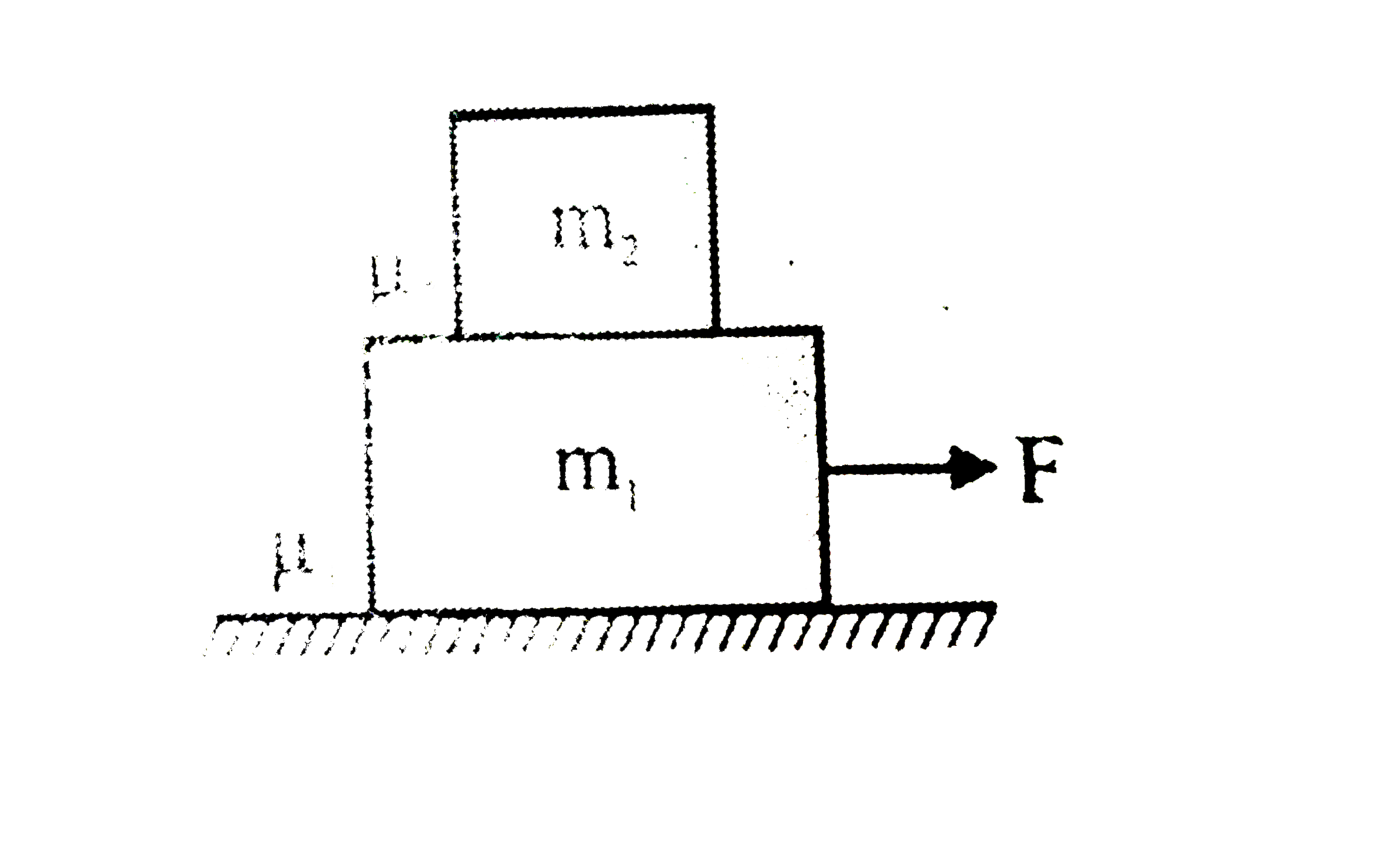
When force F applied on `m_(1)` and surface. Is `mu_(1)` and the coefficient of friction between `m_(1) and m_(2)` is `mu_(2).` What should be the minimum value of F so that there is no relative motion between `m_(1) and m_(2).`

Text Solution

Verified by Experts
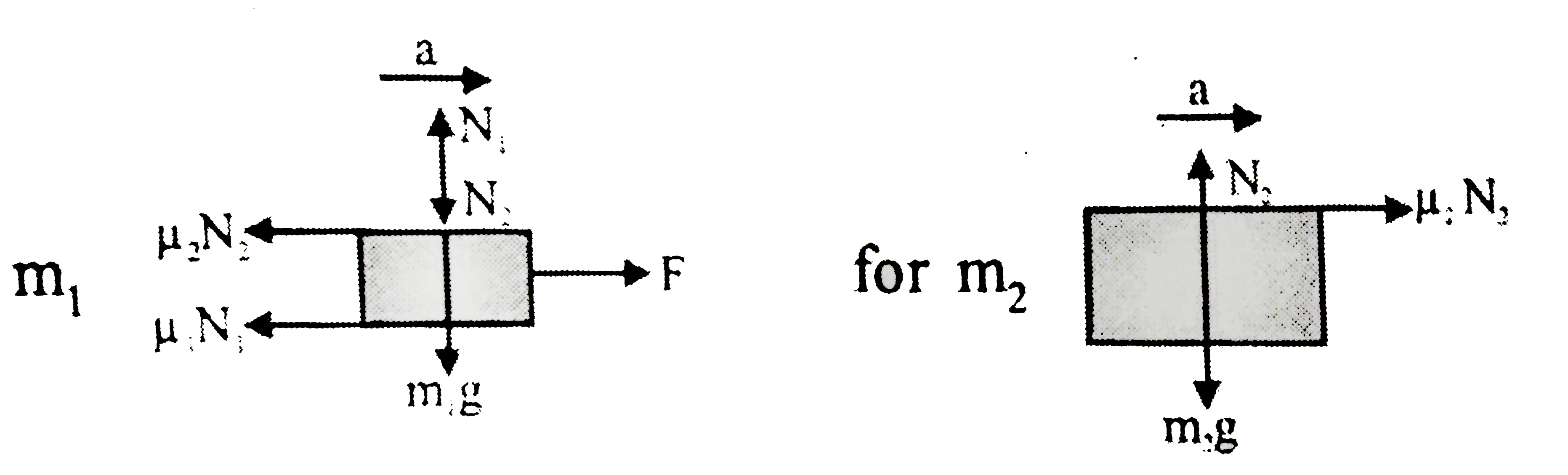

For System `a=(F-mu_(1)(m_(1)+m_(2))g)/(m_(1)+m_(2))`
For `m_(2),mu_(2)(m_(2)g)=m_(2)a=m_(2)((F-mu(m_(1)+m_(2))g)/(m_(1)+m_(2)))`
`impliesF_(min)=(m_(1)+m_(2))(mu_(1)+mu_(2))g`
Promotional Banner

Topper's Solved these Questions

  • NEWTON'S LAWS OF MOTION & FRICTION

    ALLEN |Exercise EXERCISE (S-1)|25 Videos
  • NEWTON'S LAWS OF MOTION & FRICTION

    ALLEN |Exercise EXERCISE (S-2)|9 Videos
  • MOTION IN A PALNE

    ALLEN |Exercise SOLVED EXAMPLE|28 Videos
  • NEWTONS LAWS OF MOTION

    ALLEN |Exercise EXERCISE-III|28 Videos

Similar Questions

Explore conceptually related problems

When force F applied on m_(2) and there is no friction between m_(1) and surface and the coefficient of friction between m_(1) and m_(2) is mu. What should be the minimum value of F so that there is no relative motion between m_(1) and m_(2)

When force F applied on m_(1) and there is no friction between m_(1) and surface and the coefficient of friction between m_(1)and m_(2) is mu. What should be the minimum value of F so that there is on relative motion between m_(1) and m_(2)

If system is in equilibrium then find relation between m_(1) and m_(2)

What force F must be applied so that m_(1) and m_(2) are at rest on m_(3) in

In the figure masses m_(1),m_(2) and M are kg. 5 kg and 50 kg respectively. The co-efficient of friction between M and ground is zero. The co-efficient of friction between m_(1) and M and that between m_(2) and ground is 0.3. The pulleys and the string are massless. The string is perfectly horizontal between P_(1) and m_(1) and also between P_(2) and m_(2). The string is perfectly verticle between P_(1) and P_(2). An externam horizontal force F is applied to the mass M. Take g=10m//s^(2). (i) Drew a free-body diagram for mass M, clearly showing all the forces. (ii) Let the magnitude of the force of friction between m_(1) and M be f_(1) and that between m,_(2) and ground be f_(2). For a particular F it is found that f_(1)=2f_(2). Find f_(1) and f_(2). Write down equations of motion of all the masses. Find F, tension in the string and accelerations of the masses.

What is the maximum value of force, so that both the blocks will move together ? m1=m2=2kg ,μ=1/3

Two blocks of mass m_(1)=10kg and m_(2)=5kg connected to each other by a massless inextensible string of length 0.3m are placed along a diameter of the turntable. The coefficient of friction between the table and m_(1) is 0.5 while there is no friction between m_(2) and the table. the table is rotating with an angular velocity of 10rad//s . about a vertical axis passing through its center O . the masses are placed along the diameter of the table on either side of the center O such that the mass m_(1) is at a distance of 0.124m from O . the masses are observed to be at a rest with respect to an observed on the tuntable (g=9.8m//s^(2)) . (a) Calculate the friction on m_(1) (b) What should be the minimum angular speed of the turntable so that the masses will slip from this position? (c ) How should the masses be placed with the string remaining taut so that there is no friction on m_(1) .

A block is kept on a rough horizontal surface as shown. Its mass is 2 kg and coefficient of friction between block and surface (mu)=0.5. A horizontal force F is acting on the block. When

A block of mass m1 = 1 kg another mass m2 = 2 kg, are placed together (see figure) on an inclined plane with angle of inclination theta . Various values of theta are given in List I. The coefficient of friction between the block m_(1) and the plane is always zero. The coefficient of static and dynamic friction between the block m_(2) and the plane are equal to mu = 0.3 . In List II expressions for the friction on block m_(2) are given. Match the correct expression of the friction in List II with the angles given in List I, and choose the correct option. The acceleration due to gravity is denoted by g [Useful information : tan (5.5^(@)) ~~ 0.1, tan (11.5^(@)) ~~ 0.2 , tan (16.5^(@))~~ 0.3 ].

Two bars of masses m_(1) and m_(2) connected by a non - deformed light spring rest on a horizontal plane. The coefficient of friction between the bars and the surface is equal to mu . What minimum constant force has to be appled in the horizontal direction to the bar of mass m_(1) in order to shift the other bar?

