Home
Class 12
PHYSICS
A body of mass m rests on a horizonal fl...

A body of mass m rests on a horizonal floor with which it has a coeficient of static friciton `mu`. It is desired to make the body move by applying the minimum possible force F. Find the magnitude of F and the direction in which it has to be applied.

Text Solution

Verified by Experts
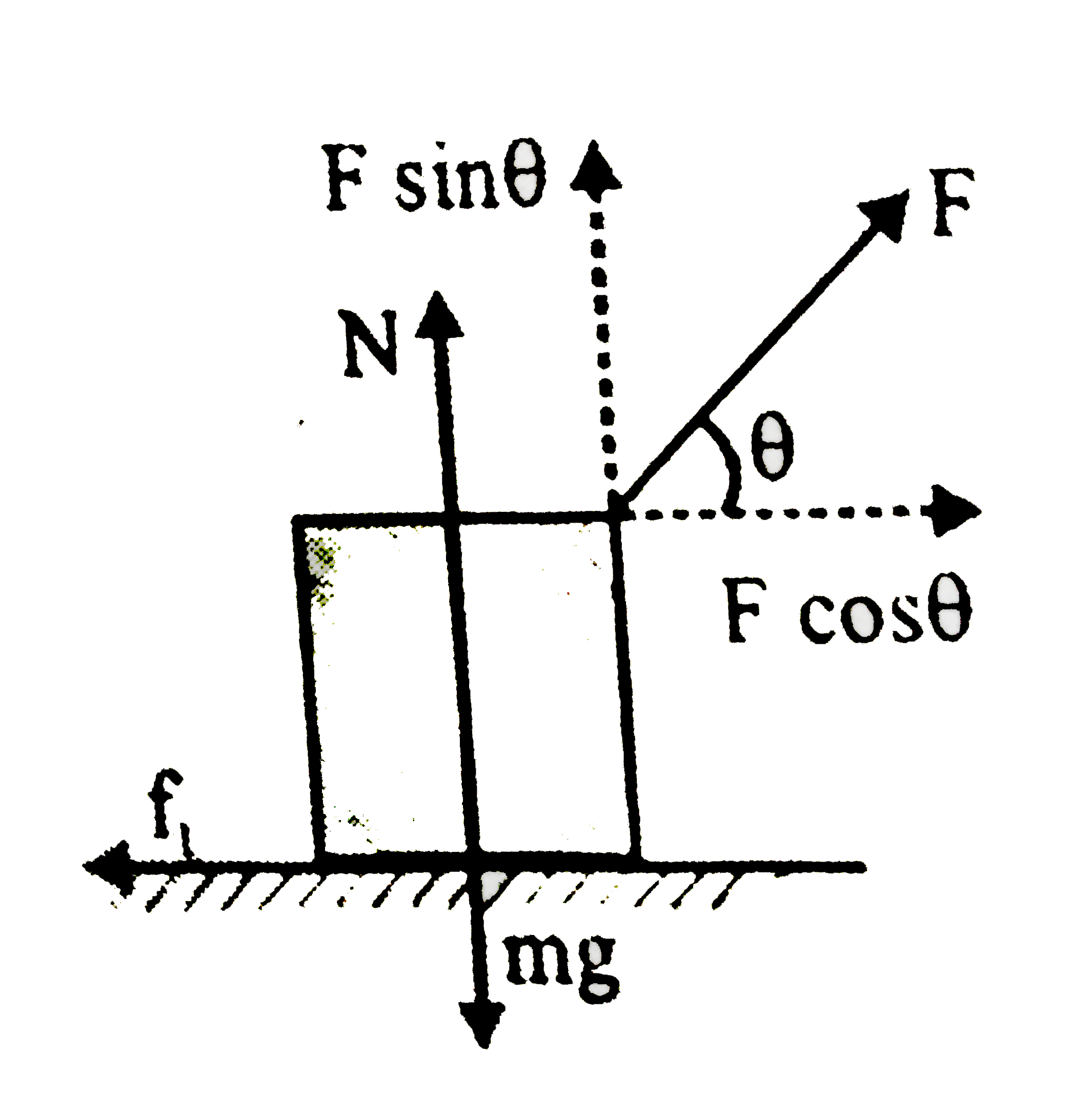
Let the force F be applied at an angle `theta` with the forizontal as shown in figure. For veritical equilibrium,
`R+Fsintheta=mgimplies" "N=mg-Fsintheta" "(i)`
for horizontal motion F `cosgef_(1)impliesFcosthetagemuN" "[asf_(1)=muN]" "(i)`
substituting value of R from equation (i) in (ii),
`Fcosthetagemu(mg-Fsintheta)impliesFge(mumg)/((costheta+musintheta))" "(iii)`
For the force F to be minimum `(costheta+musintheta)` must be maximum,
maximum value of `costheta+musinthetaissqrt(1+mu^(2))"so that" F_(min)=(mumg)/(sqrt(1+mu^(2)))withtheta=tan^(-1)(mu)`
Promotional Banner

Topper's Solved these Questions

  • NEWTON'S LAWS OF MOTION & FRICTION

    ALLEN |Exercise EXERCISE (S-1)|25 Videos
  • NEWTON'S LAWS OF MOTION & FRICTION

    ALLEN |Exercise EXERCISE (S-2)|9 Videos
  • MOTION IN A PALNE

    ALLEN |Exercise SOLVED EXAMPLE|28 Videos
  • NEWTONS LAWS OF MOTION

    ALLEN |Exercise EXERCISE-III|28 Videos

Similar Questions

Explore conceptually related problems

A particle of mass m rests on a horizontal floor with which it has a coefficient of static friction mu . It is desired to make the body move by applying the minimum possible force F. Find the magnitude of F and the direction in which it has to be applied.

A particle of mass m rests on a horizontal floor with which it has a coefficient of static friction mu . It is desired to make the body move by applying the minimum possible force F. Find the magnitude of F and the direction in which it has to be applied.

A body of mass M is kept on a rough horizontal surface (friction coefficient = mu ). A person is trying to pull the body by applying a horizontal force but the body is not moving. The force by the surface on the body is,

A block of mass m rests on a rough horizontl surface as shown in figure (a) and (b). Coefficient of friciton between block and surface is mu . A force F-mg acting at an angle theta with the vertical side of the block. Find the condition for which block will move along the surface.

A block A of mass 2 kg rests on another block B of mass 8 kg which rests on a horizontal floor. The coefficient of friction between A and B is 0.2 while that between B and floor is 0.5. when a horizontal force of 25 N is applied on the block B. the force of friction between A and B is

A block of mass 1kg is at rest on a rough horizontal surface having coefficient of static friction 0.2 and kinetic friciton 0.15, find the frictional forces if a horizontal force, (a) F=1N (b) F=1.96N (c) F=2.5N is applied on a block

A body of mass 2 kg initially at rest moves under the action of an applied horizontal force of 7N on a table with coefficient of kinetic friction = 0.1 . Compute the Change in kinetic energy of the body in 10s.

Two bars of masses m_(1) and m_(2) connected by a non - deformed light spring rest on a horizontal plane. The coefficient of friction between the bars and the surface is equal to mu . What minimum constant force has to be appled in the horizontal direction to the bar of mass m_(1) in order to shift the other bar?

A block of mass m is on an inclined plane of angle theta . The coefficient of friction between the block and the plane is mu and tanthetagtmu . The block is held stationary by applying a force P parallel to the plane. The direction of force pointing up the plane is taken to be positive. As P is varied from P_1=mg(sintheta-mucostheta) to P_2=mg(sintheta+mucostheta) , the frictional force f versus P graph will look like

