Home
Class 12
PHYSICS
Rod A can slide in vertical direction pu...

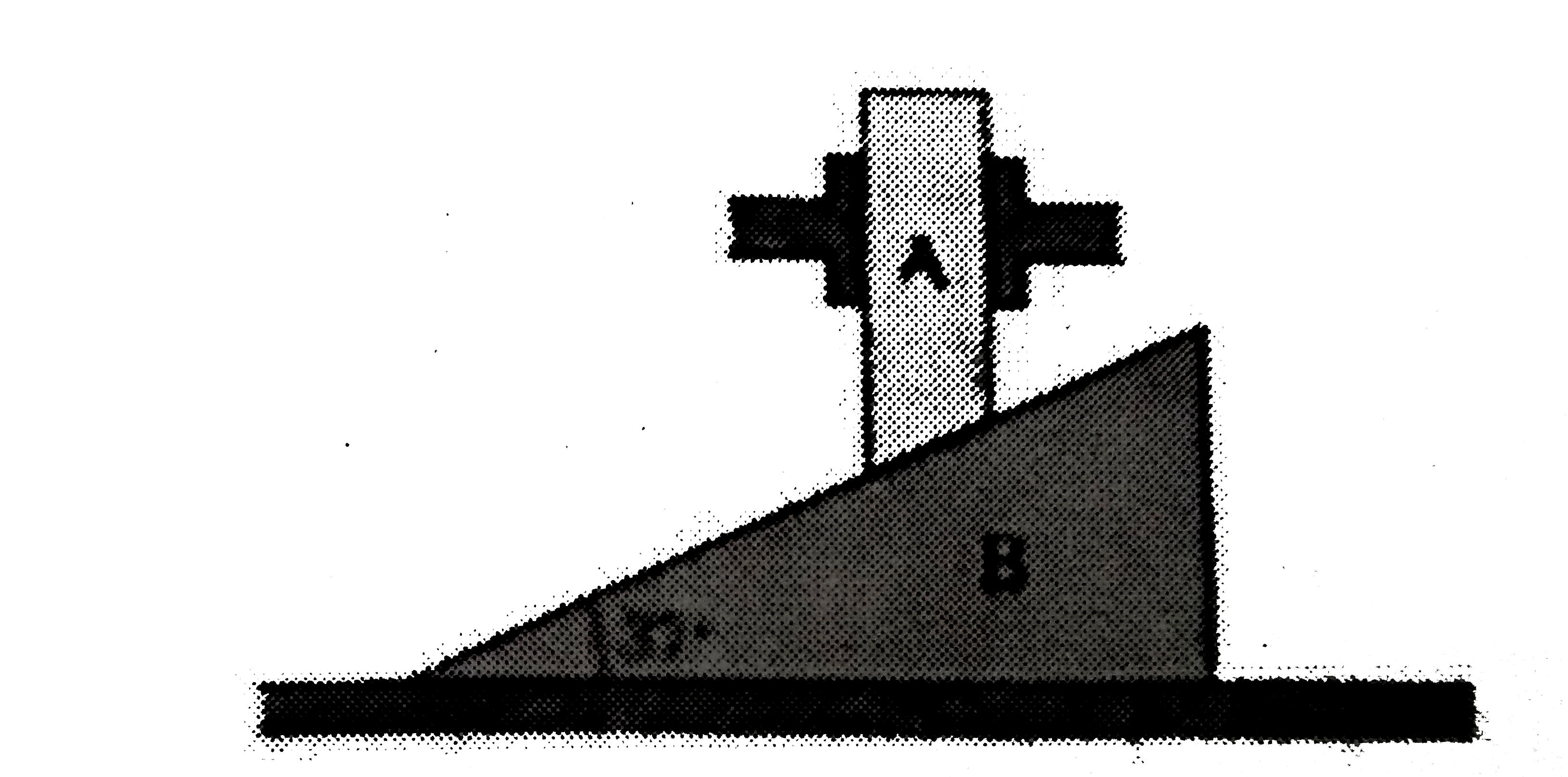
Rod A can slide in vertical direction pushing the triangular wedge B towards right. The wedge is moving toward right with uniform acceleration `a_(s).` Find acceleration of the rod A.

Text Solution

Verified by Experts

The correct Answer is:

`3a_(B)//4`
Promotional Banner

Topper's Solved these Questions

  • NEWTON'S LAWS OF MOTION & FRICTION

    ALLEN |Exercise EXERCISE (S-2)|9 Videos
  • NEWTON'S LAWS OF MOTION & FRICTION

    ALLEN |Exercise EXERCISE (O-1)|50 Videos
  • NEWTON'S LAWS OF MOTION & FRICTION

    ALLEN |Exercise EXERCISE (JA)|4 Videos
  • MOTION IN A PALNE

    ALLEN |Exercise SOLVED EXAMPLE|28 Videos
  • NEWTONS LAWS OF MOTION

    ALLEN |Exercise EXERCISE-III|28 Videos

Similar Questions

Explore conceptually related problems

A weightless inextensible rope rests on a stationary wedge forming an angle alpha with a horizontal One end of the rope is fixed to the wall to point A.A small load is attached to the rope at point B The wedge starts moving to the right with a constant acceleration a The acceleration of the load is given by .

A block A and wedge B connected through a string as shown. The wadge B is moving away from the wall with acceleration 2m//s^(2) horizonally and acceleration of block A is vertical upwards. Then

A thin rod of length 1 m is fixed in a vertical position inside a train, which is moving horizontally with constant acceleration 4 ms^(-2) .A bead can slide on the rod and friction coefficient between them is 0.5 . If the bead is released from rest at the top of the rod , it will reach the bottom in

When you are standstill holding a flag, the flag flutters in the direction of wind. When you start running the direction of fluttering of the flag changes to the direction of the wind relative to you. In all case a flag flutters in the direction of the wind relative to the flag. Winds is blowing uniformly due north everywhere with velocity 12 m/s. A car mounted with a flag starts running towards cast. after 9s from starts the flag flutters in 53^(@) north of west and after 16 s from the start the flag flutters in 37^(@) north of west. (a) Find velocity of the car 9 s after it starts. (b) Find velocity of the car 16 s after it starts. (c) If the car maintains uniform acceleration, find acceleration of the car.

A body is moving with velocity 30 m//s towards east. After 10 s its velocity becomes 40 m//s towards north. The average acceleration of the body is.

A man of mass 70 kg stands on a weighing scale in a lift which is moving (a) upwards with a uniform speed of 10 m s 1, (b) downwards with a uniform acceleration of 5 ms^(2) , (c) upwards with a uniform acceleration of 5 ms^(2) . What would be the readings on the scale in each case ? (d) What would be the reading if the lift mechanism failed and it hurtled down freely under gravity ?

Calculate the relative acceleration of A w.r.t. B if B is moving with acceleration a_(0) towards right.

A block of mass m is place on a sm ooth inclined wedge ABC of inclination 0 as shown in figure. The wedge is given an acceleration ‘a’ towards the right. The relation between a and theta for the block to rem ain stationary on the wedge is

In the figure shown S is a large nonconducting sheet of uniform charge density sigma . A rod R of length l and mass 'm' is parallel to the sheet and hinged at its mid point. The linear charge densities on the upper and lower half of the rod are shown in the figure. Find the angular acceleration of the rod just after it is released.

A 2 kg block A is attached to one end of a light string that passes over an an ideal pulley and a 1 kg sleeve B slides down the other part of the string with an acceleration of 5m//s^(2) with respect to the string. Find the acceleration of the block, acceleration of sleeve and tension in the steing. [g=10m//s^(2)]

ALLEN -NEWTON'S LAWS OF MOTION & FRICTION-EXERCISE (S-1)
  1. A 40 kg boy climbs a rope that passes over an ideal pulley. The other ...

    Text Solution

    |

  2. A 1kg block B rests as shown on a bracket A of same mass. Constant for...

    Text Solution

    |

  3. Find the reading of the massless spring balance in the given condition

    Text Solution

    |

  4. The system shown adjacent is in equilibrium. Find the acceleration of ...

    Text Solution

    |

  5. A block of mass m lies on wedge of mass. Mas shown in figure. Wit...

    Text Solution

    |

  6. The block A is moving downward with constant velocity v(0.) Find the v...

    Text Solution

    |

  7. Find force in newton which mass A exert on mass B if B is moving to wa...

    Text Solution

    |

  8. Rod A can slide in vertical direction pushing the triangular wedge B t...

    Text Solution

    |

  9. Calculate the relative acceleration of A w.r.t. B if B is moving with ...

    Text Solution

    |

  10. A block is placed on a rough horizontal plane. Three horizontalforces ...

    Text Solution

    |

  11. A force of 100 N is applied on a block of mass 3kg as shown below. The...

    Text Solution

    |

  12. Two trolleys A and B are moving with accelerations a and 2a, respectiv...

    Text Solution

    |

  13. A thin rod of length 1 m is fixed in a vertical position inside a trai...

    Text Solution

    |

  14. A block of mass m(1) = 1 kg is horizontally thrown with a velocity of ...

    Text Solution

    |

  15. A block of mass m lies on wedge of mass Mas shown in figure. Find the ...

    Text Solution

    |

  16. A block of mass 15 kg is resting on a rough inclined plane as shown in...

    Text Solution

    |

  17. In the figure, what should be mass m so that block A slides up with a ...

    Text Solution

    |

  18. Find the acceleration of the block and magnitude and direction of fric...

    Text Solution

    |

  19. Block M slides down on frictionless incline as shown. The minimum fric...

    Text Solution

    |

  20. Coefficient of friction between 5 kg and 10 kg block is 0.5. If fricti...

    Text Solution

    |
