Home
Class 12
PHYSICS
The coefficient of static and kinetic fr...

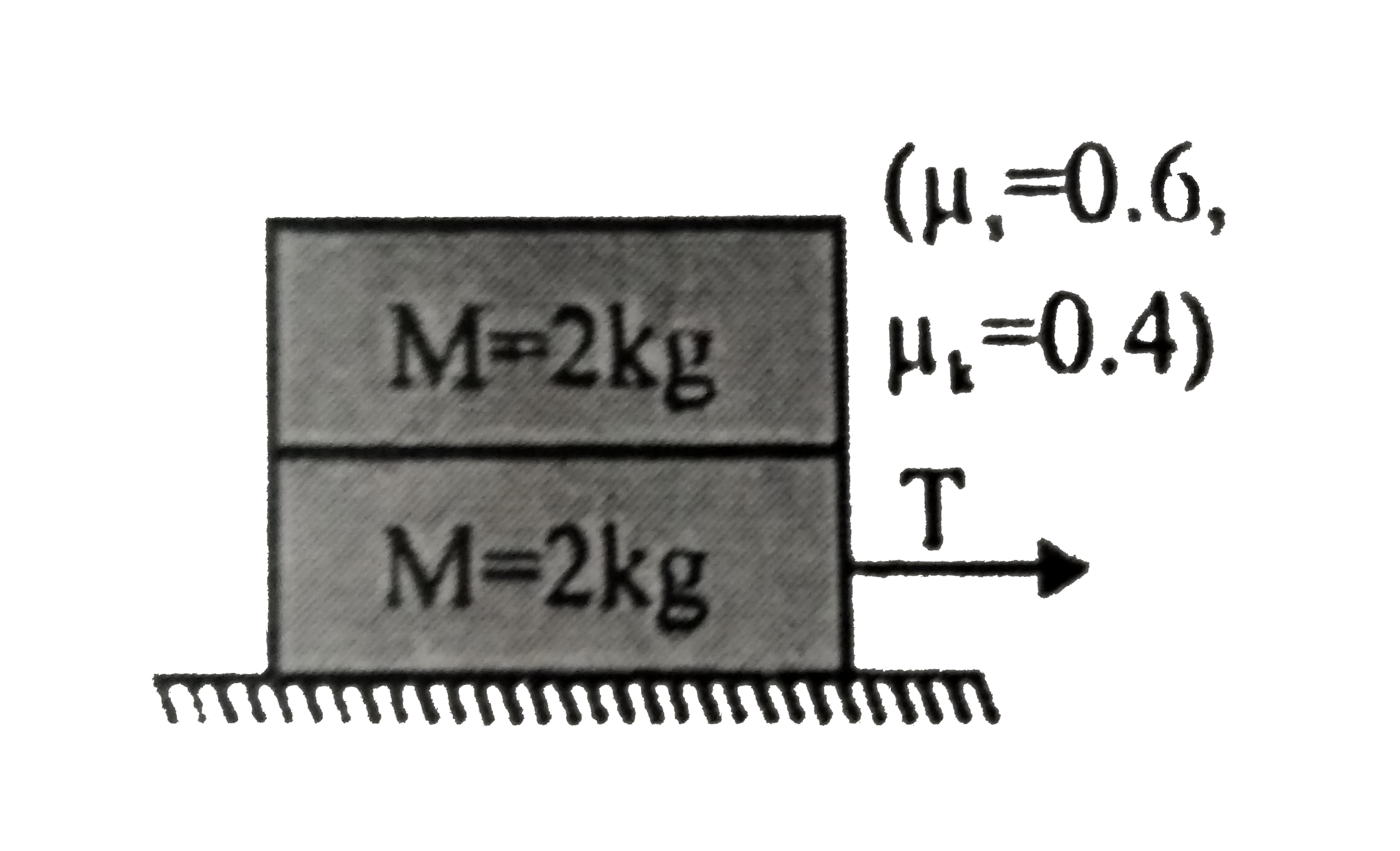
The coefficient of static and kinetic friction between the two blocks and also between the lower block and the ground are `mu_(s)=0.6 and mu_(k)=0.4` Find the value of tension T applied on the lower block at which the upper block begins to slip relative to lower block.

Text Solution

Verified by Experts

The correct Answer is:

40 N
Promotional Banner

Topper's Solved these Questions

  • NEWTON'S LAWS OF MOTION & FRICTION

    ALLEN |Exercise EXERCISE (O-1)|50 Videos
  • NEWTON'S LAWS OF MOTION & FRICTION

    ALLEN |Exercise EXERCISE (O-2)|31 Videos
  • NEWTON'S LAWS OF MOTION & FRICTION

    ALLEN |Exercise EXERCISE (S-1)|25 Videos
  • MOTION IN A PALNE

    ALLEN |Exercise SOLVED EXAMPLE|28 Videos
  • NEWTONS LAWS OF MOTION

    ALLEN |Exercise EXERCISE-III|28 Videos

Similar Questions

Explore conceptually related problems

In the figure shown if friction coefficient of block 1kg and 2kg with inclined plane is mu_(1)=0.5 and mu_(2)=0.4 respectively, then

Block A of mass 5kg is placed on long block B having a mass of 5kg . The coefficient of friction between two block is 0.4 . There is no friction between the ground and lower block. The upper block is given a sudden velocity of 10m//s . The upper block slides toward right, so friction force acting on it will be toward left. Its reaction wall act on the lower block, which will act forward . The friction force absorbs x mechanical energy from upper block but supply only y mechanical energy to lower block. Due to friction the velocity of upper block reduces and velocity of lower block increases. This will continue till velocity of both the block get equal. Which curve shows the correct variation of velocity of each block v//s time?

Block A of mass 5kg is placed on long block B having a mass of 5kg . The coefficient of friction between two block is 0.4 . There is no friction between the ground and lower block. The upper block is given a sudden velocity of 10m//s . The upper block slides toward right, so friction force acting on it will be toward left. Its reaction wall act on the lower block, which will act forward . The friction force absorbs x mechanical energy from upper block but supply only y mechanical energy to lower block. Due to friction the velocity of upper block reduces and velocity of lower block increases. This will continue till velocity of both the block get equal. The net energy loss due to friction in the entire process is

A block of mass 15 kg is placed on a long trolley. The coefficient of static friction between the block and the trolley is 0.18. The trolley accelerates from rest with 0.5 m s^(-2) for 20 s and then moves with uniform velocity. Discuss the motion of the block as viewed by (a) a stationary observer on the ground, (b) an observer moving with the trolley.

A block of mass 15 kg is placed on a long trolley. The coefficien t of static friction between the block and the trolley is 0.18. The trolley accelerates from rest with 0.5 ms^(2) for 20 s and then moves with uniform velocity. Discuss the motion of the block as viewed by (a) a stationary observer on the ground, (b) an observer moving with the trolley.

If coeffiecient of friction between the block of mass 2kg and table is 0.4 then out acceleration of the system and tension in the string. (g=10m//s^(2))

A block of mass m1 = 1 kg another mass m2 = 2 kg, are placed together (see figure) on an inclined plane with angle of inclination theta . Various values of theta are given in List I. The coefficient of friction between the block m_(1) and the plane is always zero. The coefficient of static and dynamic friction between the block m_(2) and the plane are equal to mu = 0.3 . In List II expressions for the friction on block m_(2) are given. Match the correct expression of the friction in List II with the angles given in List I, and choose the correct option. The acceleration due to gravity is denoted by g [Useful information : tan (5.5^(@)) ~~ 0.1, tan (11.5^(@)) ~~ 0.2 , tan (16.5^(@))~~ 0.3 ].

The coefficient of static friction, mu_(s) between block A of mass 2 kg and the table as shown in the figure is 0.2. What would be the maximum mass value of block B so that the two blocks do not move? The string and the pulley are assumed to be smooth and massless. (g=10m//s^(2))

The coefficient of static friction mu s, between block A of mass 2 kg and the table as shown in the figure is 0.2. What would be the maximum mass value of block B, so that two blocks do not move ? The string and the pully are assumed to be smooth and massless.
