Home
Class 12
PHYSICS
In the figure masses m(1),m(2) and M are...

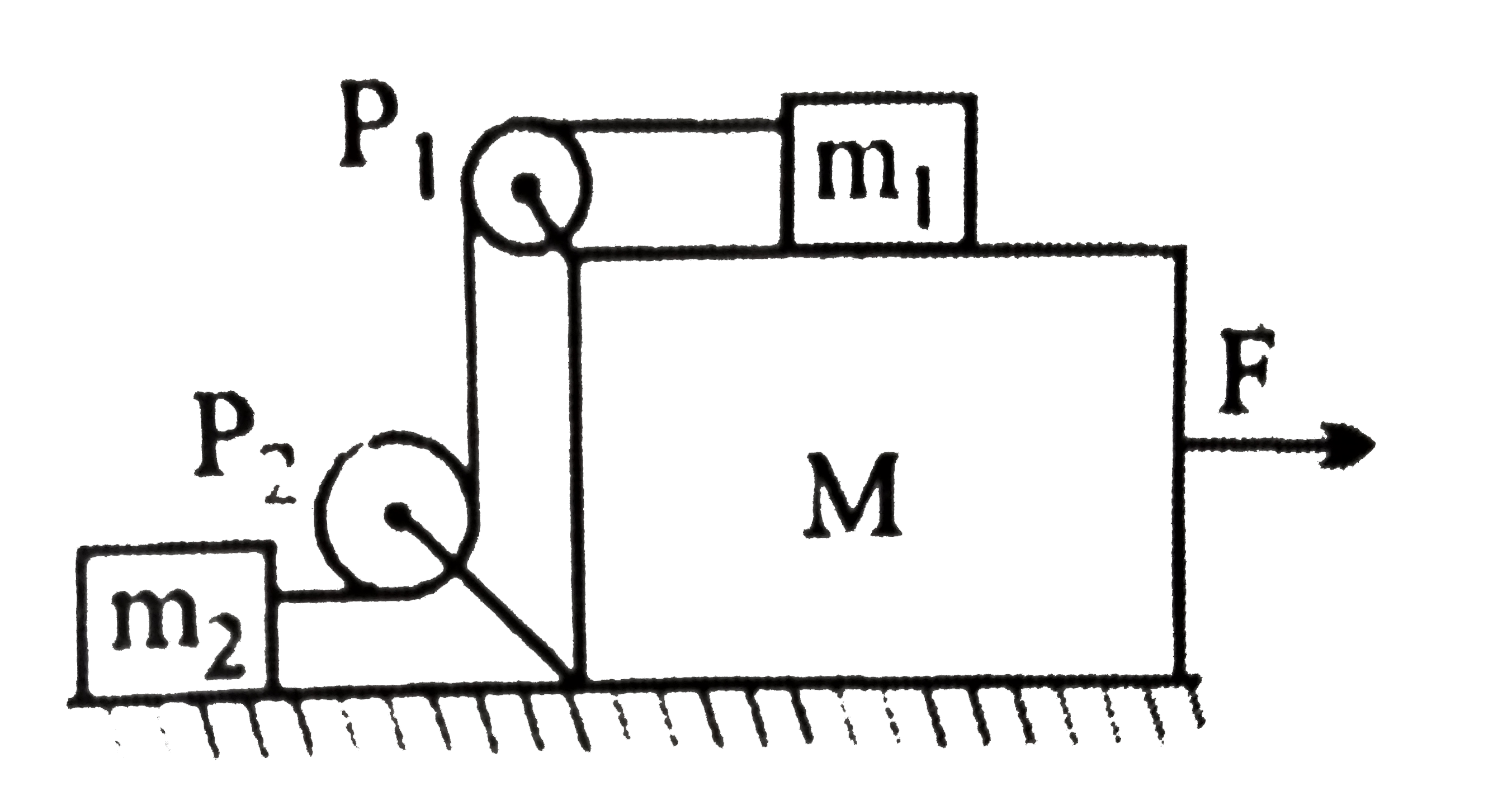
In the figure masses `m_(1),m_(2)` and M are kg. 5 kg and 50 kg respectively. The co-efficient of friction between M and ground is zero. The co-efficient of friction between `m_(1)` and M and that between `m_(2)` and ground is `0.3.` The pulleys and the string are massless. The string is perfectly horizontal between `P_(1) and m_(1)` and also between `P_(2) and m_(2).` The string is perfectly verticle between `P_(1) and P_(2).` An externam horizontal force F is applied to the mass M. Take `g=10m//s^(2).`

(i) Drew a free-body diagram for mass M, clearly showing all the forces.
(ii) Let the magnitude of the force of friction between `m_(1)` and M be `f_(1)` and that between `m,_(2)` and ground be `f_(2).` For a particular F it is found that `f_(1)=2f_(2).` Find `f_(1) and f_(2).` Write down equations of motion of all the masses. Find F, tension in the string and accelerations of the masses.

Text Solution

Verified by Experts

The correct Answer is:

`(##ALN_NC_PHY_NLMF_E02_008_A01##)`
(ii) `a=3//5m//s^(2),T=18N,F=60N`
Promotional Banner

Topper's Solved these Questions

  • NEWTON'S LAWS OF MOTION & FRICTION

    ALLEN |Exercise EXERCISE (O-1)|50 Videos
  • NEWTON'S LAWS OF MOTION & FRICTION

    ALLEN |Exercise EXERCISE (O-2)|31 Videos
  • NEWTON'S LAWS OF MOTION & FRICTION

    ALLEN |Exercise EXERCISE (S-1)|25 Videos
  • MOTION IN A PALNE

    ALLEN |Exercise SOLVED EXAMPLE|28 Videos
  • NEWTONS LAWS OF MOTION

    ALLEN |Exercise EXERCISE-III|28 Videos

Similar Questions

Explore conceptually related problems

When force F applied on m_(1) and there is no friction between m_(1) and surface and the coefficient of friction between m_(1)and m_(2) is mu. What should be the minimum value of F so that there is on relative motion between m_(1) and m_(2)

When force F applied on m_(2) and there is no friction between m_(1) and surface and the coefficient of friction between m_(1) and m_(2) is mu. What should be the minimum value of F so that there is no relative motion between m_(1) and m_(2)

If system is in equilibrium then find relation between m_(1) and m_(2)

In the coefficient of friction between the floor and the body B is 0.1. The coefficient of friction between the bodies B and A is 0.2. A force F is applied as shown on B. The mass of m A is 1/2 and of B is m. Which of the following statements are true ?

When force F applied on m_(1) and surface. Is mu_(1) and the coefficient of friction between m_(1) and m_(2) is mu_(2). What should be the minimum value of F so that there is no relative motion between m_(1) and m_(2).

If coeffiecient of friction between the block of mass 2kg and table is 0.4 then out acceleration of the system and tension in the string. (g=10m//s^(2))

Find the maximum velocity for the overturn of a car moving on a circular track of radius 100 m. The co-efficient of friction between the road and tyre is 0.2

If the string & all the pulleys are ideal, acceleration of mass m is :-

Two blocks of masses m_(1)=1 kg and m_(2)=2 kg are connected by a string and side down a plane inclined at an angle theta=45^(@) with the horizontal. The coefficient of sliding friction between m_(1) and plane is mu_(1)=0.4, and that between m_(2) and plane is mu_(2)=0.2. Calculate the common acceleration of the two blocks and the tension in the string.

In the figure shown a ring of mass M and a block of mass m are in equilibrium. The string is light and pulley P does not offer any friction and coefficient of friction between pole and M is mu. The frictional force offered by the pole to M is
