Home
Class 12
PHYSICS
A heavy cart is pulled by a constant for...

A heavy cart is pulled by a constant force F along a horizontal track with the help of a rope that passes over a fixed pulley, as shown in the figure. Assume the tension in the rope and the frictional forces on the cart remain constant and consider motion of the cart until it reaches vertically below the pulley. As the cart moves to the right, its acceleration

A

decreases.

B

increases.

C

remains constant.

D

is zero

Text Solution

Verified by Experts

The correct Answer is:

A
Promotional Banner

Topper's Solved these Questions

  • NEWTON'S LAWS OF MOTION & FRICTION

    ALLEN |Exercise EXERCISE (O-2)|31 Videos
  • NEWTON'S LAWS OF MOTION & FRICTION

    ALLEN |Exercise EXERCISE (JM)|6 Videos
  • NEWTON'S LAWS OF MOTION & FRICTION

    ALLEN |Exercise EXERCISE (S-2)|9 Videos
  • MOTION IN A PALNE

    ALLEN |Exercise SOLVED EXAMPLE|28 Videos
  • NEWTONS LAWS OF MOTION

    ALLEN |Exercise EXERCISE-III|28 Videos

Similar Questions

Explore conceptually related problems

A uniform rope of mass (m) and length (L) placed on frictionless horizontal ground is being pulled by two forces F_(A) and F_(B) at its ends as shown in the figure. As a result, the rope accelerates toward the right. Tension (T) at the mid point of the rope is

A block of mass M is pulled along a horizontal frictionless surface by a rope of mass m as shown in A horizontal force F is applied to one end of the rope. Find (a) the acceleration of the rope and block (b) the force that the rope exerts on the block (c) the tension in the rope at its mid point

A car P is moving with a uniform speed 5sqrt3 m//s towards a carriage of mass 9 kg at rest kept on the rails at a point B as shown in figure. The height AC is 120 m. Cannon balls of 1 kg are fired from the car with an initial velocity 100m//s at an angle 30^@ with the horizontal. The first cannon hall hits the stationary carriage after a time t_0 and sticks to it. Determine t_0 . At t_0 , the second cannon ball is fired. Assume that the resistive force between the rails and the carriage is constant and ignore the vertical motion of the carriage throughout. If the second ball also hits and sticks to the carriage, what will be the horizontal velocity of the carriage just after the second impact?

A uniform rope of mass (m) and length (L) placed on frictionless horizontal ground is being pulled by two forces F_(A) and F_(B) at its ends as shown in the figure. As a result, the rope accelerates toward the right. Acceleration (A) of the rope is

A uniform rope of mass (m) and length (L) placed on frictionless horizontal ground is being pulled by two forces F_(A) and F_(B) at its ends as shown in the figure. As a result, the rope accelerates toward the right. Expression T_(x) of tension at a point at distance x from the end A is

A circus wishes to develop a new clown act. Fig. (1) shows a diagram of the proposed setup. A clown will be shot out of a cannot with velocity v_(0) at a trajectory that makes an angle theta=45^(@) with the ground. At this angile, the clown will travell a maximum horizontal distance. The cannot will accelerate the clown by applying a constant force of 10, 000N over a very short time of 0.24s . The height above the ground at which the clown begins his trajectory is 10m . A large hoop is to be suspended from the celling by a massless cable at just the right place so that the clown will be able to dive through it when he reaches a maximum height above the ground. After passing through the hoop he will then continue on his trajectory until arriving at the safety net. Fig (2) shows a graph of the vertical component of the clown's velocity as a function of time between the cannon and the hoop. Since the velocity depends on the mass of the particular clown performing the act, the graph shows data for serveral different masses. If the angle the cannot makes with the horiaontal is increased from 45^(@) , the hoop will have to be

When a jet of liquid strikes a fixed or moving surface, it exerts thrust on it due to rate of change of momentum. F=(rhoAV_(0))V_(0)-(rhoAV_(0))V_(0)costheta=rhoAV_(0)^(2)[1-costheta] If surface is free and starts moving due to thrust of the liquid, then at any instant, the above equation gets modified based on relative change of momentum with respect to surface. Let, at any instant, the velocity of surface be u . Then the above equation becomes F=rhoA(V_(0)-u)^(2)[1-costheta] Based on the above concept, as shown in the following figure, if the cart is frictionless and free to move in the horizontal direction, then answer the following. Given that cross sectional area of jet =2xx10^(-4)m^(2) velocity of jet V_(0)=10m//s density of liquid =1000kg//m^(3) ,mass of cart M=10 kg . Initially ( l=0 ) the force on the cart is equal to

A steel rope has length L area of cross-section A young's modulus Y [density =d] (i) it is pulled on a horizotnal fritionless floor with a constant horizontal force F=|dALg|//2 applied at one end find the strain at the midpoint. (ii). If the steel rope is vertical and moving with the force acting vertically up at the upper end find the strain at distance L/3 from lowerr end.

A frame of reference that is accelerated with respect to an inertial frame of reference is called a non-inertial frame of reference. A coordinate system fixed on a circular disc rotating about a fixed axis with a constant angular velocity omega is an example of non=inertial frame of reference. The relationship between the force vecF_(rot) experienced by a particle of mass m moving on the rotating disc and the force vecF_(in) experienced by the particle in an inertial frame of reference is vecF_(rot)=vecF_(i n)+2m(vecv_(rot)xxvec omega)+m(vec omegaxx vec r)xxvec omega . where vecv_(rot) is the velocity of the particle in the rotating frame of reference and vecr is the position vector of the particle with respect to the centre of the disc. Now consider a smooth slot along a diameter fo a disc of radius R rotating counter-clockwise with a constant angular speed omega about its vertical axis through its center. We assign a coordinate system with the origin at the center of the disc, the x-axis along the slot, the y-axis perpendicular to the slot and the z-axis along the rotation axis (vecomega=omegahatk) . A small block of mass m is gently placed in the slot at vecr(R//2)hati at t=0 and is constrained to move only along the slot. The distance r of the block at time is

A frame of reference that is accelerated with respect to an inertial frame of reference is called a non-inertial frame of reference. A coordinate system fixed on a circular disc rotating about a fixed axis with a constant angular velocity omega is an example of non=inertial frame of reference. The relationship between the force vecF_(rot) experienced by a particle of mass m moving on the rotating disc and the force vecF_(in) experienced by the particle in an inertial frame of reference is vecF_(rot)=vecF_(i n)+2m(vecv_(rot)xxvec omega)+m(vec omegaxx vec r)xxvec omega . where vecv_(rot) is the velocity of the particle in the rotating frame of reference and vecr is the position vector of the particle with respect to the centre of the disc. Now consider a smooth slot along a diameter fo a disc of radius R rotating counter-clockwise with a constant angular speed omega about its vertical axis through its center. We assign a coordinate system with the origin at the center of the disc, the x-axis along the slot, the y-axis perpendicular to the slot and the z-axis along the rotation axis (vecomega=omegahatk) . A small block of mass m is gently placed in the slot at vecr(R//2)hati at t=0 and is constrained to move only along the slot. The distance r of the block at time is

ALLEN -NEWTON'S LAWS OF MOTION & FRICTION-EXERCISE (O-1)
  1. In the arrangement shown, the blocks of unequal masses are held at res...

    Text Solution

    |

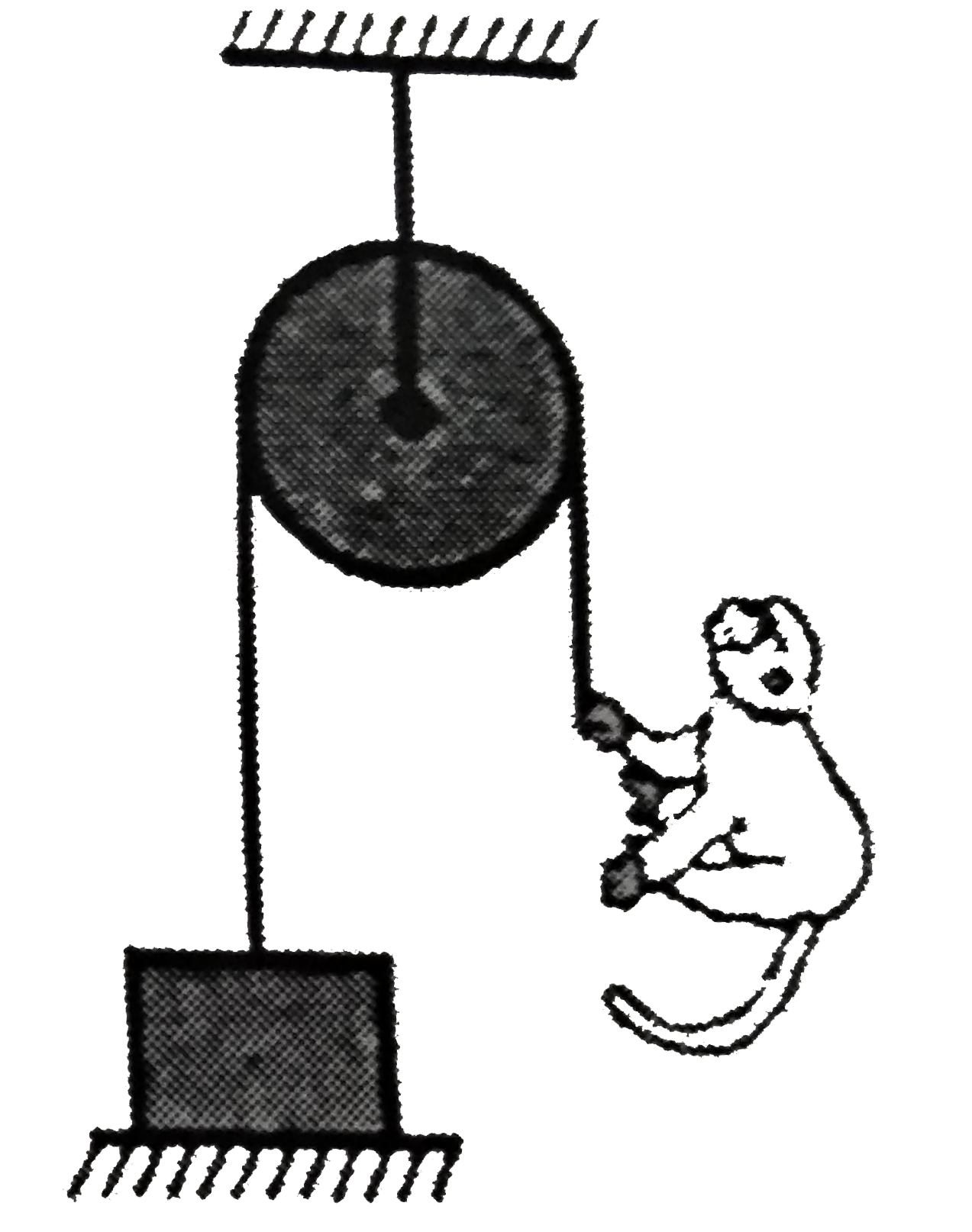
  2. A monkey weighing 10 kg climbing up a light rope and frictionless pull...

    Text Solution

    |

  3. A heavy cart is pulled by a constant force F along a horizontal track ...

    Text Solution

    |

  4. In arrangement shown the block A of mass 15 kg supported in equilibriu...

    Text Solution

    |

  5. In the given figure, Find mass of the block A, if it remains at rest, ...

    Text Solution

    |

  6. In the arrangement shown, the 2 kg block is held to keep the system at...

    Text Solution

    |

  7. A string of negligible mass going over a clamped puley of mass m suppo...

    Text Solution

    |

  8. Block A is moving away from the wall at a speed v and acceleration a.

    Text Solution

    |

  9. In the setup shown, fird acceleration of the block C.

    Text Solution

    |

  10. A block of mass 2 kg is kept on a rough horizontal floor an pulled wit...

    Text Solution

    |

  11. In the figure shown a ring of mass M and a block of mass m are in equi...

    Text Solution

    |

  12. A force barF=hati+4hatj acts on block shown. The force of friction act...

    Text Solution

    |

  13. Block B of mass 100 kg rests on a rough surface of friction coeffcient...

    Text Solution

    |

  14. A block of mass 3kg is at rest on a rough inclined plan as shown in th...

    Text Solution

    |

  15. A block of mass m=2kg is resting on a rough inclined plane of inclinat...

    Text Solution

    |

  16. In the figure shown if friction coefficient of block 1kg and 2kg with ...

    Text Solution

    |

  17. A block is pushed with some velocity up a rough inclined plane. It sto...

    Text Solution

    |

  18. A system is pushed by a force F as shown in figure All surfaces are sm...

    Text Solution

    |

  19. Refer the system shown in the figure. Block is siding down the wedge. ...

    Text Solution

    |

  20. A block of mass 1 kg is held at rest against a rough vertical surface ...

    Text Solution

    |
