Home
Class 12
PHYSICS
In the figure, F(1) " and " F(2), the tw...

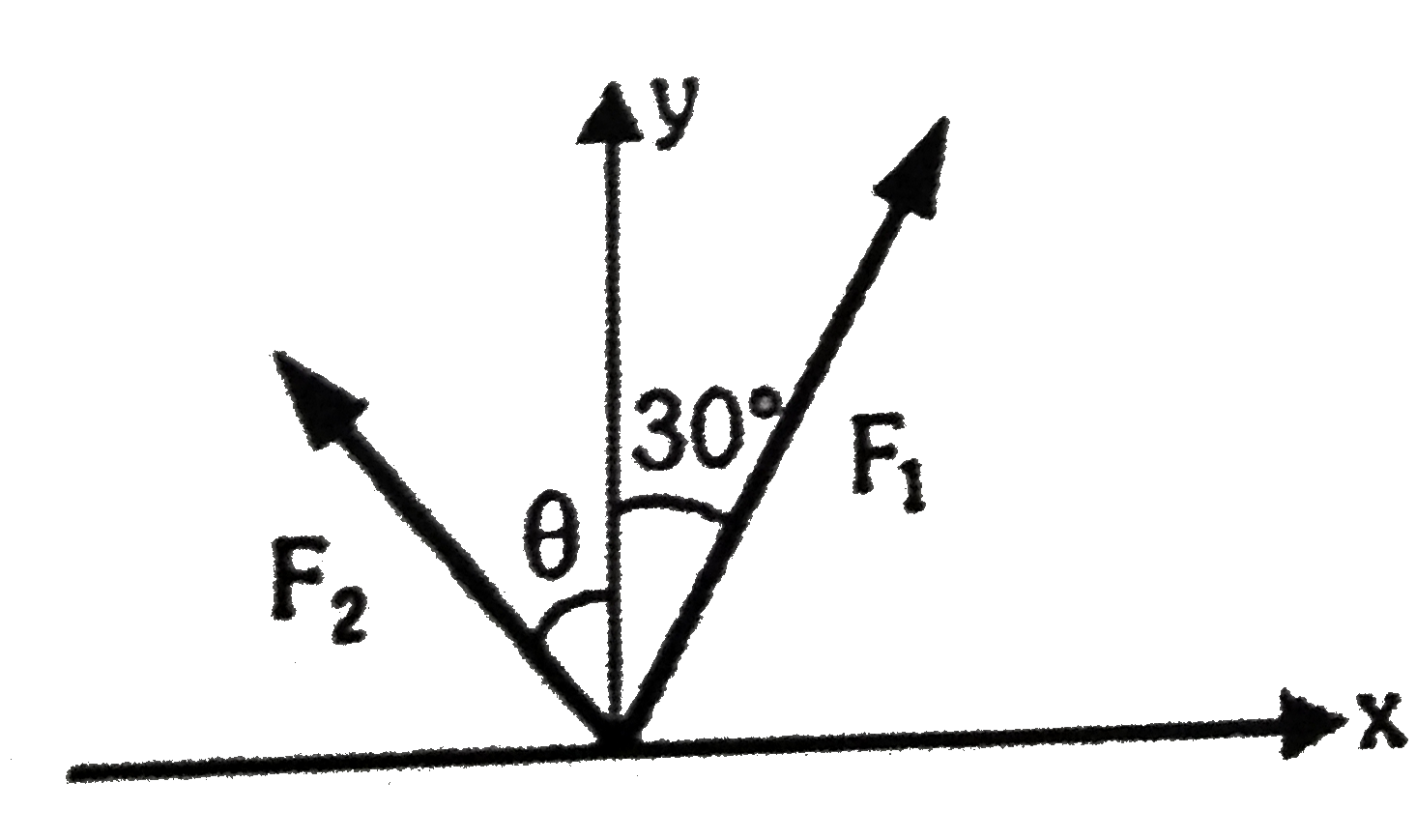
In the figure, `F_(1) " and " F_(2)`, the two unkown forces give a resultant force of `80sqrt(3)N` along the y-axis. It is required that `F_(2)` must have minimum magnitude. Find tht magnitude of `F_(1)` and `F_(2)`

Text Solution

Verified by Experts

The correct Answer is:

160N, `80N`
Promotional Banner

Topper's Solved these Questions

  • UNIT & DIMENSIONS, BASIC MATHS AND VECTOR

    ALLEN |Exercise Exercise (O-1) Single Correct Type Questions.|37 Videos
  • UNIT & DIMENSIONS, BASIC MATHS AND VECTOR

    ALLEN |Exercise Exercise (O-1) Multiple Correct Type Questions.|3 Videos
  • UNIT & DIMENSIONS, BASIC MATHS AND VECTOR

    ALLEN |Exercise Exercise (S-1)|22 Videos
  • TEST PAPERS

    ALLEN |Exercise MATHS|1 Videos
  • WAVE OPTICS

    ALLEN |Exercise Exercise 2 (Previous Year Questions)|7 Videos

Similar Questions

Explore conceptually related problems

Three forces acting on a body are shown in figure. To have the resultant force only along the y-directon, the magnitude of the minimum additional force needed along OX is

At what angle should the two forces vectors 2F and sqrt(2) F act so that the resultant force is sqrt(10)F

Two force F_(1)" and "F_(2) are acting on a body. One force is double that of the other force and the resultant is equal to the greater force. Then the angle between the two forces is :-

Three ant P,Q and R are pulling a grain with forces of magnitude 6N,3sqrt(3) N " and " 3sqrt(2)N as shown in the figure. Find the magnitude of resultant force (in N ) acting on the grain .

Assertion :- when two non parallel forces F_(1) and F_(2) act on a body. The magnitude of the resultant force acting on the is less than the "sum" of F_(1) and F_(2) Reason :- In a triangle, any side is less then the "sum" of the other two sides.

A particle of mass m rests on a horizontal floor with which it has a coefficient of static friction mu . It is desired to make the body move by applying the minimum possible force F. Find the magnitude of F and the direction in which it has to be applied.

A particle of mass m rests on a horizontal floor with which it has a coefficient of static friction mu . It is desired to make the body move by applying the minimum possible force F. Find the magnitude of F and the direction in which it has to be applied.

Two forces, each of magnitude F have a resultant of the same magnitude F. The angle between the two forces is

There are four forces acting at a point P produced by strings as shown in figure. Which is at rest ? Find the forces F_(1) and F_(2) .

A particle is dropped along the axis from a height (f)/(2) on a concave mirror of focal length f as shown in figure. Find the maximum speed of image .
