Home
Class 12
PHYSICS
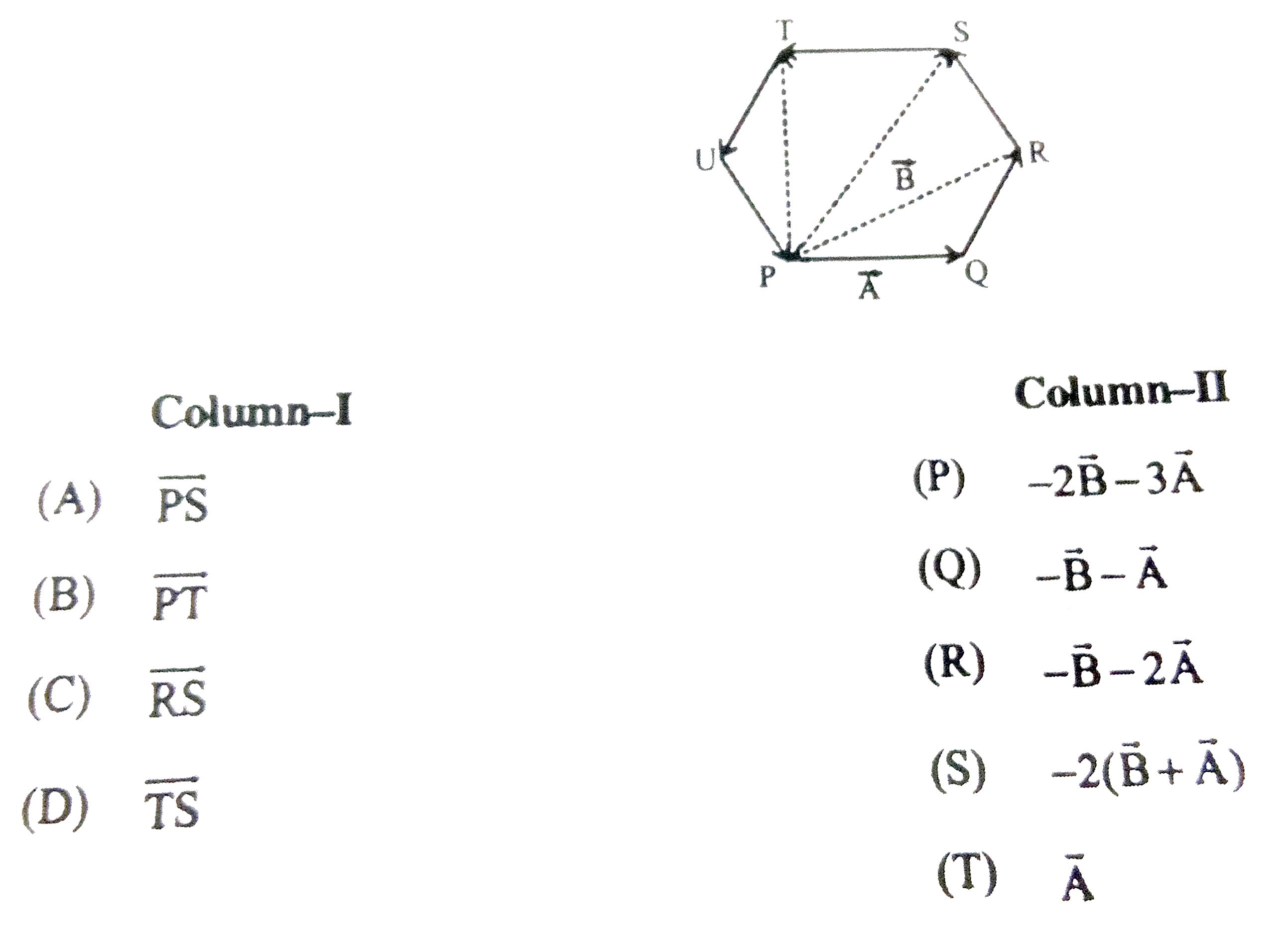
In a regular hexagon two vec(PQ)=vecA, ...

In a regular hexagon two `vec(PQ)=vecA, vec(RP)=vecB`. Express other vectors's in term of them :-

Text Solution

Verified by Experts

The correct Answer is:

(A)-(S);(B)-(P);(C)-(R);(D)-(T)
Promotional Banner

Topper's Solved these Questions

  • UNIT & DIMENSIONS, BASIC MATHS AND VECTOR

    ALLEN |Exercise Exercise (O-2) Single Correct Type Questions.|17 Videos
  • UNIT & DIMENSIONS, BASIC MATHS AND VECTOR

    ALLEN |Exercise Exercise (O-2) Multiple Correct Type Questions.|7 Videos
  • UNIT & DIMENSIONS, BASIC MATHS AND VECTOR

    ALLEN |Exercise Exercise (O-1) ParagraphType Questions.|2 Videos
  • TEST PAPERS

    ALLEN |Exercise MATHS|1 Videos
  • WAVE OPTICS

    ALLEN |Exercise Exercise 2 (Previous Year Questions)|7 Videos

Similar Questions

Explore conceptually related problems

In a regular hexagon ABCDEF, vec(AE)

In a regular hexagon ABCDEF, vec(AB)=a, vec(BC)=b and vec(CD) = c. Then, vec(AE) =

If ABCDEF is a regular hexagon then vec(AD)+vec(EB)+vec(FC) equals :

In a regular hexagon ABCDEF, vec(AB) +vec(AC)+vec(AD)+ vec(AE) + vec(AF)=k vec(AD) then k is equal to

If vec(a) and vec(b) are the vectors determined by two adjacent sides of a regular hexagonn ABCDEF. What are the vectors determined by the other sides taken in order ?

Keeping one vector constant, if direction of other to be added in the first vector is changed continuously, tip of the resultant vector describes a circles, In the following figure vector vec(a) is kept constant. When vector vec(b) addede to vec(a) changes its direction, the tip of the resultant vector vec(r)=vec(a)+vec(b) describes circles of radius b with its centre at the tip of vector vec(a) . Maximum angle between vector vec(a) and the resultant vec(r)=vec(a)+vec(b) is

If P(-1,2) and Q(3,-7) are two points, express the vector PQ in terms of unit vectors hati and hatj also, find distance between point P and Q. What is the unit vector in the direction off PQ?

Consider two points P and Q with position vectors vec(OP)=3veca-2vecb and vec(OQ)=veca+vecb . Find the position vector of a point R which divides the line joining P and Q in the ratio 2:1 , (i) intermally , and (ii) externally.

Figure shows three vectors vec(a), vec(b) and vec(c) , where R is the midpoint of PQ. Then which of the following relations is correct?

Let vec(a),vec(b) and vec( c ) be three vectors such that |vec(a)|=3,|vec(b)|=4,|vec( c )|=5 and each one the them being perpendicular to the sum of the other two, find |vec(a)+vec(b)+vec( c )| .
