Home
Class 12
PHYSICS
Show a vector veca at angle theta as sho...

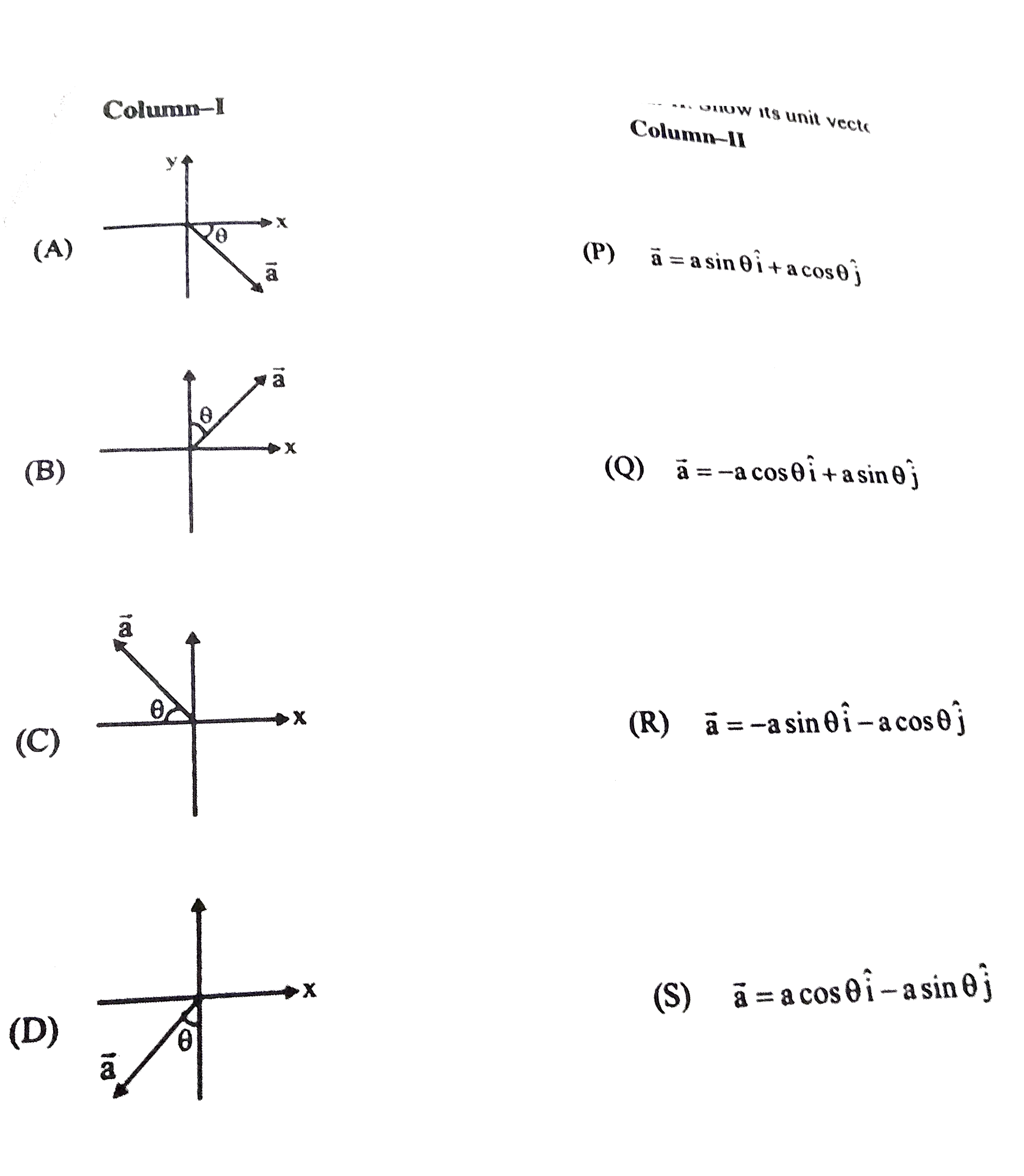
Show a vector `veca` at angle `theta` as shown in the figure column-II. Shows its unit vector representation.

Text Solution

Verified by Experts

The correct Answer is:

(A)-(S);(B)-(P);(C)-(Q);(D)-(R)
Promotional Banner

Topper's Solved these Questions

  • UNIT & DIMENSIONS, BASIC MATHS AND VECTOR

    ALLEN |Exercise Exercise (O-2) Single Correct Type Questions.|17 Videos
  • UNIT & DIMENSIONS, BASIC MATHS AND VECTOR

    ALLEN |Exercise Exercise (O-2) Multiple Correct Type Questions.|7 Videos
  • UNIT & DIMENSIONS, BASIC MATHS AND VECTOR

    ALLEN |Exercise Exercise (O-1) ParagraphType Questions.|2 Videos
  • TEST PAPERS

    ALLEN |Exercise MATHS|1 Videos
  • WAVE OPTICS

    ALLEN |Exercise Exercise 2 (Previous Year Questions)|7 Videos

Similar Questions

Explore conceptually related problems

Two vectors vecP and vecQ are inclined to each other at angle theta . Which of the following is the unit vector perpendicular to vecP and vecQ ?

Let vec a= hat i be a vector which makes an angle of 120^@ with a unit vector vec b in XY plane. then the unit vector (vec a+ vec b) is

Column-I show vector diagram relating three vectors veca, vecb " and " vecc . Match the vector equation in column -II, with vector diagram in column-I:

If hatn is a unit vector in the direction of the vector vecA , then hatn is

If veca and vecb are two unit vectors and theta is the angle between them, then the unit vector along the angular bisector of veca and vecb will be given by

Let vec(a) and vec(b) be two unit vectors and theta is the angle between them. Then vec(a)+vec(b) is a unit vector if ……….

A vector of length l is turned through the angle theta about its tail. What is the change in the position vector of its head ?

Keeping one vector constant, if direction of other to be added in the first vector is changed continuously, tip of the resultant vector describes a circles, In the following figure vector vec(a) is kept constant. When vector vec(b) addede to vec(a) changes its direction, the tip of the resultant vector vec(r)=vec(a)+vec(b) describes circles of radius b with its centre at the tip of vector vec(a) . Maximum angle between vector vec(a) and the resultant vec(r)=vec(a)+vec(b) is
