Home
Class 12
MATHS
A bead is moving on a frictionless fixed...

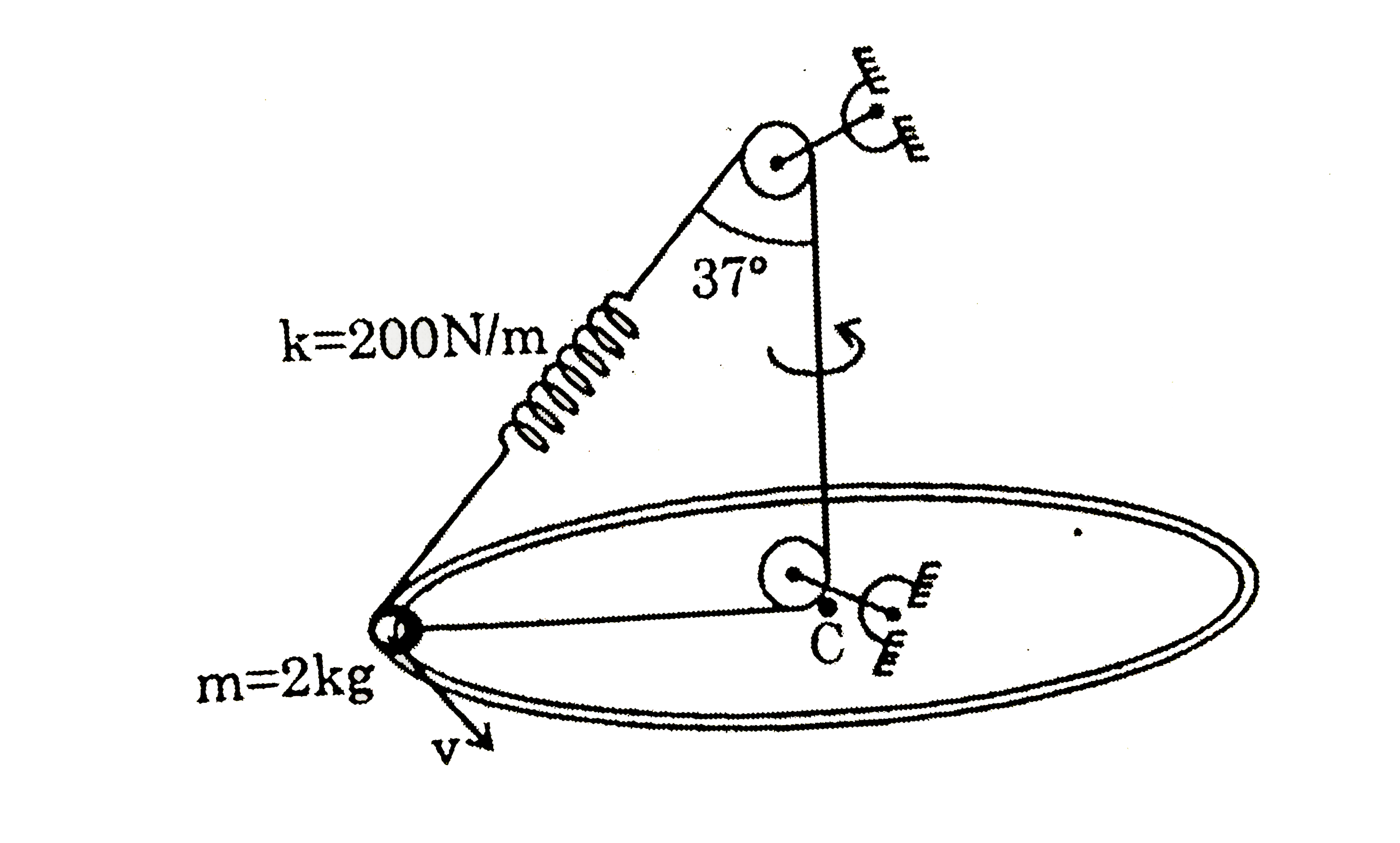
A bead is moving on a frictionless fixed circular wire of radius 0.8 m in horizontal plane with constant speed & there is no interaction force between bead & wire & it is also connected with string & spring .

A

Speed of bead is 4m/sec

B

Elongation in spring is 10 cm

C

If we cut the string , normal force due to wire on bead is `20sqrt5N`.

D

If we cut the spring , normal force due to wire is `20sqrt5N`.

Text Solution

Verified by Experts

The correct Answer is:

A,C,D
Promotional Banner

Topper's Solved these Questions

  • TEST PAPER

    ALLEN |Exercise PHYSICS SECTION-II|16 Videos
  • TEST PAPER

    ALLEN |Exercise CHEMISTRY SECTION-I|20 Videos
  • TEST PAPER

    ALLEN |Exercise MATHEMATICS|34 Videos
  • SEQUENCE AND PROGRESSION

    ALLEN |Exercise Exercise (JA)|10 Videos
  • TEST PAPERS

    ALLEN |Exercise MATHEMATICS|136 Videos

Similar Questions

Explore conceptually related problems

A bob of mass m is attached at one end of a string of length l other end of the string is fixed at point O . Bob is rotating in a circular path of radius l in horizontal plane about O with constant speed v , as shown in the figure. The average force exterted by string on the bob during its :- (A) half revolution will be (mv^(2))/(pil) (B) half revolution will be (2mv^(2))/(pil) (C) one fourth revolution will be (sqrt2mv^(2))/(pil) (D) one revolution will be zero Select correct alternative :-

A block of mass m lies on a horizontal frictionless surface and is attached to one end of a horizontal spring (with spring constant k ) whose other end is fixed . The block is intinally at rest at the position where the spring is unstretched (x=0) . When a constant horizontal force vec(F) in the positive direction of the x- axis is applied to it, a plot of the resulting kinetic energy of the block versus its position x is shown in figure. What is the magnitude of vec(F) ?

A block of mass m lies on a horizontal frictionless surface and is attached to one end of a horizontal spring (with spring constant k ) whose other end is fixed . The block is intinally at rest at the position where the spring is unstretched (x=0) . When a constant horizontal force vec(F) in the positive direction of the x- axis is applied to it, a plot of the resulting kinetic energy of the block versus its position x is shown in figure. What is the magnitude of vec(F) ?

A cyclist moving on level circular path of radius 4 m with speed of 4.9 m/s takes sharp turn. Co-efficient of friction between tyre and road will b e .......

A stone of mass 0.25 kg tied to the end of a string is whirled round in a circle of radius 1.5 m with a speed of 40 rev./min in a horizontal plane. What is the tension in the string ? What is the maximum speed with which the stone can be whirled around if the string can withstand a maximum tension of 200 N ?

A stone of of mass 0 .25 kg tied to the end of a string is whirled round in a circle of radius 1.5 m with a speed of 40 rev//min in a horizontal plane What is the tension in the string ? What is the maximum speed with which the stone can be whirled around If the string can withstand a maximum tension of 200 N ?

A stone is tied at end of string and whirled in horizontal plane with circular path of radius 20 cm. If its acceleration is 980 cms^(-2) , then what will be its angular speed ?

A bead is arranged to move with constant speed around a loop that lies in a vetical plane. The magnitude of the net force on the bead is

In a body A of mass tn slides on plane inclined at angle theta_(1) , to the horizontal and p is the coefficent of friction between A and the plane. A is connected by a light string passing over a frictionless pulley to another body B, also of mass m, sliding on a frictionless plane inclined at an angle theta_(2) to the horizontal. Which of the following statements are true ?

Two blocks of equal mass m are connected by an unstretched spring and the system is kept at rest on a frictionless horizontal surface. A constant force F is applied on the first block pulling away from the other as shown in Fig. If the extension of the spring is x_(0) at time t , then the displacement of the first block at this instant is

ALLEN -TEST PAPER-PHYSICS SECTION-I
  1. Given arrangement is in equilibrium and elongation in spring is 1cm. T...

    Text Solution

    |

  2. Net force acting on a particle is always perpendicular to its velocity...

    Text Solution

    |

  3. Two blocks on horizontal ground are connected by a spring. At an insta...

    Text Solution

    |

  4. A bead is moving on a frictionless fixed circular wire of radius 0.8 m...

    Text Solution

    |

  5. Choose the CORRECT statements

    Text Solution

    |

  6. A particle stays at rest as seen in frame. Then which of the following...

    Text Solution

    |

  7. In the List-I some arrangement with ideal string & frictionless & ligh...

    Text Solution

    |

  8. Figure shows a practical situation.The event is observed by four obser...

    Text Solution

    |

  9. In the given figure

    Text Solution

    |

  10. Study the velocity-time graph pictured below and match each segment of...

    Text Solution

    |

  11. If x=a+bt+ct^2 , where x is length and t is time then a,b and c respec...

    Text Solution

    |

  12. If vecA=3hati+4hatj, vecB=6hati+8hatj and vecC=15/sqrt2(hati-hatk) the...

    Text Solution

    |

  13. If two vectors are parallel vectors then :

    Text Solution

    |

  14. There are two vectors vecA and vecB then component of vecA in the dire...

    Text Solution

    |

  15. If force F, density D and area A are taken as fundamental quantities t...

    Text Solution

    |

  16. Which of the following operations is not possible ?

    Text Solution

    |

  17. Which set of magnitude of vectors can give null vector ?

    Text Solution

    |

  18. A particle moves 30m in east and 40 m in north then ratio of magnitude...

    Text Solution

    |

  19. In a new system, unit of mass, length and time is 2kg, 2m and 4sec res...

    Text Solution

    |

  20. In the equation Y=C/K e^((KV-1)) , Y is length and V is velocity then ...

    Text Solution

    |
