Home
Class 12
MATHS
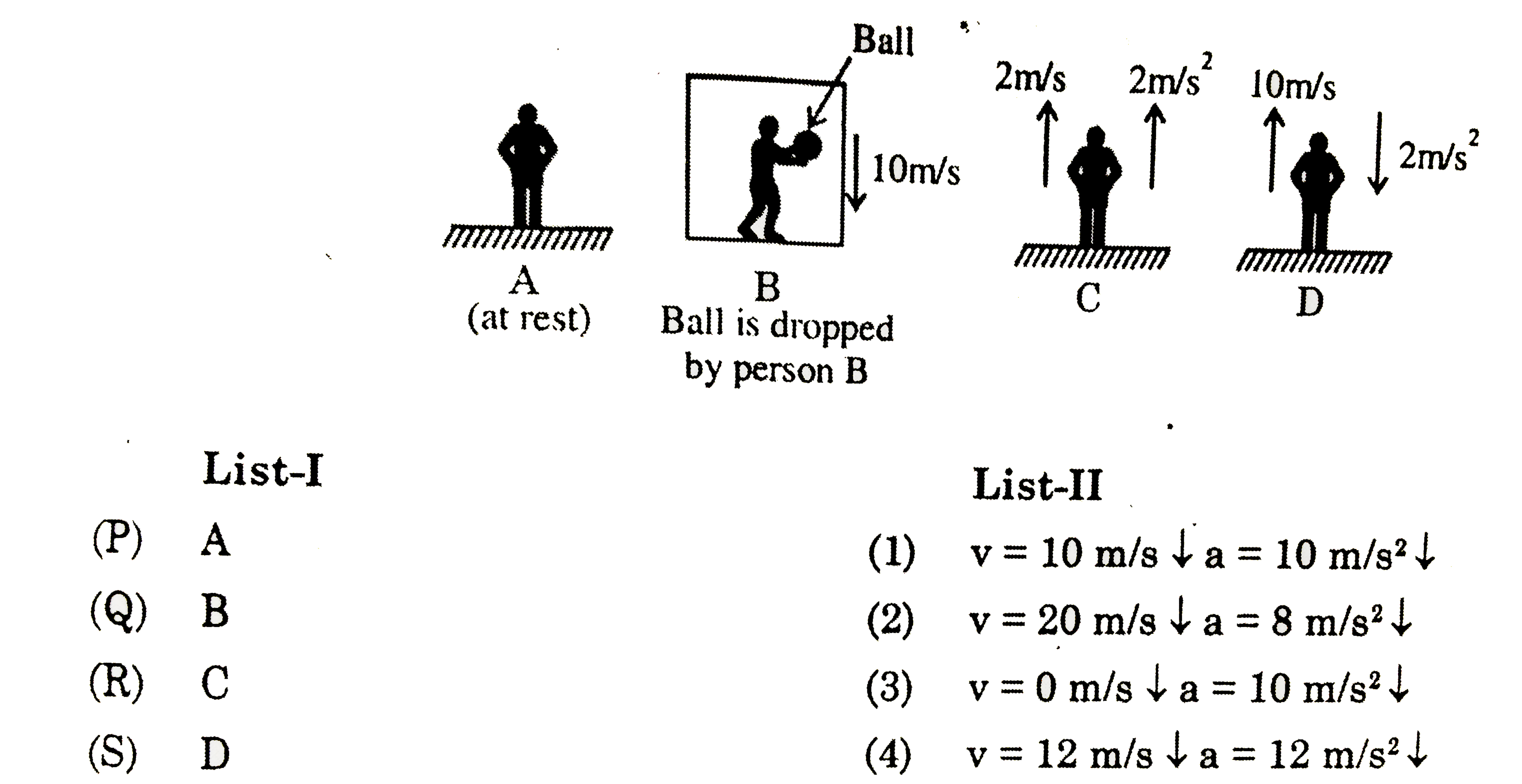
Figure shows a practical situation.The e...

Figure shows a practical situation.The event is observed by four observer.List-II gives the value of acceleration and intial velocity of ball as observed by observer given in List-I .
Match them correctly : -`(g=10 m//s)^2`

A

P`to`1, Q`to`3 , R`to`2, S`to`4

B

P`to`2, Q`to`3 , R`to`4, S`to`1

C

P`to`1, Q`to`3 , R`to`4, S`to`2

D

P`to`4, Q`to`3 , R`to`1, S`to`2

Text Solution

Verified by Experts

The correct Answer is:

C
Promotional Banner

Topper's Solved these Questions

  • TEST PAPER

    ALLEN |Exercise PHYSICS SECTION-II|16 Videos
  • TEST PAPER

    ALLEN |Exercise CHEMISTRY SECTION-I|20 Videos
  • TEST PAPER

    ALLEN |Exercise MATHEMATICS|34 Videos
  • SEQUENCE AND PROGRESSION

    ALLEN |Exercise Exercise (JA)|10 Videos
  • TEST PAPERS

    ALLEN |Exercise MATHEMATICS|136 Videos

Similar Questions

Explore conceptually related problems

A ball is thrown upward from edge of a cliff with an intial velocity of 6 m/s. How fast is it moving 1/2 s later ? (g=10 m/s^(2))

A ball is thrown upward from edge of a cliff with an intial velocity of 8 m/s. How fast is it moving half second later ? (g=10 m/s^(2))

An object falling through a fluid is observed to have acceleration given by a = g - bv where g = gravitational acceleration and b is constant. After a long time of release, it is observed to fall with constant speed. What must be the value of constant speed ?

An aqueous solution of X is added slowly to an aqueous solution of Y as shown in List-I. The variation in conductivity of these reactions is given in List-II. Match List-I with List-II and select the correct answer using the code given below the lists: {:(List-I,List-II),((P)(C_(2)H_(5))_(3)N +CH_(3)COOH,(1)"Conductivity decreases adn then increases"),(" X Y",),((Q)KI(0.1M)+AgNO_(3)(0.01M),(2)"Conductivity decreases and then does not change much"),(" X Y",),((R)CH_(3)COOH+KOH,(3)"Conductivity increases and then does not change much"),(" X Y",),((S)NaOH+Hi,(4)"Conductivity does not change much and then increases"),(" X Y",):} Codes:

A player throwsa a ball upwards with an initial speed of 29.4 ms^(-1) . (i) What is the direction of acceleration during the upwared motion of the ball? (ii) What are the velocity and acceleration of the ball at the highest point of its motion? (iii) Choose the x=0 and t=0 to be the location and time of the ball at its highest point, vertically downward direction to be the positive direction of X-axis, and give the signs of positive, velocity and acceleration of the ball during its upward, and downward motion. (iv) To what height does the ball rise and after how long does the ball return to the player's hand?( Take g =9.8 ms^(-2) , and neglect air resistance).

A player throws a ball upwards with an initial speed of 29.4 ms^(-1) (a) What is the direction of acceleration during the upward motion of the ball ? (b) What are the velocity and acceleration of the ball at the highest point of its motion ? (c) Choose the x = 0 m and t=0 s to be the location and time of the ball at its highest point vertically downward direction to be the positive direction of x-axis and give the signs of position, velocity and acceleration of the ball during its upward and downward motion. (d) To what height does the ball rise and after how long does the ball return to the player's hands ? (Take g = 9.8 ms^(-2) and neglect air resistance).

An observer is travelling in east with a velocity of 2 m/s and observes that wind is blowing in north with a velocity of 2m/s. If observer doubles his velocity then find out the velocity of wind appears to observer ?

Four physical quantities are listed in column I. Their values are listed in column II in random order. Match the column correctly.

A small ball is prjected along the surface of a smooth inclined plane with speed 10m/s along the direction shown at t = 0. The point of projection is origin, z-axis is along vertical. The acceleration due to gravity is 10m//s^(2) . Column-I lists values of certain parameters related to motion of ball and column-II lists different time instants. Match appropriately.

When a particle is undergoing motion, the diplacement of the particle has a magnitude that is equal to or smaller than the total distance travelled by the particle. In many cases the displacement of the particle may actually be zero, while the distance travelled by it is non-zero. Both these quantities, however depend on the frame of reference in which motion of the particle is being observed. Consider a particle which is projected in the earth's gravitational field, close to its surface, with a speed of 100sqrt(2) m//s , at an angle of 45^(@) with the horizontal in the eastward direction. Ignore air resistance and assume that the acceleration due to gravity is 10 m//s^(2) . Consider an observer in frame D (of the previous question), who observes a body of mass 10 kg acelerating in the upward direction at 30 m//s^(2) (w.r.t. himself). The net force acting on this body, as observed from the ground is :-

ALLEN -TEST PAPER-PHYSICS SECTION-I
  1. Given arrangement is in equilibrium and elongation in spring is 1cm. T...

    Text Solution

    |

  2. Net force acting on a particle is always perpendicular to its velocity...

    Text Solution

    |

  3. Two blocks on horizontal ground are connected by a spring. At an insta...

    Text Solution

    |

  4. A bead is moving on a frictionless fixed circular wire of radius 0.8 m...

    Text Solution

    |

  5. Choose the CORRECT statements

    Text Solution

    |

  6. A particle stays at rest as seen in frame. Then which of the following...

    Text Solution

    |

  7. In the List-I some arrangement with ideal string & frictionless & ligh...

    Text Solution

    |

  8. Figure shows a practical situation.The event is observed by four obser...

    Text Solution

    |

  9. In the given figure

    Text Solution

    |

  10. Study the velocity-time graph pictured below and match each segment of...

    Text Solution

    |

  11. If x=a+bt+ct^2 , where x is length and t is time then a,b and c respec...

    Text Solution

    |

  12. If vecA=3hati+4hatj, vecB=6hati+8hatj and vecC=15/sqrt2(hati-hatk) the...

    Text Solution

    |

  13. If two vectors are parallel vectors then :

    Text Solution

    |

  14. There are two vectors vecA and vecB then component of vecA in the dire...

    Text Solution

    |

  15. If force F, density D and area A are taken as fundamental quantities t...

    Text Solution

    |

  16. Which of the following operations is not possible ?

    Text Solution

    |

  17. Which set of magnitude of vectors can give null vector ?

    Text Solution

    |

  18. A particle moves 30m in east and 40 m in north then ratio of magnitude...

    Text Solution

    |

  19. In a new system, unit of mass, length and time is 2kg, 2m and 4sec res...

    Text Solution

    |

  20. In the equation Y=C/K e^((KV-1)) , Y is length and V is velocity then ...

    Text Solution

    |
