Home
Class 12
PHYSICS
Match List-I with List-II and select the...

Match List-I with List-II and select the correct answer by using the codes given below the lists

A

potential at its surface is `150 V`

B

the charge on the sphere is `(5//3)xx10^(-10)C`

C

the electric field on the surface is `1500 V//m`

D

the electric potential at its centre is `225 V`

Text Solution

Verified by Experts

The correct Answer is:

A, C, D

Potential at 5 cm from surface`=(KQ)/(R+5)=100`
Potential at `10` cm from surface
`=(KQ)/(R+10)=75 rArr R=10` cm.
`:.` Potential at surface `=(KQ)/(R)=(100xx15)/10=150 V`
Electric field on surface`=(KQ)/R^(2)=(100xx15Vxxcm)/(100 cm^(2))`
`=1500 V//m`
Promotional Banner

Topper's Solved these Questions

Similar Questions

Explore conceptually related problems

Match List I with List II and select the correct answer using the codes given below the lists :

An aqueous solution of X is added slowly to an aqueous solution of Y as shown in List-I. The variation in conductivity of these reactions is given in List-II. Match List-I with List-II and select the correct answer using the code given below the lists: {:(List-I,List-II),((P)(C_(2)H_(5))_(3)N +CH_(3)COOH,(1)"Conductivity decreases adn then increases"),(" X Y",),((Q)KI(0.1M)+AgNO_(3)(0.01M),(2)"Conductivity decreases and then does not change much"),(" X Y",),((R)CH_(3)COOH+KOH,(3)"Conductivity increases and then does not change much"),(" X Y",),((S)NaOH+Hi,(4)"Conductivity does not change much and then increases"),(" X Y",):} Codes:

Match List I with List II and select the correct answer using the codes given below the lists: {:(,"List I",,,"List II"),(P.,"Boltzmann constant",,1.,[ML^(2)T^(-1)]),(Q.,"Coefficient of viscosity",,2.,[ML^(-1)T^(-1)]),(R.,"Planck constant",,3.,[MLT^(-3)K^(-1)]),(S.,"Thermal conductivity",,4.,[ML^(2)T^(-2)K^(-1)]):}

Four charges Q_(1), Q_(2), Q_(3) and Q_(4) oof same magnitude are fixed along the x axis at x=-2a, -a, +a and +2a , respectively. A positive charge q is placed on the positive y axis at a distance b gt 0 . Four options of the signs of these charges are given in List I. The direction of the forces on the charge q is given in List II. Match List I with List II and select the correct answer using the code given below the lists. {:(,"List-I",,,"List-II"),((P),Q_(1)","Q_(2)","Q_(3)","Q_(4) "all positive",,(1),+x),((Q),Q_(1)","Q_(2) " positive, "Q_(3)","Q_(4)" negative",,(2),-x),((R),Q_(1)","Q_(4)" positive ,"Q_(2)","Q_(3)" negative",,(3),+y),((S),Q_(1)","Q_(3)" positive , "Q_(2)","Q_(4)" negative",,(4),-y):}

Match list I with II and select the correct answer :

A right angled prism of refractive index mu_(1) is placed in a rectangular block of refractive index mu_(2) , which is surrounded by a medium of refractive index mu_(3) ,as shown in the figure . A ray of light 'e' enters the rectangular block at normal incidence . depending upon the relationship between mu_(1) , mu_(2) "and" mu_(3) , it takes one of the four possible paths 'ef' , 'eg' , 'eh' or 'ef' Match the paths in List I with conditions of refractive indices in List II and select the correct answer using the codes given below the lists: {:("List" I , "List" II) , ( P. e rarr f , 1. mu_(1)gt sqrt(2mu_(2))) , ( Q. e rarr g , 2. mu_(2) gt mu_(1) "and" mu_(2) gt mu_(3)), ( R. e rarr f , 3. mu_(1) = mu_(2)), ( S. e rarr f , 4. mu_(2) lt mu_(1) lt sqrt(2mu_(2)) "and" mu_(2) gt mu_(3)):} Codes : {:( P , Q , R , S) , ((A) 2 , 3 , 1 , 4), ((B) 1 , 2 , 4 , 3) , ((C) 4 , 1 , 2 , 3) , ((D) 2, 3 , 4 , 1):}

Four combinations of two thin lenses are given in List I . The radius of curvature of all curved surfaces is r and the refractive index of all the lenses is 1.5 Match lens combinations in List I with their focal length in List II and select the correct answer using the code given below the lists. (A) (p) 2 r (B) (q) ( r)/(2) ( C) (r) - r (D) (s) r . Code :

One mole of a monatomic ideal gas is taken along two cyclic processes E to F to G to E and E to F to H to E as shown in the PV diagram. The processes involved are purely isochoric , isobaric , isothermal or adiabatic . Match the paths in List I with the magnitudes of the work done in List II and select the correct answer using the codes given below the lists.

Match the chemical conversion in List-I with the approprotae reagents in List-II and select the correct answer using the code given below this list- ,

ALLEN -BASIC MATHS-Exercise-02
  1. The fundamental quantity which has the same power in the dimensional f...

    Text Solution

    |

  2. The ratio of one micron to one nanometre is

    Text Solution

    |

  3. The equation of a wave is given by Y = A sin omega ((x)/(v) - k), wher...

    Text Solution

    |

  4. Find Dimensional formula of impulse.

    Text Solution

    |

  5. The time dependence of a physical quantity P is given by P=P(0) exp (-...

    Text Solution

    |

  6. Find the dimensional formula of pressure.

    Text Solution

    |

  7. Find the dimensional formula of Moment if inertia.

    Text Solution

    |

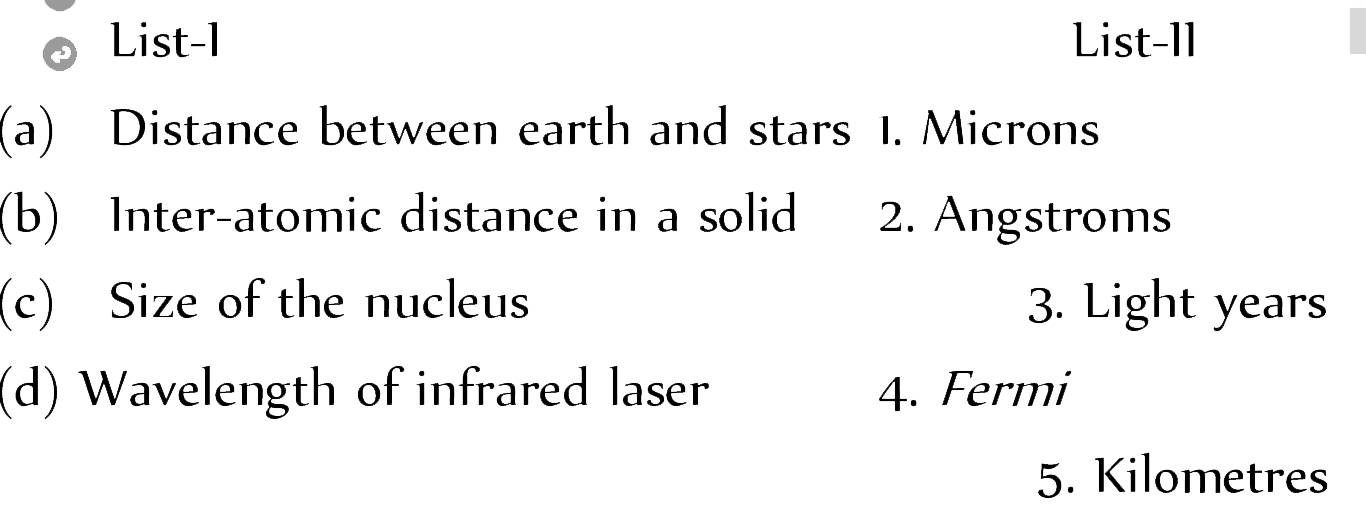
  8. Match List-I with List-II and select the correct answer by using the c...

    Text Solution

    |

  9. Which of the following is not the unit of time

    Text Solution

    |

  10. Which of the following is smallest unit?

    Text Solution

    |

  11. Find the dimensional formula of surface tension.

    Text Solution

    |

  12. The dimensional formula of angular velocity is

    Text Solution

    |

  13. If A and B are two physical quantities having different dimensions the...

    Text Solution

    |

  14. The dimensional formula of product and quotient of two physical quanti...

    Text Solution

    |

  15. Find the dimensional formula of surface energy.

    Text Solution

    |

  16. Force on a particle in one-dimensional motion is given by F=Av+Bt+(Cx)...

    Text Solution

    |

  17. Find the dimensional formula of the stress.

    Text Solution

    |

  18. Dimensional formula for latent heat is

    Text Solution

    |

  19. The radiation emitted per unit time by unit area of a black body at te...

    Text Solution

    |

  20. In the formula X=3YZ^(2), X and Z have dimensions of capacitance and m...

    Text Solution

    |
