Home
Class 12
PHYSICS
On an open ground, a motorist follows a ...

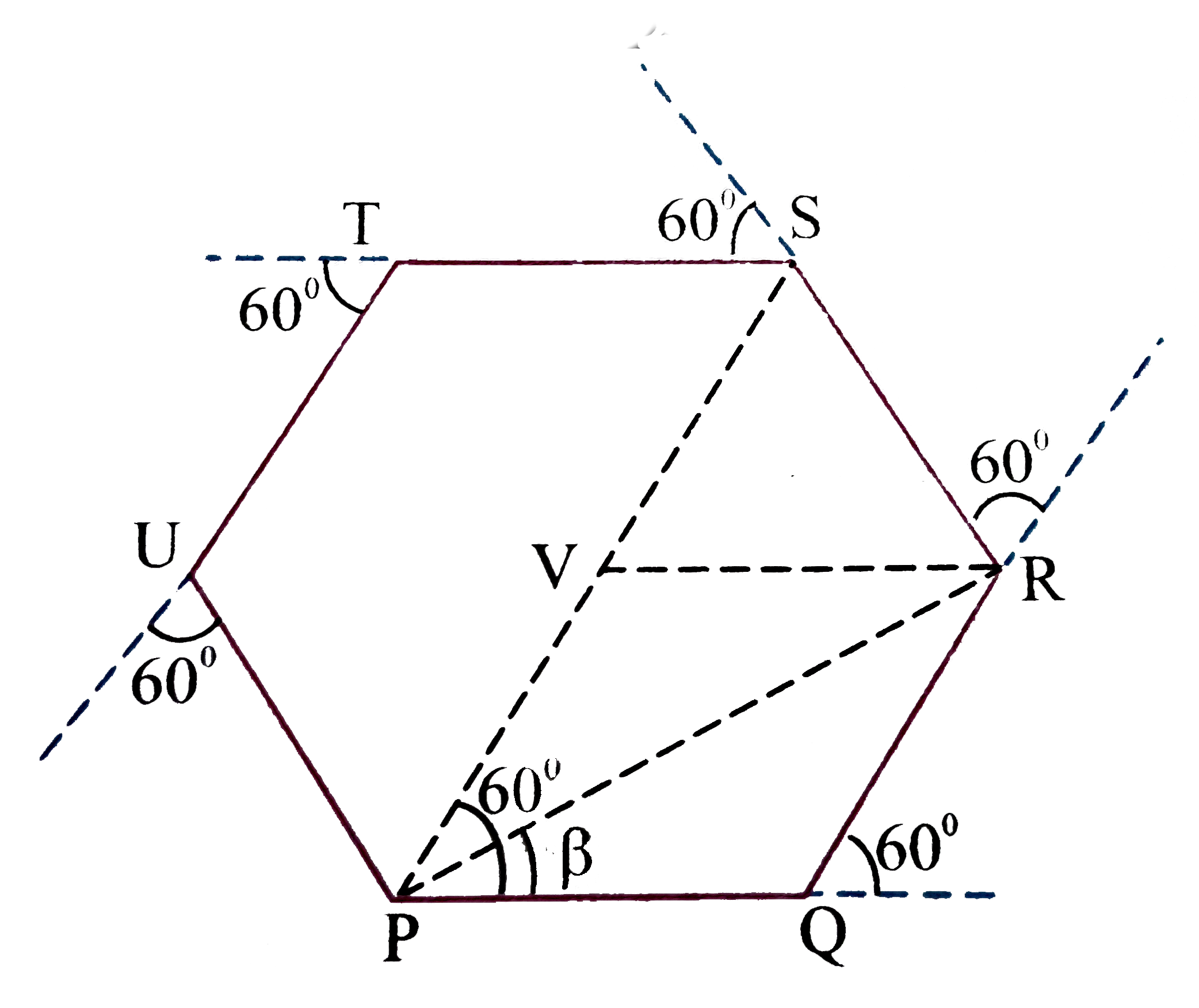
On an open ground, a motorist follows a track that turns to his left by an angle of `60^(@)` after every `500 m`. Starting from a given turn, The path followed by the motorist is a regular hexagon with side `500 m`, as shown in the given figure specify the displacement of the motorist

at the end of sixth turn.

Text Solution

Verified by Experts
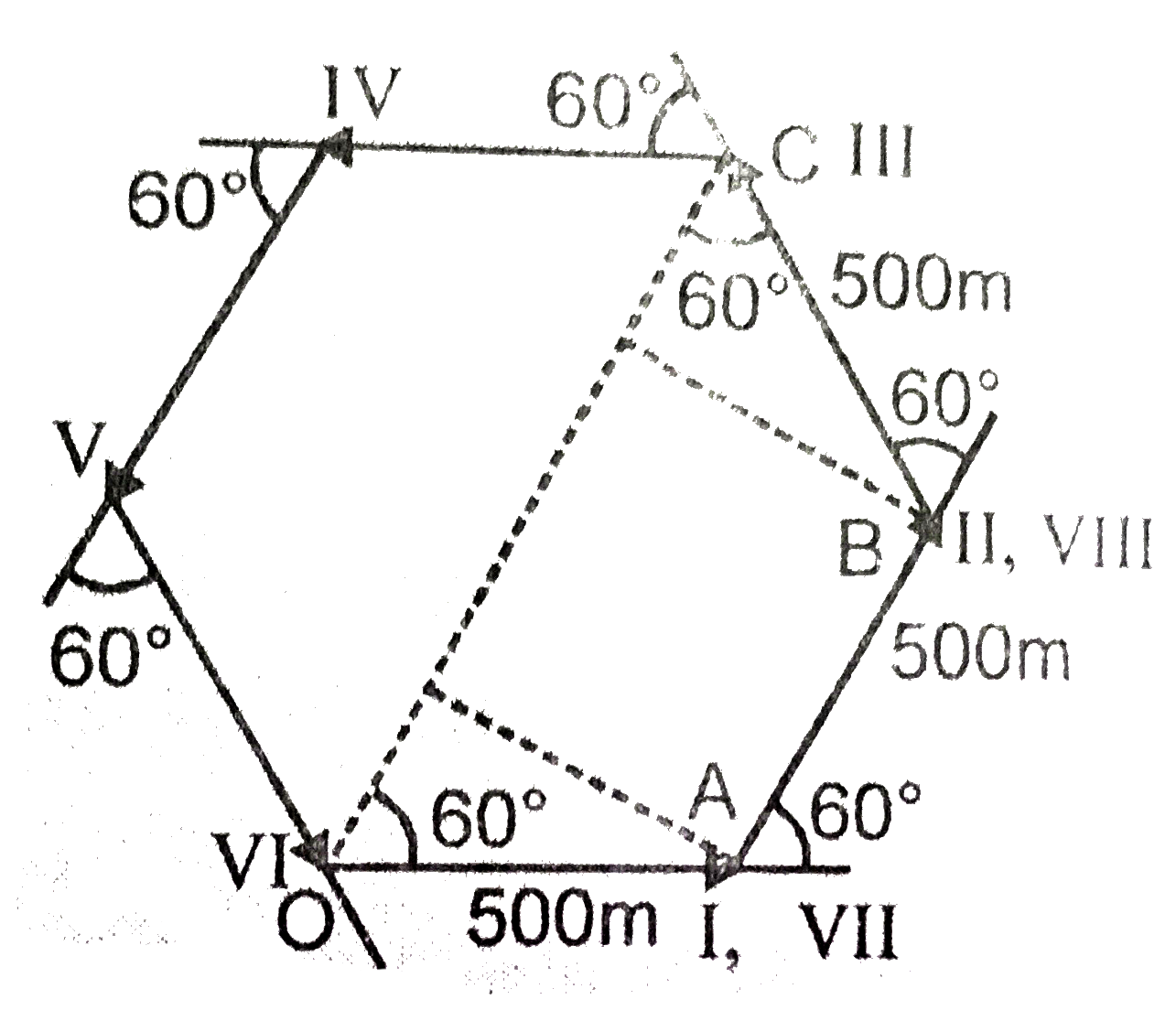
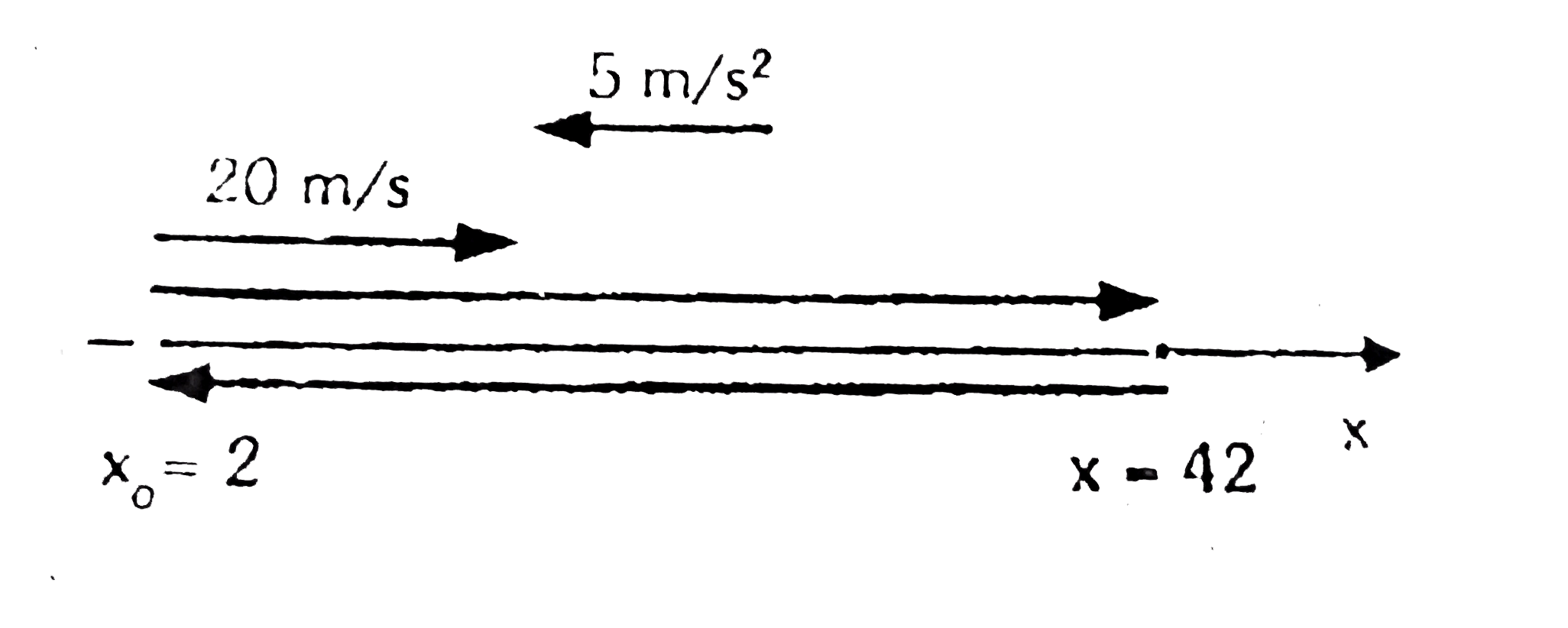
In the adjoining figure the given and required information shown are not to a scale. As motion diagram is a schematic representation only.
(a) Using the third equation of uniform acceleration motion, we have
`v_(t)^(2)=v_(o)^(2)+2a(x_(t)-x_(o))rarr a=(v_(t)^(2)-v_(o)^(2))/(2(x_(t)-x_(o)))=(10^(2)-20^(2))/(2(32-2))=-5 m//s^(2)`

(b) Using second equation of uniform acceleration motion, we have
`x_(t)=x_(o)+v_(o)t+1/2 at^(2) rarr x_(8)=2+20xx8+1/2 (-5)8^(2)=2 m`
Using the first equation of uniform acceleration motion, we have
`v_(t)=v_(o)+at rarr v_(8)=20+(-5)xx8=-20 m//s`
(c) Where the particle returns, its velocity must be zero. Using the third equation of uniform acceleration motion, we have
`v^(@)=v_(o)^(2)+2a(x-x_(o)) rarr x=x_(o)+(v^(2)-v_(o)^(2))/(2a)=2+(0-20^(2))/(2(-5))=42 m`
This location is shown in the adjoining modified motion diagram.
The distance `Deltas` is `Deltas=|x-x_(o)|+|x_(o)-x|=80 m`
Promotional Banner

Topper's Solved these Questions

  • MOTION IN A PALNE

    ALLEN |Exercise EXERCISE-02|37 Videos
  • MOTION IN A PALNE

    ALLEN |Exercise EXERCISE-03|6 Videos
  • KINEMATICS-2D

    ALLEN |Exercise Exercise (O-2)|47 Videos
  • NEWTON'S LAWS OF MOTION & FRICTION

    ALLEN |Exercise EXERCISE (JA)|4 Videos

Similar Questions

Explore conceptually related problems

On an open ground , a motorist follows a track that turns to his left by an angle of 60^(@) after every 500 m. Starting from a given turn , specify the displacement of of the motorist at the third , sixth and eighth turn . Compare the magnitude of the displacement with the total path length covered by the motorist in each case.

Three girls skating on a circular ice ground of radius 200 m start from a point P on the edge of the ground and a point Q diametrically opposite to P following different paths as shown in figure. What is the magnitude of the placement for each ? For which girl is this equal to the actual to the actual length of path skate ?

A 1.2m tall girl spots a balloon moving with the wind in a horizontal line at a height of 88.2 m from the ground. The angle of elevation of the balloon from the eyes of the girl at any instant is 60^(@) . After some time, the angle of elevation reduces to 30^(@) (see the given figure). FInd the distance travelled by the balloon during the interval.

By the term velocity of rain, we mean velocity with which raindrops fall relative to the ground. In absence of wind, raindrops fall vertically and in presence of wind raindrops fall obliqucly. Moreover raindrops acquire a constant terminal velocity due air resistance very quickly as they fall toward the carth. A moving man relative to himself observes an altered velocity of raindrops. Which is known as velocity of rain relative to the man. It is given by the following equation. vec(v)_(rm)=vec(v)_(r)-vec(v)_(m) A standstill man relative to himself observes rain falling with velocity, which is equal to velocity of the raindrops relative to the ground. To protect himself a man should his umbrella against velocity of raindrops relative to himself as shown in the following figure. Rain is falling vertically with velocity 80 cm/s. (a) How should you hold your umbrella ? (b) You start walking towards the east with velocity 60 cm/s. How should you hold umbrella ? (c) You are walking towards the west with velocity 60 cm/s. How should you hold your umbrella ? (d) You are walking towards the north with velocity 60 cm/s. How should you hold your umbrella? (e) You are walking towards the south with velocity 80 cm/s. How should you hold your umbrella ?

By the term velocity of rain, we mean velocity with which raindrops fall relative to the ground. In absence of wind, raindrops fall vertically and in presence of wind raindrops fall obliqucly. Moreover raindrops acquire a constant terminal velocity due air resistance very quickly as they fall toward the carth. A moving man relative to himself observes an altered velocity of raindrops. Which is known as velocity of rain relative to the man. It is given by the following equation. vec(v)_(rm)=vec(v)_(r)-vec(v)_(m) A standstill man relative to himself observes rain falling with velocity, which is equal to velocity of the raindrops relative to the ground. To protect himself a man should his umbrella against velocity of raindrops relative to himself as shown in the following figure. When you are standstill in rain, you have to hold umbrella vertically to protect yourself. (a) When you walk with velocity 90 cm/s, you have to hold your umbrella at 53^(@) above the horizontal. What is velocity of the raindrops relative to the ground and relative to you ? (b) If you walk with speed 160 cm/s, how should you hold your umbrella ?

A body lost in a jungle finds a note. In the note was written the following things. Displacements 1. 300 m 53^(@) South of East . 2. 400 m 37^(@) North of East 3. 500 m North 4. 500sqrt(2) m North- West 5. 500 m South He starts walking at constant speed 2m/s following these displacements in the given order. How far and in which direction has he finally displaced after all the displaced after all the displacements in the note ?

A car is moving with at a constant speed of 60 km h^(-1) on a straight road. Looking at the rear view mirror, the driver finds that the car following him is at a distance of 100 m and is approaching with a speed of 5 km h^(-1) . In order to keep track of the car in the rear, the driver begins to glance alternatively at the rear and side mirror of his car after every 2 s till the other car overtakes. If the two cars were maintaining their speeds, which of the following statement (s) is // are correct?

A circus wishes to develop a new clown act. Fig. (1) shows a diagram of the proposed setup. A clown will be shot out of a cannot with velocity v_(0) at a trajectory that makes an angle theta=45^(@) with the ground. At this angile, the clown will travell a maximum horizontal distance. The cannot will accelerate the clown by applying a constant force of 10, 000N over a very short time of 0.24s . The height above the ground at which the clown begins his trajectory is 10m . A large hoop is to be suspended from the celling by a massless cable at just the right place so that the clown will be able to dive through it when he reaches a maximum height above the ground. After passing through the hoop he will then continue on his trajectory until arriving at the safety net. Fig (2) shows a graph of the vertical component of the clown's velocity as a function of time between the cannon and the hoop. Since the velocity depends on the mass of the particular clown performing the act, the graph shows data for serveral different masses. The slope of the line segments plotted in figure 2 is a figure constant. Which one of the following physical quantities does this slope represent?

A body lost in a jungle finds a note. In the note was written the following things. Displacements 1. 300 m 53^(@) South of East . 2. 400 m 37^(@) North of East 3. 500 m North 4. 500sqrt(2) m North- West 5. 500 m South He starts walking at constant speed 2m/s following these displacements in the given order. How far and in which direction is he from the starting ponit after 5 min. and 50 s ?

A body lost in a jungle finds a note. In the note was written the following things. Displacements 1. 300 m 53^(@) South of East . 2. 400 m 37^(@) North of East 3. 500 m North 4. 500sqrt(2) m North- West 5. 500 m South He starts walking at constant speed 2m/s following these displacements in the given order. How far and in which direction is he from teh starting point after 10 minutes ?

ALLEN -MOTION IN A PALNE-SOLVED EXAMPLE
  1. On an open ground, a motorist follows a track that turns to his left b...

    Text Solution

    |

  2. A particle thrown over a triangle from one end of a horizontal base fa...

    Text Solution

    |

  3. A projectile is fired horizontally with a velocity of 98 ms^(-1) from ...

    Text Solution

    |

  4. Two tall buildings face each other and are at a distance of 180 m from...

    Text Solution

    |

  5. Two paper screens A and B are separated by a distance of 100m. A bulle...

    Text Solution

    |

  6. A ball rolls off top of a stair case with horizontal velocity u (m)/(s...

    Text Solution

    |

  7. A football player kicks a ball at ball at an angle of 30 ^(0) with the...

    Text Solution

    |

  8. A cricketer can throw a ball to a maximum horizontal distance of 100 m...

    Text Solution

    |

  9. A ball is thown at angle theta and another ball is thrown at angle (90...

    Text Solution

    |

  10. Two bodies are thrown with the same initial speed at angles alpha and ...

    Text Solution

    |

  11. The range of a projectile launched at an angle of 15^(@) with horizont...

    Text Solution

    |

  12. A ball of mass (m) is thrown vertically up. Another ball of mass 2 m ...

    Text Solution

    |

  13. A body is projectd with the velcity (U1) from the point (A) as shown...

    Text Solution

    |

  14. An aeroplane is flying at a constant height of 1960 m with speed 600 k...

    Text Solution

    |

  15. A body is projected up such that its position vector varies with time ...

    Text Solution

    |

  16. Two particles A and B are projected simultaneously in the directins sh...

    Text Solution

    |

  17. Two bodies were thrown simultaneously from the same point, one straigh...

    Text Solution

    |

  18. Two particles are projected from the two towers simultaneously, as sho...

    Text Solution

    |

  19. A projectile is thrown with speed u making angle theta with horizontal...

    Text Solution

    |

  20. A particle has initial velocity (3hati+4hatj) and has acceleration (0....

    Text Solution

    |

  21. A particle travels according to the equation y=x-(x^(2)/(2)). Find the...

    Text Solution

    |