Home
Class 12
PHYSICS
Three boys A,B and C are situated at the...

Three boys A,B and C are situated at the vertices of an equilateral triangle of side d at t=0. Each of the boys moves with constant speed v. A always moves towards C and C towards A, At what time and where they meet each other?

Text Solution

Verified by Experts
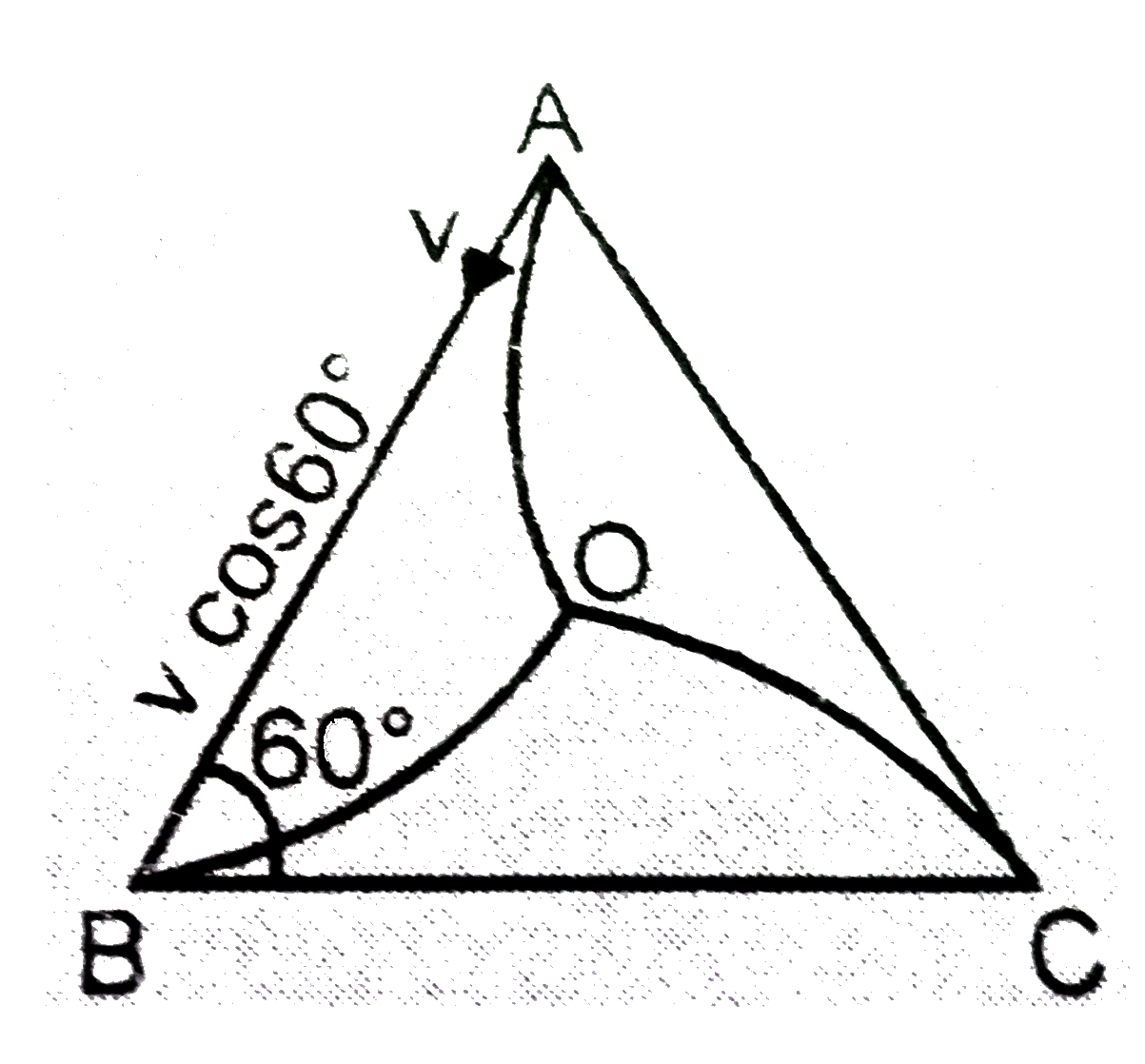

This can be solved by considering reference frame attached to one of the particles. (By relative motion) Velocity of A w.r.t. B `" "vec(v)_(AB)=vec(v)_(A)-vec(v)_(B)`
`=(sqrt(2)hat(i)+sqrt(2)hat(j))-(-7sqrt(2)hat(i)+7sqrt(2)hat(j))`
`=8sqrt(2)hat(i)-6sqrt(2)hat(j)`
Dir. of `vec(v)_(AB)" "tan alpha=(-6sqrt(2))/(8sqrt(2))=(-3)/4`
`alpha=37^(@)` (downward from horizontal)
from
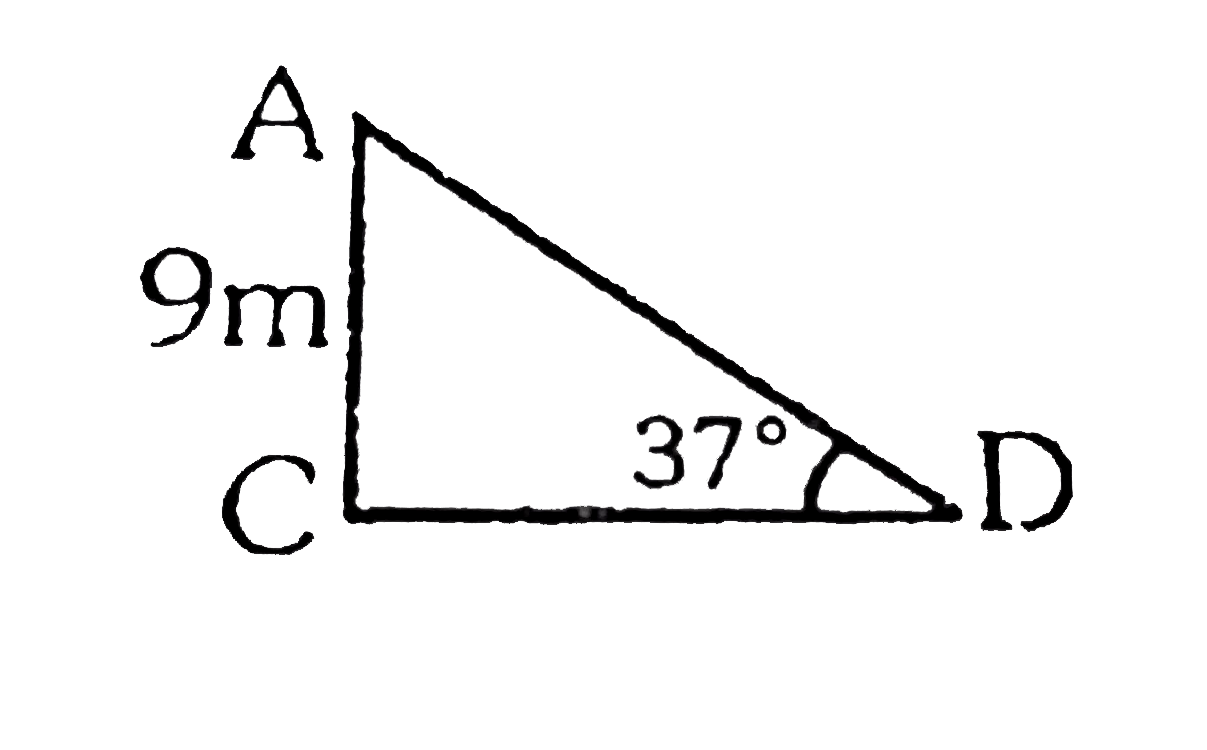
`tan 37^(@)=(AC)/(CD)=3/4`
`CD=(9xx4)/3=12 m" " :' " "BD=27-12=15m`
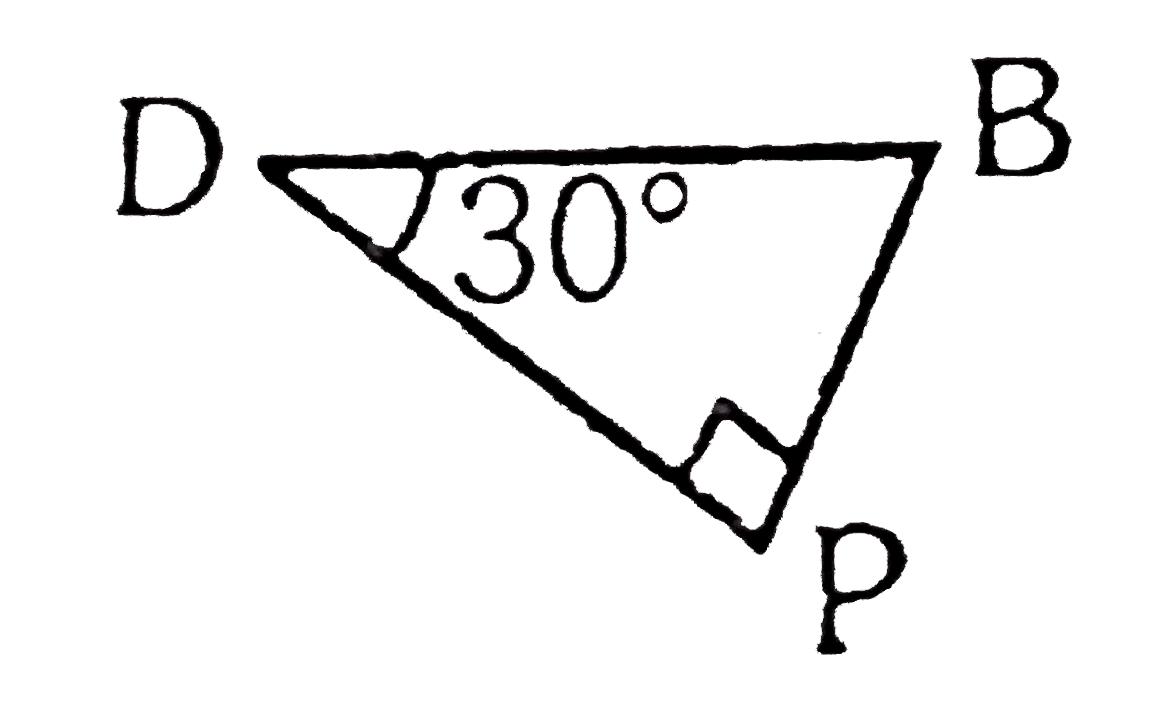
From
`(BP)/(BD)=sin 37^(@)=3/5`
`(BP)/15=3/5 rArr BP=9 m`
Promotional Banner

Topper's Solved these Questions

  • MOTION IN A PALNE

    ALLEN |Exercise EXERCISE-02|37 Videos
  • MOTION IN A PALNE

    ALLEN |Exercise EXERCISE-03|6 Videos
  • KINEMATICS-2D

    ALLEN |Exercise Exercise (O-2)|47 Videos
  • NEWTON'S LAWS OF MOTION & FRICTION

    ALLEN |Exercise EXERCISE (JA)|4 Videos

Similar Questions

Explore conceptually related problems

Three particles, each of the mass m are situated at the vertices of an equilateral triangle of side a . The only forces acting on the particles are their mutual gravitational forces. It is desired that each particle moves in a circle while maintaining the original mutual separation a . Find the initial velocity that should be given to each particle and also the time period of the circular motion. (F=(Gm_(1)m_(2))/(r^(2)))

Three particles A, B, Care located at the comers of an equilateral triangle as shown in figure. Each of the particle is moving with velocity v. Then at the instant shown, the relative angular velocity of

Three particles of masses 1 kg, 2 kg and 3 kg are situated at the corners of an equilateral triangle move at speed 6ms^(-1), 3ms^(-1) and 2ms^(-1) respectively. Each particle maintains a direction towards the particles at the next corners symmetrically. Find velocity of CM of the system at this instant

Three point charges 1C, 2C and 3C are placed at the corners of an equilaternal triangle of side 1m . The work required to move these charges to the corners of a smaller equilaternal triangle of side 0.5 m in two differenct ways as in fig. (A) and fig. (B) are W_(a) and W_(b) then:

Three identical bodies (each mass M) are placed at vertices of an equilateral triangle of arm L, keeping the triangle as such by which angular speed the bodies should rotated in their gravitional fields so that the triangle moves along circumference of circular orbit :

n' number of particles are located at the verticles of a regular polygon of n sides having the edge length 'a'. They all start moving simultaneously with equal constant speed 'v' heading towards each other all the time. How long will the particles take to collide?

Three particles with equal mass move with equal speed v along the medians of an equilateral triangle as shown. They all collide at the centroid simultaneously. After the collision. A comes to rest, B retraces it's path with same speed. What is speed of C after the collision?

Two particles are in SHM in a straight line about same equilibrium position. Amplitude A and time period T of both the particles are equal. At time t=0 , one particle is at displacement y_(1)=+A and the other at y_(2)=-A//2 , and they are approaching towards each other. after what time they cross each other?

One conducing U tube can be slide inside another as shown in figure, maintaining electrical contacts between the tubes. The magnetic field B is perpendicular to the plane of the figure. If each tube moves towards the other at a constant speed v, then the emf induced in the circuit in terms of B, l and v where l is the width of each tube, will be ........

A passenger is standing d metres away from a bus. The bus begins to move eith constat acceleration a. To catch the bus the passenger runs at a constant speed (v) towards the bus, at what minimum speed he must have ,so that he may catch the bus.

ALLEN -MOTION IN A PALNE-SOLVED EXAMPLE
  1. Three boys A,B and C are situated at the vertices of an equilateral tr...

    Text Solution

    |

  2. A particle thrown over a triangle from one end of a horizontal base fa...

    Text Solution

    |

  3. A projectile is fired horizontally with a velocity of 98 ms^(-1) from ...

    Text Solution

    |

  4. Two tall buildings face each other and are at a distance of 180 m from...

    Text Solution

    |

  5. Two paper screens A and B are separated by a distance of 100m. A bulle...

    Text Solution

    |

  6. A ball rolls off top of a stair case with horizontal velocity u (m)/(s...

    Text Solution

    |

  7. A football player kicks a ball at ball at an angle of 30 ^(0) with the...

    Text Solution

    |

  8. A cricketer can throw a ball to a maximum horizontal distance of 100 m...

    Text Solution

    |

  9. A ball is thown at angle theta and another ball is thrown at angle (90...

    Text Solution

    |

  10. Two bodies are thrown with the same initial speed at angles alpha and ...

    Text Solution

    |

  11. The range of a projectile launched at an angle of 15^(@) with horizont...

    Text Solution

    |

  12. A ball of mass (m) is thrown vertically up. Another ball of mass 2 m ...

    Text Solution

    |

  13. A body is projectd with the velcity (U1) from the point (A) as shown...

    Text Solution

    |

  14. An aeroplane is flying at a constant height of 1960 m with speed 600 k...

    Text Solution

    |

  15. A body is projected up such that its position vector varies with time ...

    Text Solution

    |

  16. Two particles A and B are projected simultaneously in the directins sh...

    Text Solution

    |

  17. Two bodies were thrown simultaneously from the same point, one straigh...

    Text Solution

    |

  18. Two particles are projected from the two towers simultaneously, as sho...

    Text Solution

    |

  19. A projectile is thrown with speed u making angle theta with horizontal...

    Text Solution

    |

  20. A particle has initial velocity (3hati+4hatj) and has acceleration (0....

    Text Solution

    |

  21. A particle travels according to the equation y=x-(x^(2)/(2)). Find the...

    Text Solution

    |