Home
Class 12
PHYSICS
Initially a body is at rest. If its acce...

Initially a body is at rest. If its acceleration is `5ms^(-2)` then the distance travelled in the `18^(th)` second is :-

Text Solution

Verified by Experts

The correct Answer is:
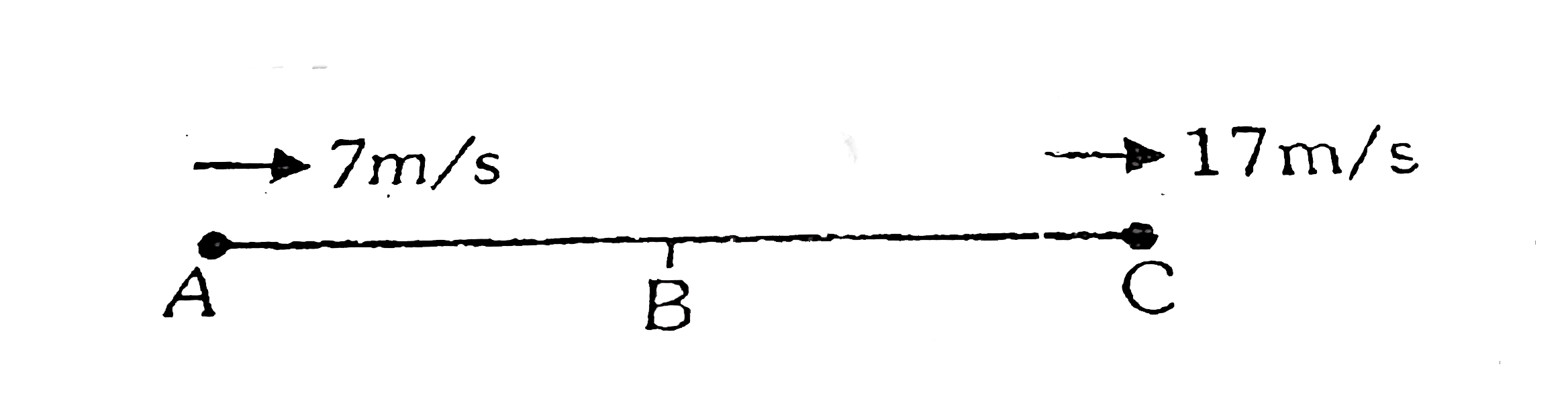
B, C, D

Motion A to C `rArr 17^(2)=7^(2)+2as`

Motion A to B `rArr v_(B)^(2)=7^(2)+2a(s/2)=(17^(2)+7^(2))/2`
`(A) v_(B)=sqrt((289+49)/2)=13 m//s`
(B) `lt v_(AB) gt =(7+13)/2=10 m//s`
(C) `t_(1)=(13-7)/a, t_(2)=(17-13)/a, t_(1)/t_(2)=6/4=3/2`
(D) `lt v_(BC) gt =(13+17)/2=15 m//s`
Promotional Banner

Topper's Solved these Questions

  • MOTION IN A PALNE

    ALLEN |Exercise EXERCISE-03|6 Videos
  • MOTION IN A PALNE

    ALLEN |Exercise Assertion-Reason|20 Videos
  • MOTION IN A PALNE

    ALLEN |Exercise SOLVED EXAMPLE|28 Videos
  • KINEMATICS-2D

    ALLEN |Exercise Exercise (O-2)|47 Videos
  • NEWTON'S LAWS OF MOTION & FRICTION

    ALLEN |Exercise EXERCISE (JA)|4 Videos

Similar Questions

Explore conceptually related problems

A particle, starting from rest, moves with constant acceleration 4 ms^(-2). The distance travelled by the particle in 5^(th) second is.

If body having initial velocity zero is moving with uniform acceleration 10m//sec^(2) the distance travelled by it in third second will be

If body having initial velocity zero is moving with uniform acceleration 8m//sec^(2) the distance travelled by it in fifth second will be

A car is moving with the accelaration 2 m/ s^(2) from rest. Find the distance traveled by the car in 10th second.

An object is moving on a linear path in definite direction with initial velocity 'u' with constant acceleration. Prove that the distance travelled by it during 'n'th second is u + (a)/(2) (2n -1).

A body starts from rest, what is the ratio of the distance travelled by the body during the 4th and 3rd s?

A body starts from rest and is uniformly accelerated is 30m//s . The distance travelled in the first 10 s is x_(1) , next 10 s is x_(2) and the last 10 s is x_(3) . Then x_(1):x_(2):x_(3) is the same as :-

A particle starting from initial velocity v_0 moves on straight line with constant acceleration equation of distance travelled during n^"th" second will be …... .

A particle starts with an initial velocity 2.5 m//s along the posiive x-direction and it accelerates uniformly at the rate 0.50 m//s^2. Find the distance travelled by it in the first two seconds

ALLEN -MOTION IN A PALNE-EXERCISE-02
  1. The motion of a particle is described by the equation x = a+bt^(2) whe...

    Text Solution

    |

  2. The motion of a particle is described by the equation x = at^(2)+bt^(3...

    Text Solution

    |

  3. Initially a body is at rest. If its acceleration is 5ms^(-2) then the ...

    Text Solution

    |

  4. A balloon starts rising from the ground with an acceleration of 1.25ms...

    Text Solution

    |

  5. A body is thrown vertically upwards. If air resistance is to be taken ...

    Text Solution

    |

  6. A particle moves in east direction with 15m/sec for 2 sec then moves i...

    Text Solution

    |

  7. A 210 meter long train is moving due north at a of 25 m/s. a small bir...

    Text Solution

    |

  8. A force vecF=6t^(2)hati+4thatj is acting on a particle of mass 3 kg th...

    Text Solution

    |

  9. Starting from rest, the acceleration of a particle is a=2(t-1). The ve...

    Text Solution

    |

  10. Three different objects of masses m(1) , m(2) and m(2) are allowed to ...

    Text Solution

    |

  11. A ball is thrown upwards . Its height varies with time as shown in fig...

    Text Solution

    |

  12. A man walks on a straight road form his home to a market 2.5 km away w...

    Text Solution

    |

  13. A particle experiences a constant acceleration for 20 sec after starti...

    Text Solution

    |

  14. If a ball is thrown vertically upwards with speed u, the distance cove...

    Text Solution

    |

  15. A man throws balls with the same speed vertically upwards one after th...

    Text Solution

    |

  16. A stone falls freely such that the distance covered by it in the last ...

    Text Solution

    |

  17. The velocity of a particle is given by v=(5t^(2)-6t+5)m//s where t is ...

    Text Solution

    |

  18. Which of the following equation represents the motion of a body moving...

    Text Solution

    |

  19. The variation of velocity of a particle moving along a straight line i...

    Text Solution

    |

  20. Find the integration of the 1/(2x+1).

    Text Solution

    |

