Home
Class 12
PHYSICS
A boy is runing on the plane road with v...

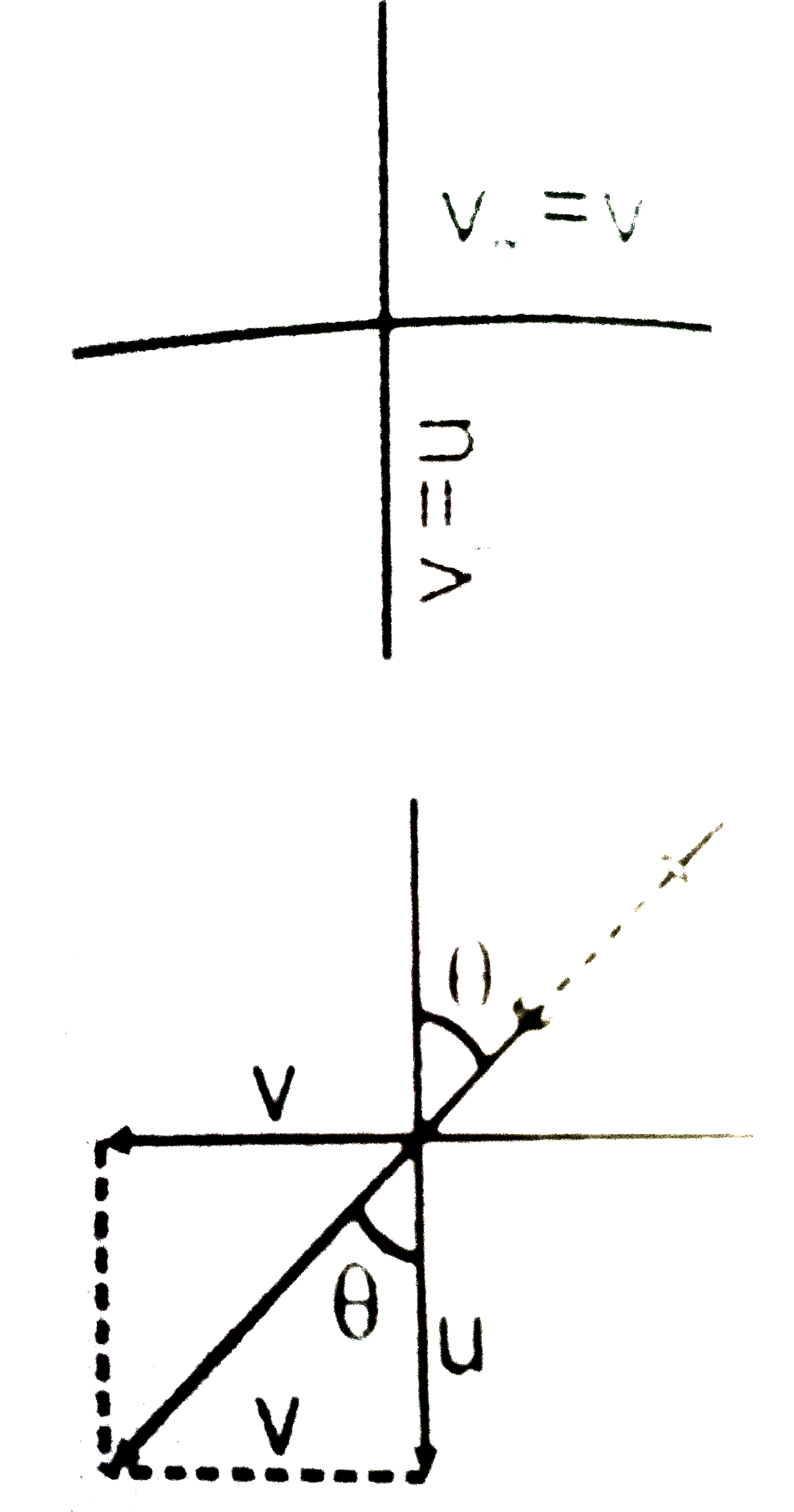
A boy is runing on the plane road with velocity v with a long hollow tube in his hand. The water is falling vertically downwards with velocity u. At water angle to the verticaly, he must inclined the tube the water drops enter it without touching its sides ?

Text Solution

Verified by Experts

The correct Answer is:
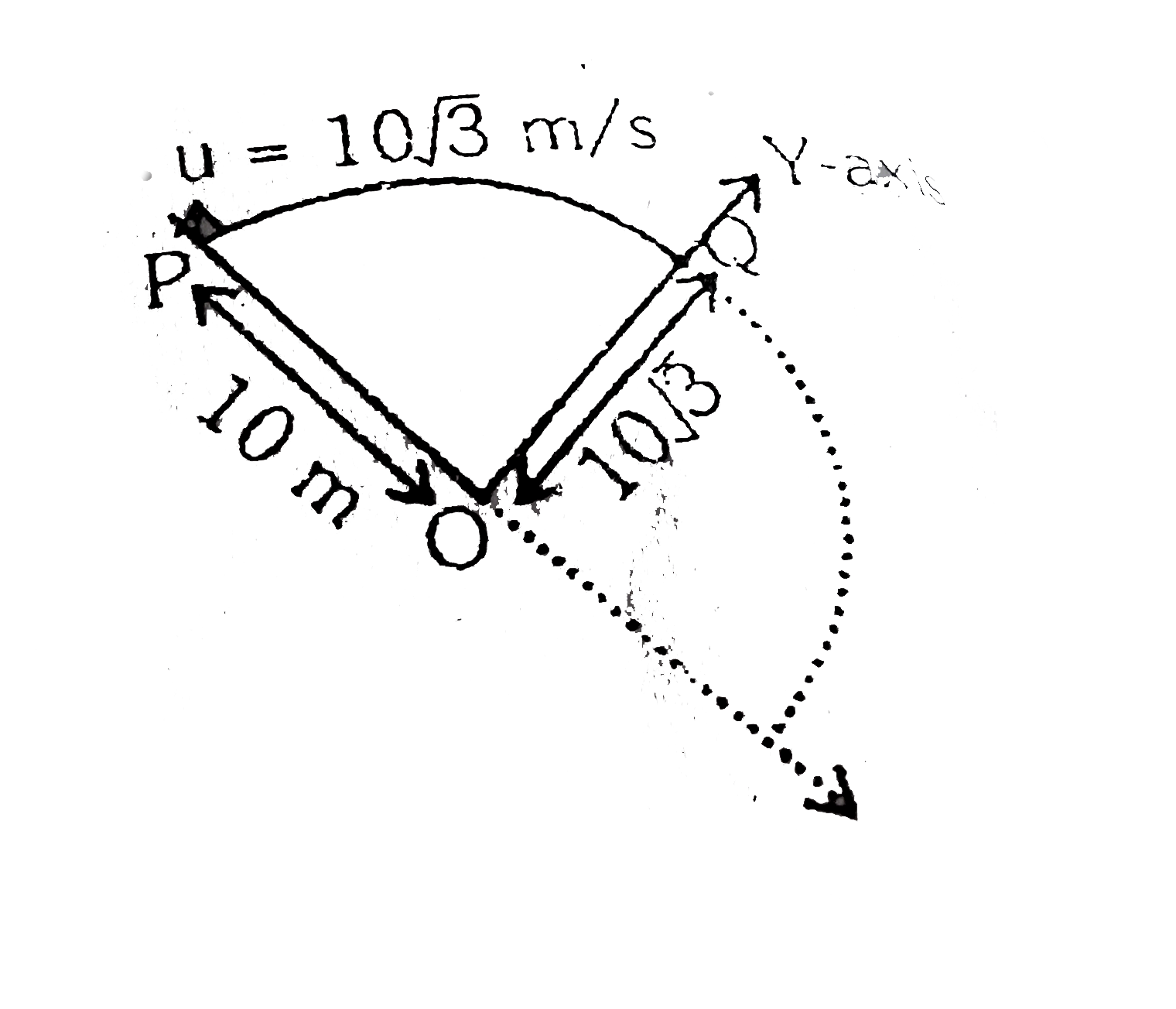
(i) 2s (ii) `10 ms^(-1)` (iii) 5m (iv) `16.25 m` (v) 20 m


(i) `v(t)=(u -g cos 30^(@) t) hat(i) -g sin theta t hat(j)`
From given situation
`u -g cos 30^(@) t = 0`
`t =2 sec`
(ii) Velocity `u_(x) = 0,a_(x) = g cos 30^(@) = (g)/(2)`
`:. v_(x) =0 +(g)/(2) xx 2 = 10 m//s`
(iii) Distance `PO =`
`10 sqrt(3) cos 90^(@) xx t +(1)/(2) xxg sin 30^(@) xx (2)^(2)`
`PO = 10 m :. h = 10 sin 30^(@) = 5 m`
(iv) Maximum height `= h + (u(sin 60^(@))^(2))/(2g)`
`= 5 +((10 sqrt(3) xx (sqrt(3))/(2)))/(20) =16.25 m`
(v) Distance PQ
`OQ = ((10 sqrt(3))^(2))/(2g cos 30^(@))`
`OQ =1 0 sqrt(3)`
`:. PQ = sqrt((PO)^(2) +(O)^(2))`
`= sqrt(10^(2)+(10 sqrt(3))^(2))= 20m`.
Promotional Banner

Topper's Solved these Questions

  • MOTION IN A PALNE

    ALLEN |Exercise Exercise-05 [A]|11 Videos
  • MOTION IN A PALNE

    ALLEN |Exercise Exercise-05[B]|5 Videos
  • MOTION IN A PALNE

    ALLEN |Exercise EXERCISE-04[A]|35 Videos
  • KINEMATICS-2D

    ALLEN |Exercise Exercise (O-2)|47 Videos
  • NEWTON'S LAWS OF MOTION & FRICTION

    ALLEN |Exercise EXERCISE (JA)|4 Videos

Similar Questions

Explore conceptually related problems

A man starts running along a straight road with uniform velocity observes that the rain is falling vertically downward. If he doubles his speed, he finds that the rain is coming at an angle theta to the vertical. The velocity of rain with respect to the ground is :

An open water tight railway wagon of mass 5 xx 10(3) kg coats at an initial velocity 1.2 m//s without friction on a railway track. Rain drops fall vertically downwards into the wagon. The velocity of the wagon after it has collected 10^(3) kg of water will be :-

A swimmer starts to swim from point a to cross a river. He wants to reach point B on the opposite side of the river. The line AB makes an angle 60^(@) with the river flow as hown. The velocity of the swimmer in still water is same as that of the water (i) In what direction should he try to direct his velocity ? Calculate angle between his velocity anf river velocity. (ii) Find the ratio of the time taken to cross the river in this situation to the minimum time in which he can cross this river.

A swimmer starts to swim from point a to cross a river. He wants to reach point B on the opposite side of the river. The line AB makes an angle 60^(@) with the river flow as shown. The velocity of the swimmer in still water is same as that of the water (i) In what direction should he try to direct his velocity ? Calculate angle between his velocity and river velocity. (ii) Find the ratio of the time taken to cross the river in this situation to the minimum time in which he can cross this river.

In the figure there is a long horizontal bridge over a river 75 m high from water surface. A strong man throws a stone in the parallel plane of the bridge. A observer in a car travelling on the bridge finds the stone going pass by the car while ascending and also while descending between two points on the road 30 m away. The car is travelling at a speed of 15 m/s. The stone is thrown from the bank of river just at the same level of water. What is the angle the velocity makes with the bridge when it goes past the car while ascending ?

A boatman moves his boat with a velocity 'v' (relative to water) in river and finds to his surprise that velocity of river 'u' (with respect to ground) is more than 'v'. He has to reach a point directly opposite to the starting point on another bank by travelling minimum possible distance. Then

Diameters of the arms of a U tube are 10 mm and 1 mm . It is partially filled with water and it is held in a vertical plane . Find the difference in heights of water in both the arms . (Surface tension of water =70 dyne cm^(-1) angle of contact =0^(@).g=980cms^(-2))

A man of height H is standing in front of an inclined plane mirror at an angle theta from horizontal. The vertical separation between man and inclined plane is x. Man can see its complete image in length (H(H+x)"sin"theta)/(H +2x) of mirror . (Given : x = H = 1m and theta = 45^(@) ) If man starts moving with velocity 1 ms^(-1) along vertical, find out length of mirror at t = 1s in which he can see his complete image.

When an object moves through a fluid, as when a ball falls through air or a glass sphere falls through water te fluid exerts a viscous foce F on the object this force tends to slow the object for a small sphere of radius r moving is given by stoke's law, F_(w)=6pietarv . in this formula eta in the coefficient of viscosity of the fluid which is the proportionality constant that determines how much tangential force is required to move a fluid layer at a constant speed v, when the layer has an area A and is located a perpendicular distance z from and immobile surface. the magnitude of the force is given by F=etaAv//z . For a viscous fluid to move from location 2 to location 1 along 2 must exceed that at location 1, poiseuilles's law given the volumes flow rate Q that results from such a pressure difference P_(2)-P_(1) . The flow rate of expressed by the formula Q=(piR^(4)(P_(2)-P_(1)))/(8etaL) poiseuille's law remains valid as long as the fluid flow is laminar. For a sfficiently high speed however the flow becomes turbulent flow is laminar as long as the reynolds number is less than approximately 2000. This number is given by the formula R_(e)=(2overline(v)rhoR)/(eta) In which overline(v) is the average speed rho is the density eta is the coefficient of viscosity of the fluid and R is the radius of the pipe. Take the density of water to be rho=1000kg//m^(3) Q. If the sphere in previous question has mass of 1xx10^(-5)kg what is its terminal velocity when falling through water? (eta=1xx10^(-3)Pa-s)

A man of height H is standing in front of an inclined plane mirror at an angle theta from horizontal. The vertical separation between man and inclined plane is x. Man can see its complete image in length (H(H+x)"sin"theta)/(H +2x) of mirror . (Given : x = H = 1m and theta = 45^(@) ) If man starts moving with velocity 1 ms^(-1) horizontally, find out length of mirror at t=1s in which he can see his complete image.