Home
Class 12
PHYSICS
A scooter going due east at 10 ms^(-1) t...

A scooter going due east at `10 ms^(-1)` turns right through an angle of `90^(@)`. If the speed of the scooter remain unchanged in taking turn, the change is the velocity the scooter is

A

20.0 `m s^(-1)` in south-western direction

B

zero

C

`10.0 m s^(-1)` south-east direction

D

`14.14m s^(-1)` in south-western direction

Text Solution

Verified by Experts

The correct Answer is:
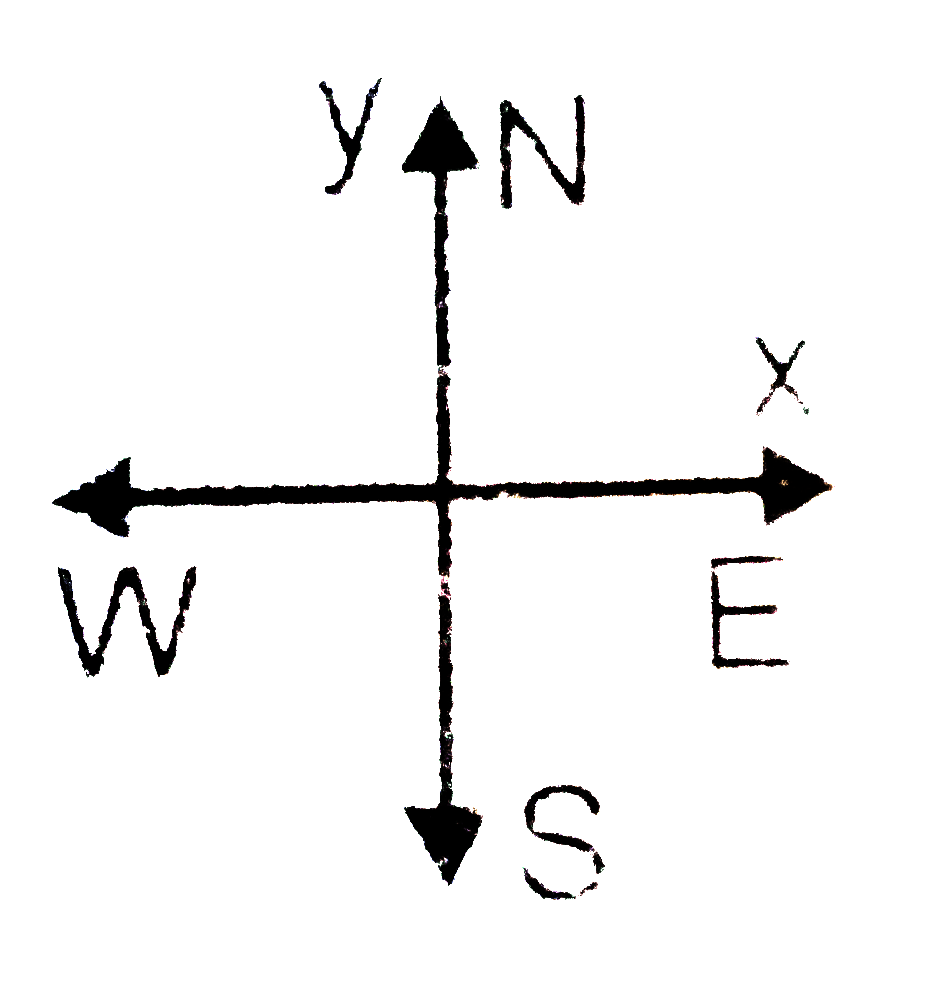
D

`vecv_(i)=10hati rArr vecv_(f)=10hatj`
`Deltavecv=vecv_(i)-vecv_(i)=-10hatj-10hati` (south-west)
`Deltav=sqrt((10)^(2)+(10)^(2))=14.14 m//sec`
Promotional Banner

Topper's Solved these Questions

  • MOTION IN A PALNE

    ALLEN |Exercise EXERCISE-3|41 Videos
  • MOTION IN A PALNE

    ALLEN |Exercise SOLVED EXAMPLE|28 Videos
  • MOTION IN A PALNE

    ALLEN |Exercise EXERCISE-1|99 Videos
  • KINEMATICS-2D

    ALLEN |Exercise Exercise (O-2)|47 Videos
  • NEWTON'S LAWS OF MOTION & FRICTION

    ALLEN |Exercise EXERCISE (JA)|4 Videos

Similar Questions

Explore conceptually related problems

A 100 turn closely wound circular coil of radius 10 cm carries a current of 3.2 A. (a) What is the field at the centre of the coil? (b) What is the magnetic moment of this coil? The coil is placed in a vertical plane and is free to rotate about a horizontal axis which coincides with its diameter. A uniform magnetic field of 2T in the horizontal direction exists such that initially the axis of the coil is in the direction of the field. The coil rotates through an angle of 90^@ under the influence of the magnetic field. (c) What are the magnitudes of the torques on the coil in the initial and final position? (d) What is the angular speed acquired by the coil when it has rotated by 90^@ ? The moment of inertia of the coil is 0.1 kg m^2 .

A circus wishes to develop a new clown act. Fig. (1) shows a diagram of the proposed setup. A clown will be shot out of a cannot with velocity v_(0) at a trajectory that makes an angle theta=45^(@) with the ground. At this angile, the clown will travell a maximum horizontal distance. The cannot will accelerate the clown by applying a constant force of 10, 000N over a very short time of 0.24s . The height above the ground at which the clown begins his trajectory is 10m . A large hoop is to be suspended from the celling by a massless cable at just the right place so that the clown will be able to dive through it when he reaches a maximum height above the ground. After passing through the hoop he will then continue on his trajectory until arriving at the safety net. Fig (2) shows a graph of the vertical component of the clown's velocity as a function of time between the cannon and the hoop. Since the velocity depends on the mass of the particular clown performing the act, the graph shows data for serveral different masses. From figure 2, approximately how much time will it take for clown with a mass of 60 kg to reach the safety net located 10 m below the height of the cannot?

A circus wishes to develop a new clown act. Fig. (1) shows a diagram of the proposed setup. A clown will be shot out of a cannot with velocity v_(0) at a trajectory that makes an angle theta=45^(@) with the ground. At this angile, the clown will travell a maximum horizontal distance. The cannot will accelerate the clown by applying a constant force of 10, 000N over a very short time of 0.24s . The height above the ground at which the clown begins his trajectory is 10m . A large hoop is to be suspended from the celling by a massless cable at just the right place so that the clown will be able to dive through it when he reaches a maximum height above the ground. After passing through the hoop he will then continue on his trajectory until arriving at the safety net. Fig (2) shows a graph of the vertical component of the clown's velocity as a function of time between the cannon and the hoop. Since the velocity depends on the mass of the particular clown performing the act, the graph shows data for serveral different masses. If the angle the cannot makes with the horiaontal is increased from 45^(@) , the hoop will have to be

A circus wishes to develop a new clown act. Fig. (1) shows a diagram of the proposed setup. A clown will be shot out of a cannot with velocity v_(0) at a trajectory that makes an angle theta=45^(@) with the ground. At this angile, the clown will travell a maximum horizontal distance. The cannot will accelerate the clown by applying a constant force of 10, 000N over a very short time of 0.24s . The height above the ground at which the clown begins his trajectory is 10m . A large hoop is to be suspended from the celling by a massless cable at just the right place so that the clown will be able to dive through it when he reaches a maximum height above the ground. After passing through the hoop he will then continue on his trajectory until arriving at the safety net. Fig (2) shows a graph of the vertical component of the clown's velocity as a function of time between the cannon and the hoop. Since the velocity depends on the mass of the particular clown performing the act, the graph shows data for serveral different masses. If a clown holds on to hoop instead of passing through it, what is the position of the cable so that he doesn't hit his head on the ceiling as he swings upward?

A circus wishes to develop a new clown act. Fig. (1) shows a diagram of the proposed setup. A clown will be shot out of a cannot with velocity v_(0) at a trajectory that makes an angle theta=45^(@) with the ground. At this angile, the clown will travell a maximum horizontal distance. The cannot will accelerate the clown by applying a constant force of 10, 000N over a very short time of 0.24s . The height above the ground at which the clown begins his trajectory is 10m . A large hoop is to be suspended from the celling by a massless cable at just the right place so that the clown will be able to dive through it when he reaches a maximum height above the ground. After passing through the hoop he will then continue on his trajectory until arriving at the safety net. Fig (2) shows a graph of the vertical component of the clown's velocity as a function of time between the cannon and the hoop. Since the velocity depends on the mass of the particular clown performing the act, the graph shows data for serveral different masses. If the clown's mass is 80 kg , what initial velocity v_(0) will have as he leaves the cannot?

A circus wishes to develop a new clown act. Fig. (1) shows a diagram of the proposed setup. A clown will be shot out of a cannot with velocity v_(0) at a trajectory that makes an angle theta=45^(@) with the ground. At this angile, the clown will travell a maximum horizontal distance. The cannot will accelerate the clown by applying a constant force of 10, 000N over a very short time of 0.24s . The height above the ground at which the clown begins his trajectory is 10m . A large hoop is to be suspended from the celling by a massless cable at just the right place so that the clown will be able to dive through it when he reaches a maximum height above the ground. After passing through the hoop he will then continue on his trajectory until arriving at the safety net. Fig (2) shows a graph of the vertical component of the clown's velocity as a function of time between the cannon and the hoop. Since the velocity depends on the mass of the particular clown performing the act, the graph shows data for serveral different masses. If the mass of a clown doubles, his initial kinetic energy, mv_(0)^(2)//2 , will :-

A circus wishes to develop a new clown act. Fig. (1) shows a diagram of the proposed setup. A clown will be shot out of a cannot with velocity v_(0) at a trajectory that makes an angle theta=45^(@) with the ground. At this angile, the clown will travell a maximum horizontal distance. The cannot will accelerate the clown by applying a constant force of 10, 000N over a very short time of 0.24s . The height above the ground at which the clown begins his trajectory is 10m . A large hoop is to be suspended from the celling by a massless cable at just the right place so that the clown will be able to dive through it when he reaches a maximum height above the ground. After passing through the hoop he will then continue on his trajectory until arriving at the safety net. Fig (2) shows a graph of the vertical component of the clown's velocity as a function of time between the cannon and the hoop. Since the velocity depends on the mass of the particular clown performing the act, the graph shows data for serveral different masses. The slope of the line segments plotted in figure 2 is a figure constant. Which one of the following physical quantities does this slope represent?

ALLEN -MOTION IN A PALNE-EXERCISE-2
  1. An athelete completes one round of a circular track of radius R in 40...

    Text Solution

    |

  2. The displacement-time graph of moving particle is shown below The...

    Text Solution

    |

  3. A scooter going due east at 10 ms^(-1) turns right through an angle of...

    Text Solution

    |

  4. A body is imparted motion from rest to move in a straight line. If it ...

    Text Solution

    |

  5. A train covers the first half of the distance between two stations at ...

    Text Solution

    |

  6. A particle is moing with a velocity of 10m//s towards east. After 10s ...

    Text Solution

    |

  7. Which of the following four statements is false

    Text Solution

    |

  8. One car moving on a staright road covers one-third of the distance wit...

    Text Solution

    |

  9. Figure below shows the velocity-time graph of a one dimensional motion...

    Text Solution

    |

  10. If a car at rest, accelerates uniformly to a speed of 144 km//h in 20s...

    Text Solution

    |

  11. A body starts from rest, what is the ratio of the distance travelled b...

    Text Solution

    |

  12. The intial velocity of a particle is u (at t=0) and the acceleration i...

    Text Solution

    |

  13. If a body starts from rest and travels 120 cm in the 6 second then wha...

    Text Solution

    |

  14. If a train travelling at 72 km/h is to be brought to rest in a distanc...

    Text Solution

    |

  15. A car moving with a speed of 40 km//h can be stopped by applying the b...

    Text Solution

    |

  16. If a body starts from rest and travels 120 cm in the 6 second then wha...

    Text Solution

    |

  17. A car moving with a velocity of 10m/s can be stopped by the applicatio...

    Text Solution

    |

  18. A body is dropped from a tower with zero velocity, reaches ground in 4...

    Text Solution

    |

  19. The graph between the displacement x and time t for a particle moving ...

    Text Solution

    |

  20. A body starts from rest and travels a distance x with uniform accelera...

    Text Solution

    |

