Home
Class 12
PHYSICS
A bead is free to slide down a smooth wi...

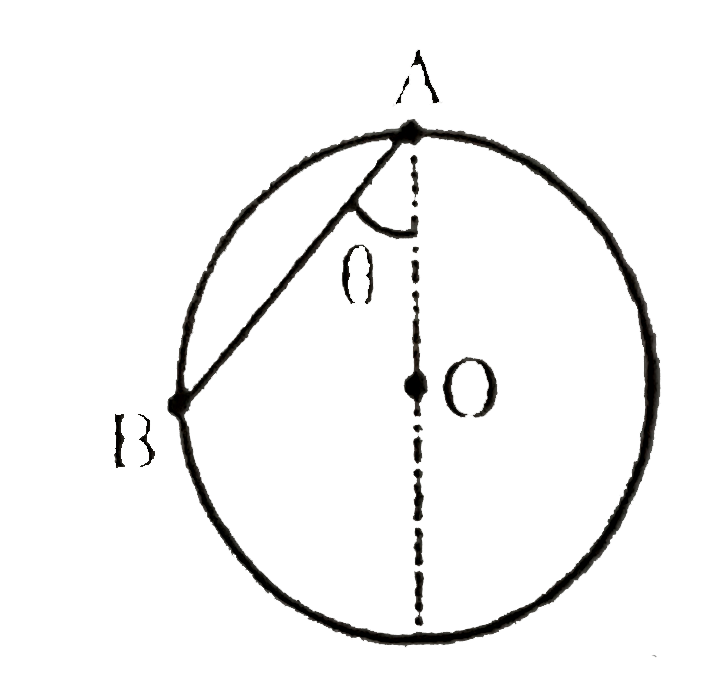
A bead is free to slide down a smooth wire tightly stretched between points A and on a verticle circle of radius R. if the bead starts from rest at 'A', the highest point on the circle, its velocity when it arrives at B is :-

A

`2sqrt(gR)`

B

`2sqrt(gR) cos theta`

C

`(2sqrt(r))/(g)`

D

None of these

Text Solution

Verified by Experts

The correct Answer is:
B

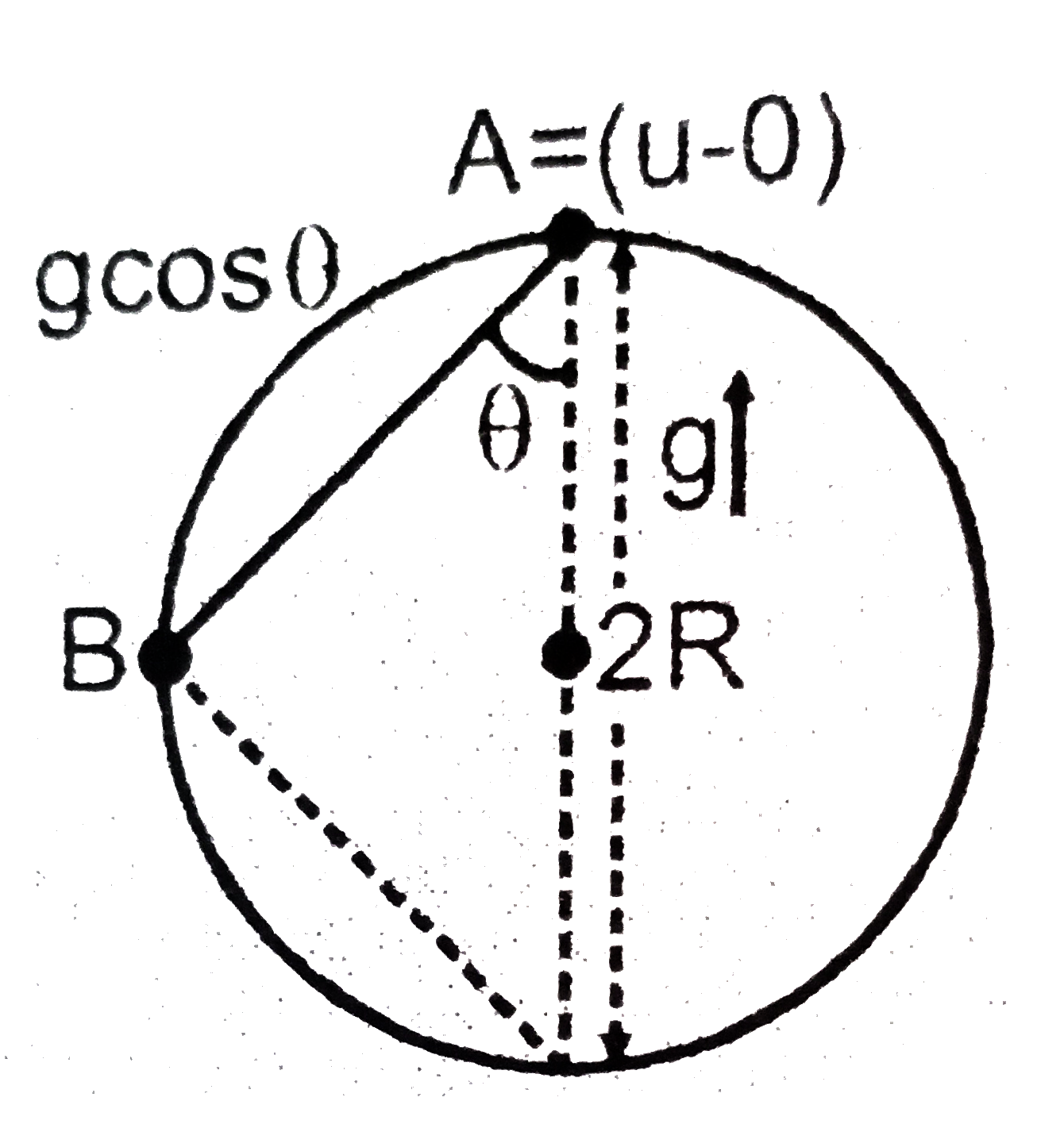
`s=AB=2R cos theta[cos theta=(AB)/(2R)]`
`v^(2)=u^(2)+2aS`
`v^(2)=0+2(g cos theta)xx(@R cos theta)`
`v=2sqrt(gR) cos theta`
Promotional Banner

Topper's Solved these Questions

  • MOTION IN A PALNE

    ALLEN |Exercise EXERCISE-3|41 Videos
  • MOTION IN A PALNE

    ALLEN |Exercise SOLVED EXAMPLE|28 Videos
  • MOTION IN A PALNE

    ALLEN |Exercise EXERCISE-1|99 Videos
  • KINEMATICS-2D

    ALLEN |Exercise Exercise (O-2)|47 Videos
  • NEWTON'S LAWS OF MOTION & FRICTION

    ALLEN |Exercise EXERCISE (JA)|4 Videos

Similar Questions

Explore conceptually related problems

A stone of m ass m tied to the end of a string revolves in a vertical circle of radius R. The net force at the lowest and highest points of the circle d irected vertically dow nw ards are : [Choose the correct alternative] Lowest Point (a) mg - T_(1) (b) mg + T_(1) (c) mg + T_(1) - (mv_(1)^(2))//R (d) mg - T_(1) - (mv_(1)^(2))//R Highest Point mg + T_(2) mg - T_(2) mg - T_(2) + (mv_(1)^(2))//R mg + T_(2) + (mv_(1)^(2))/R T_(1) and denote the tension and speed at the lowest point. T_(2) and v_(2) denote corresponding values at the highest point.

A bead slides on a frictoinless strainght rod fixed between points A and B of a vertical circular loop of radius as shown in the figure. Line BC is a vertical diameter. Denoting acceleration due to gravity by g , which of the following is correct expression for the time taken by the bead to slide from A to B

A 14.5 kg mass, fastened to the end of a steel wire of unstretched length 1.0 m, is whirled in a vertical circle with an angular velocity of 2 rev/s at the bottom of the circle. The crosssectional area of the wire is 0.065 cm. Calculate the elongation of the wire when the mass is at the lowest point of its path. [Y_("Steel") =2 xx 10 ^(11) N,m ^(-2)]

A 14.5 kg mass, fastened to the end of a steel wire of unstretched 1.0 m, is whirled in a vertical circle with an angular velocity of 2 rev/s at the bottom of the circle. The cross- sectional area of the wire is 0.065" cm"^(2) . Calculate the elongation of the wire when the mass is at the lowest point of its path.

Two beads of masses m_(1) and m_(2) are closed threaded on a smooth circular loop of wire of radius R. Intially both the beads are in position A and B in vertical plane . Now , the bead A is pushed slightly so that it slide on the wire and collides with B . if B rises to the height of the centre , the centre of the loop O on the wire and becomes stationary after the collision , prove m_(1) : m_(2) = 1 : sqrt(2)

A particle goes from point A to point B, moving in a semicircle of radius 1 m in 1 second. Find the magnitude of its average velocity.

A wire, which passes through the hole in a small bead, is bent in the form of quarter of a circle. The wire is fixed vertically on ground as shown in the figure. The bead is released from near the top of the wire and it slides along the wire without friction. As the bead moves from A to B, the force it applies on the wire is

A piece of wire is bent in the shape of a parabola y=kx^(2) (y-axis vertical) with a bead of mass m on it. The bead can slide on the wire without friction. It stays at the lowest point of the parabola when the wire is at rest. The wire is now accelerated parallel to the x-axis with a constant acceleration a. The distance of the new equilibrium position of the bead, where the bead can stay at rest with respect to the wire, from the y-axis is:

The diagram show a small bead of mass m carrying charge q . The bead can freely move on the smooth fixed ring placed on a smooth horizontal plane . In the same pane a charge +Q has also been fixed as shown. The potential at the point P due to +Q is V . The velocity which the bead should projected from the point P so that it can complete a circle should be greater than .

A wire of resistance 12 Omega m^(-1) is bent to from a complete circle of radius 10 cm . The resistance between its two diametrically opposite points, A and B as shown in the figure, is

ALLEN -MOTION IN A PALNE-EXERCISE-2
  1. A disc in which serval grooves are cut along the chord drawn from a po...

    Text Solution

    |

  2. A body is slipping from an inclined plane of height h and length l . I...

    Text Solution

    |

  3. A bead is free to slide down a smooth wire tightly stretched between p...

    Text Solution

    |

  4. Three boys A,B and C are situated at the vertices of an equilateral tr...

    Text Solution

    |

  5. A particle start from rest and move with constant acceleration. Than v...

    Text Solution

    |

  6. In the graph shown in fig. the time is plotted along x-axis. Which qua...

    Text Solution

    |

  7. A particle of mass m is projected with velocity v making an angle of 4...

    Text Solution

    |

  8. In case of a projectile fired at an angle equally inclined to the hori...

    Text Solution

    |

  9. A cannon of mass 5m (including a shell of mass m) is at rest on a smoo...

    Text Solution

    |

  10. The range of a projectile when fired at 75^(@) with the horizontal is ...

    Text Solution

    |

  11. A particle is projected with a velocity u making an angle theta with t...

    Text Solution

    |

  12. The speed at the maximum height of a projectile is sqrt(3)/(2) times o...

    Text Solution

    |

  13. What is the ratio of P.E. w.r.t. ground and K.E. at the top most point...

    Text Solution

    |

  14. A ball is thrown at an angle theta with the horizontal and the range i...

    Text Solution

    |

  15. A student is able to throw a ball vertically to maximum height of 40m....

    Text Solution

    |

  16. Three projectile A, B and C are thrwon from the same point in the same...

    Text Solution

    |

  17. A projectile is thrown with an initial velocity of (a hati +b hatj) ms...

    Text Solution

    |

  18. The equation of a projectile is y=sqrt(3)x-(gx^(2))/(2) the angle of...

    Text Solution

    |

  19. The equation of projectile is y=16x-(x^(2))/(4) the horizontal range i...

    Text Solution

    |

  20. If a projectile is fired at an angle theta with the vertical with velo...

    Text Solution

    |

