Home
Class 12
PHYSICS
The resistance 4R,16R,64R....oo are conn...

The resistance 4R,16R,64R....`oo` are connected in series. Find their equivalent resistance.

Text Solution

Verified by Experts
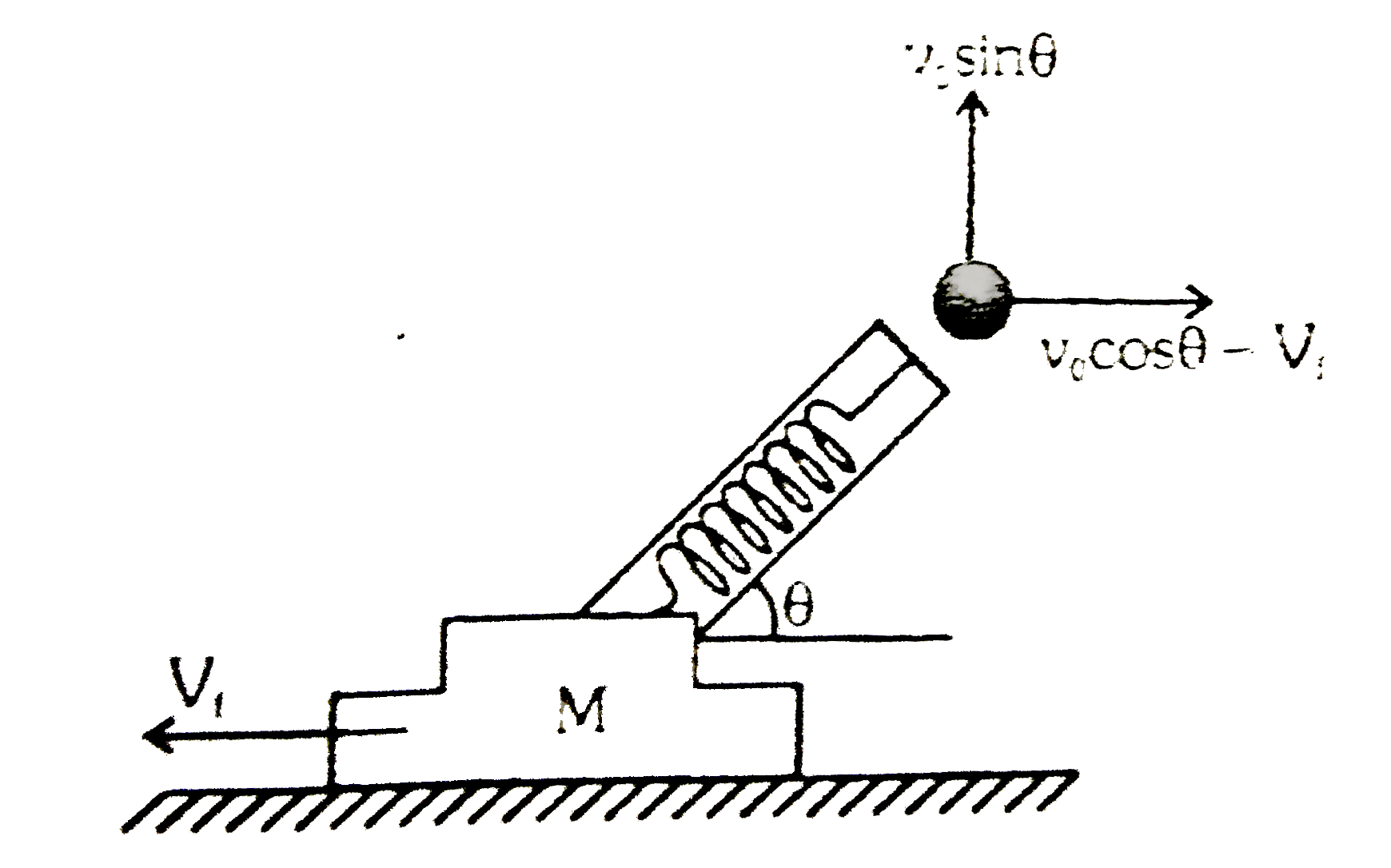
Take the physical system to be the gun and marble. Gravity and the normal force of the table act on the system. Both these forces are vertical. Since there are no horizontal external forces, the x component of the vector equation `F=dP/dt` is `0=dP_x/dt` According to equation (1), `P_x` is conserved:
`P_(x. "initial") = P_(x."final")`
Let the initial time be prior to firing the gun. Then `P_(x."initial") = 0`, since the system is initially at rest. After the marble has left the muzzle, the gun recoils with some speed `V_(1)`, and its final horizontal momentum is `MV_(1)`, to the left. FInding the final velocity of the marble involves a subtle point, however. Physically, the marble's accelaration is due to the force of the gun, and the gun's recoil is due to the reaction force of the marble. The gun stops accelerating once the marble leaves the barrel, so that at the instant the marble and the gun part company, the gun has its final speed `V_(f)`. At that same instant the speed of the marble relative to the gun is `v_(0)`. Hence, the final horizontal speed of the marble relative to the tablet is `v_(0) cos theta-V_(f)`. By conservation of horizontal momentum, we therefore have

`0=m(v_(0)costheta-V_(f))-MV_(f)`
or `V_(f) = (mv_(0)costheta)/(M+m)`
By using conversation of momentum we found the final motion of the system in a few steps. To show the advantage of this method, let us repeat the problem using Newton's laws directly. Let v(t) be the velocity of marble at time t and let `V(t)` be the velocity of the gun. While the marble is going fired, it is acted on by the spring, by gravity, and by friction forces with the muzzle wall. Let the net force on the marble be f(t). The x equation of motion for the marble is
`m(dv_(x))/dt=f_(x)(t)` Formal integration of equation (3) gives
`mv_(x)(t)=mv_(z)(0) + int_(0)^(t) f_(x)dt`
The external forces are all vertical, and therefore the horizontal force `f_(x)` on the marble is due entirely to the gun. By newton's third law, there is a reaction force- `f_(x)` on the gun due to the marble. No other horizontal forces acts on the gun, and the horizontal equation of motion for the gun is therefore `M(dV_x)/(dt)=-f_x(t)`, which can be integrated to give
`MV_(x)(t)=MV_(x)(0) - int_(0)^(t) f_(x)dt` we can eliminate the integral by combining equation (4) and (5).
`MV_(x)(t)+mv_(x)(t)=MV_(x)(0)+mv_(z)(0)`
we have rediscovered that the horizontal component of momentum is conserved. What about the motion of the center of mass? Its horizontal velocity is
`R_(x)(t)=(MV_(x)(t) +mv_(x)(t))/(M+m)` Using equation (6), the numerator can be rewritten to give
`R_(x)(t)=(MV_(x)(0)+mv_(x)(0))/(M+m)=0`
SInce the system is initially at rest. `R_x` is constant, as we expect.
We did not include the small force of air friction. Would the center of mass remain at rest if we had included it? The essential step in our derivation of the law of conservation of momentum was to use Newton's third law. Thus, conservation of momentum appears to be natural consequence of newtonian mechanics. It has been found, however, that conservation of momentum holds true even in areas where newtonian mechanics proves inadequate, including the realms of quantum mechanics and relativity. In addition, conservation of momentumcan be generalized to apply to systems like the electromagnetic field, which possess momentum but not mass. For these reasons, conservation of momentum is generally regarded as being more fundamental than newtonian mechanics. From the point of view, Newton's thitd law is a simple consequance of conservation of momentum for interacting particles. For our present purposes it is purely a matter of taste whether we wish to regard Newton's third law or conservation of momentum as more fundamental.
Promotional Banner

Topper's Solved these Questions

  • CURRENT ELECTRICITY

    ALLEN |Exercise EXERCISE-III|26 Videos
  • CURRENT ELECTRICITY

    ALLEN |Exercise EXERCISE-IV A|32 Videos
  • CIRCULAR MOTION

    ALLEN |Exercise EXERCISE (J-A)|6 Videos
  • GEOMETRICAL OPTICS

    ALLEN |Exercise subjective|14 Videos

Similar Questions

Explore conceptually related problems

Resistance R,2R,4R,8R ...... oo are connected in parallel. What is their resutlant resistance will be

Five resistance, each of 5Omega are connected as shown in figure. Find the equivalent resistance between points (1) A and B , (2) A and C .

When three resistors, each of resistance R, are connected in parallel, the equivalent resistance is found out to be 10 Omega . R must be …………………. .

The resistance of each arm of the wheat stone bridge is 10Omega . A resistance of 10Omega is connected in series with galvanometer then the equivalent resistance across the battery will be:-

For three resistors of different value connected in series obtain equation of equivalent resistance. From this write equation of n resistors connected in series.

N batteries each of emf E and internal resistance r are first connected in series and then in parallel to an external resistance R. if current through R is same in both cases then.

If five equal pieces of a resistance wire having 5 Omega resistance are connected in parallel, their equivalent resistance will be …………… .

12 identical wires, each with resistance R are interconnected to form a cube. Find equivalent resistance of this cube across its diagonally opposite points.

Seven resistance are connected as shown in the firgure. The equivalent resistance between A and B is

Resistances of three resistors are in the proportion connected in parallel, their effective resistance is 6 Omega . Then connect on if these resistance are connect in series so equivalent resistance will be .......

ALLEN -CURRENT ELECTRICITY-EX.II
  1. The resistance 4R,16R,64R....oo are connected in series. Find their eq...

    Text Solution

    |

  2. In the Bohr's model of hy drogen atom, the electron moves around the n...

    Text Solution

    |

  3. Lengths and cross-sectional areas of three copper wires are (l, A ), (...

    Text Solution

    |

  4. When a piece of aliminium wire of finite length is drawn through a ser...

    Text Solution

    |

  5. Every atom makes one free electron in copper. If 1.1 ampere current is...

    Text Solution

    |

  6. A metal wire of resistance R is cut into three equal pieces that are t...

    Text Solution

    |

  7. Two cells X and Y are connected to a resistance of 10Omega shown in th...

    Text Solution

    |

  8. Masses of 3 wires of same metal are in the ratio 1 : 2 : 3 and their l...

    Text Solution

    |

  9. As the temperature of a metallic resistor is increased,the product of ...

    Text Solution

    |

  10. What will b e the equivalent resistance b etween the A and D?

    Text Solution

    |

  11. In the arrangement of resistances shown in the circuit. The potential...

    Text Solution

    |

  12. It is observed in a potentiometer experiment that no current passes th...

    Text Solution

    |

  13. The resistance across P and Q in the given figure is

    Text Solution

    |

  14. When no current is passed through a conductor,

    Text Solution

    |

  15. A steady current flows in a metallic conductor of non-uniform cross-se...

    Text Solution

    |

  16. Internal resistance of a cell depends on

    Text Solution

    |

  17. The resistance of the circuit between A and B is:-

    Text Solution

    |

  18. The number of free electrons per 100 mm of ordinary copper wire is 2xx...

    Text Solution

    |

  19. The potential difference between the terminals of a cells is found to ...

    Text Solution

    |

  20. What is the reading of ammeter is adjoining circuit diagram.

    Text Solution

    |

  21. The following diagram shows the circuit for the comparision of e.m.f. ...

    Text Solution

    |
