Home
Class 12
PHYSICS
Practical diagram for meter bridge is as...

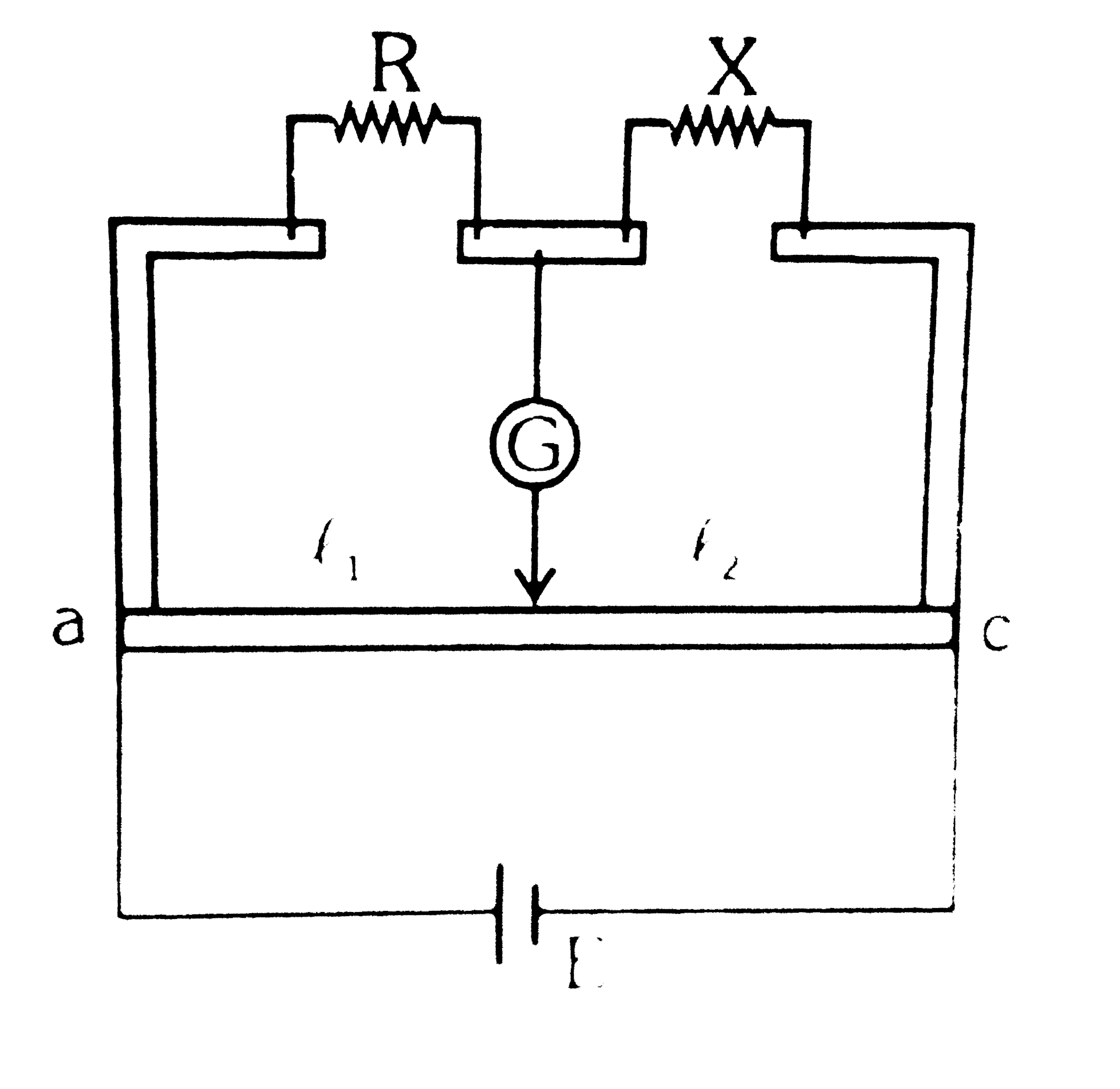
Practical diagram for meter bridge is as shown in figure.
(a) G deflects zero, when `l_(1)=20cm` and `R=100Omega` then find X.
(b) If R and X are interchanged then find `l_(1)` for zero deflection.

Text Solution

Verified by Experts

(a) `l_(1)=20cm, l_(2)=100-l_(1)=100-20=80cm,R=100Omega`
`(P)/(Q)=(R)/(S)rArr(l_(1))/(l_(2))=(R)/(X)rArr(20)/(80)=(100)/(X)rArrX=400Omega`
(b) `(l_(1))/(100-l_(1))=(X)/(R)=(400)/(100)rArrl_(1)=80cm` or R and X interchane then `l_(1),l_(2)` interchanged.
Promotional Banner

Similar Questions

Explore conceptually related problems

Each resistance is of 1Omega in the circuit diagram shown in figure. Find out equivalent resistance between A and B.

In a meter bridge as shown in figure, the balance point is found to be at 39.5 cm from the end A, when the Y resistor is of 12.5 Omega . Determlne the resistance of X. Why are the connections between resistors in a Wheatstone or meter bridge made of thick copper strips ?

In the circuit shown the cells A and B have negligible resistance. For V_(A) = 12 V, R_(1) = 500 Omega and R = 100 Omega , the galvanometer (G) shows no deflection. The value of V_(B) is

Find out the magnitude of resistance X in the circuit shown in figure, When no current flows through the 5 Omega resistance

Find the range of the following function f(x)= |x-1|, x in R

Six resistances each of v ale r= 6Omega are connected between points A,B and C as shown in the figure if R_(1),R_(2) and R_(3) are the net resistances between A and B, between B and C and between A and C respectively, the R_(1):R_(2):R_(3) will be equal to

The emf E and the internal resistance r of the battery shown in figure are 4.3V and 1.0Omega respectively. The external resistan ce R is 50Omega . The resistance of the ammeter and voltameter are 2.0Omega an d 200Omega respectively. Find the respective reading of the voltmeter.

Comprehension # 1 If net force on a system in a particular direction is zero (say in horizontal direction) we can apply: Sigmam_(R )x_(R )= Sigmam_(L)x_(L), Sigmam_(R )v_(R )= Sigmam_(L)v_(L) and Sigmam_(R )a_(R ) = Sigmam_(L)a_(L) Here R stands for the masses which are moving towards right and L for the masses towards left, x is displacement, v is veloctiy and a the acceleration (all with respect to ground). A small block of mass m = 1 kg is placed over a wedge of mass M = 4 kg as shown in figure. Mass m is released from rest. All surface are smooth. Origin O is as shown. Normal reaction between the two blocks at an instant when absolute acceleration of m is 5 sqrt3 m//s^(2) at 60^(@) with horizontal is ......... N. Normal reaction at this instant is making 30^(@) with horizontal :-

Find zero of the polynomial 2x -1.

Comprehension # 1 If net force on a system in a particular direction is zero (say in horizontal direction) we can apply: Sigmam_(R )x_(R )= Sigmam_(L)x_(L), Sigmam_(R )v_(R )= Sigmam_(L)v_(L) and Sigmam_(R )a_(R ) = Sigmam_(L)a_(L) Here R stands for the masses which are moving towards right and L for the masses towards left, x is displacement, v is veloctiy and a the acceleration (all with respect to ground). A small block of mass m = 1 kg is placed over a wedge of mass M = 4 kg as shown in figure. Mass m is released from rest. All surface are smooth. Origin O is as shown. At the same instant reaction on the wedge from the ground is ........N.
