Home
Class 12
PHYSICS
In the shown arrangement of the experime...

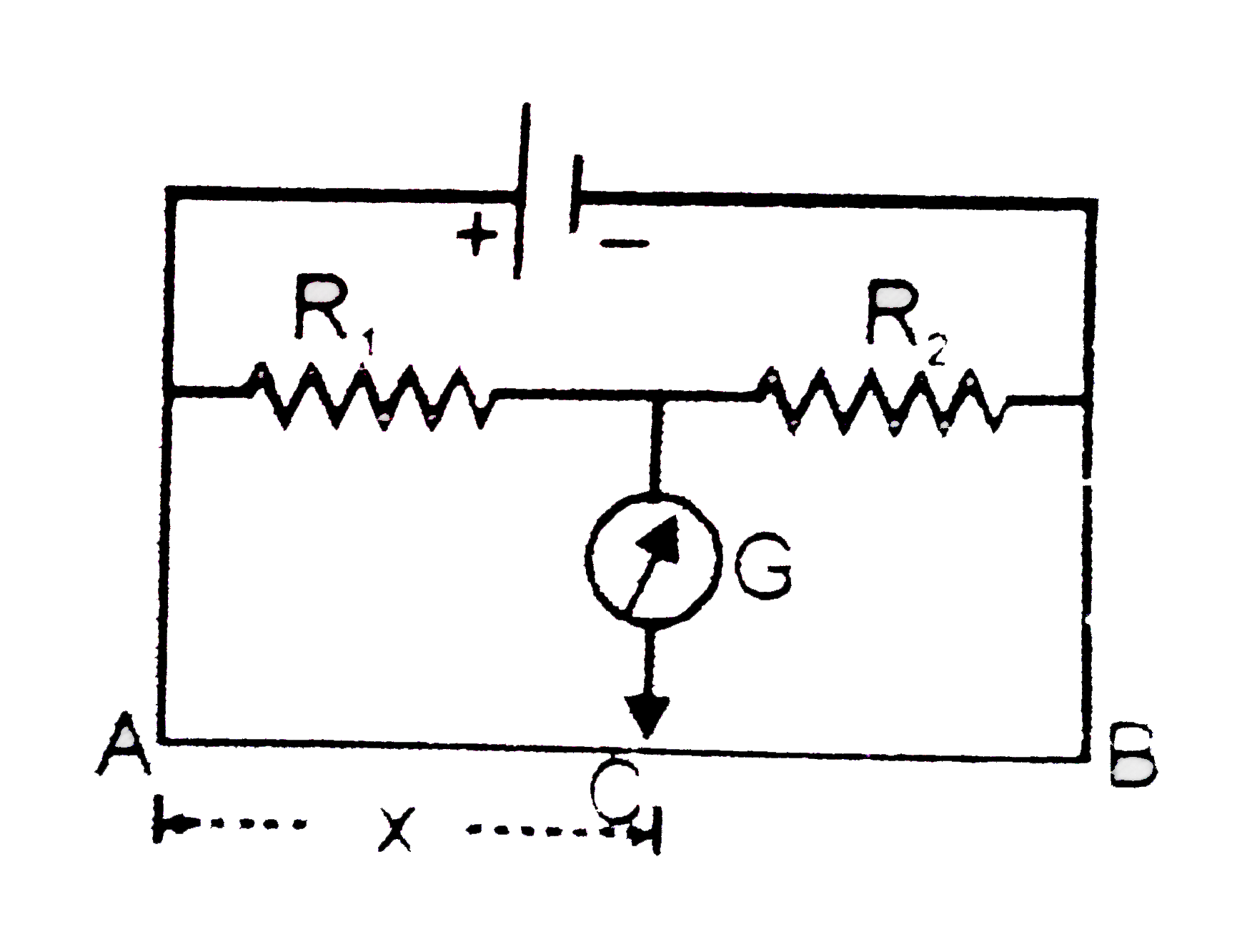
In the shown arrangement of the experiment of the meter bridge if AC corresponding to null deflection of galvanometer is x. what would b e its value if the radius of the wire AB is doubled:-

A

Statement-1 is true, Statement-2 is false

B

Statement-1 is true, Statement-2 is true, Statement-2 is the correct explanation of Statement-1

C

Statement-1 is true, Statement-2 is true, Statement-2 is not the correct explanation of Statement-1

D

Statement-1 is false, Statement-2 is true

Text Solution

Verified by Experts

The correct Answer is:

B
Promotional Banner

Topper's Solved these Questions

  • CURRENT ELECTRICITY

    ALLEN |Exercise EX.II|66 Videos
  • CURRENT ELECTRICITY

    ALLEN |Exercise EXERCISE-V A|20 Videos
  • CIRCULAR MOTION

    ALLEN |Exercise EXERCISE (J-A)|6 Videos
  • GEOMETRICAL OPTICS

    ALLEN |Exercise subjective|14 Videos

Similar Questions

Explore conceptually related problems

In the shown arrangement of the experiment of the meter bridge if AC corresponding to null deflection of galvanometer is x, what would be its value if the radius of the wire AB is doubled?

Figure shows a metal rod PQ resting on the smooth rails AB and positioned between the poles of a permanent magnet. The rails, the rod, and the magnetic field are in three mutual perpendicular directions. A galvanometer G connects the rails through a switch K. Length of the rod =15 cm, B =0.50 T, resistance of the closed loop containing the rod 9.0 m Omega . Assume the field to be uniform. (a) Suppose K is open and the rod is moved with a speed of 12 "cm s"^(-1) in the direction shown. Give the polarity and magnitude of the induced emf. (b) Is there an excess charge built up at the ends of the rods when K is open ? What if K is closed ? (c) With K open and the rod moving uniformly, there is no net force on the electrons in the rod PQ even though they do experience magnetic force due to the motion of the rod. Explain. (d) What is the retarding force on the rod when K is closed ? How much power is required (by an external agent) to keep the rod moving at the same speed (= 12 cm s^(-1) ) when K is closed ? How much power is required when K is open? (f)How much power is dissipated as heat in the closed circuit ? What is the source of this power ? (g) What is the induced emf in the moving rod if the magnetic field is parallel to the rails instead of being perpendicular ?

Consider Experiment: (a) What would you do to obtain a large deflection of the galvanometer ? (b) How would you demonstrate the presence of an induced current in the absence of a galvanometer ?

While doing an experiment with potcntiometc as shown in figure in was found that th deflection is one sided and (i) the detlectio, decreased while moving from one end A of the wire to the end B, (ii) the deflection increase while the jockey was moved towards the end (i) Which terminal + or - ve Of the cell E_(1) connected at X in case (i) and how is related to E ? (ii) Which terminal of the cell E_(1) is connected at X in case (ii) ?

A room has AC run for 5 hours a day at a voltage of 220V. The wiring of the room consists of Cu of 1mm radius and a length of 10m. Power consumption per day is 10 commerical units. What fraction of its goes in the joule heating in wires? What would happen if the wiring is made of aluminium of the same dimensions.

Consider the MB shown in the diagram, let the resistance X have temperature coefficient alpha_(1) and the resistance from the RB have the temperature coefficient alpha_(2) . Let the reading of the meter scale be 10 cm from the LHS. if the temperature of the two resistance increase by small temperature DeltaT then what is the shift in the position of the null point ? Neglect all the other changes in the bridge due to temperature rise.

In an experiment to estimate the size of a molecule of oleic acid 1 mL of oleic acid is dissolved in 19 ml of alcohol. Then I mL of this solution is diluted to 20 mL by adding alcohol. Now 1 drop of this diluted solution is placed on water in a shallow through. The solution spreads over the surface of water forming one molecule thick layer. Now lycopodium powder is sprinkled evenly over the film and its diameter is measured. Knowing the volume of the drop and area of the film we can calculate the thickness of the film which will give us the size of oleic acid molecule. Read the passage carefully and answer the following questions. (a) Why do we dissolve oleic acid in alcohol ? (b) What is the role of lycopodium powder ? (c) What would be the volume of oleic acid in each ml of solution prepared ? (d) How will you calculate the volume of n drops of this solution of oleic acid ? (e) What will be the volume of oleic acid in one drop of this solution ?

An electromagnetic wave can be represented by E = A sin (kx- omega t + phi) , where E is electric field associated with wave, According this equation, for any value of x, E remains sinusoidal for -oolt t lt oo . Obviously this corresponds to an idealised situation because radiation from ordinary sources consists of finite size wavetrains. In general, electric field remains sinusoidal only for times of order tau_(c) ' which is called coherence time. In simpler language it means that for times of order tau_(c)' a wave will have a definite phase. The finite value of coherence time could be due to many factors, for example if radiating atom undergoes collision with another atom then wave train undergoes an abrupt phase change or due to the fact that an atom responsible for emitting radiation has a finite life time in the energy level from which it drops to lower energy level, while radiating. Concept of coherence time can be easily understood using young's double slit experiment. Let interference patten is observed around point P at time t , due to superposition of waves emanting from S_(1) and S_(2) at times t =(r_(1))/(c) and (r_(2))/(c) respectively, where r_(1) and r_(2) are the distances S_(1) P & S_(2)P . Obviously if (r_(2)-r_(1))/(c) lt lt tau_(e),{"where" " "c = 3xx10^(8)m//s} then, wavetrain arriving at point P from S_(1) & S_(2) will have a definite phase relationship and an interference pattern of good contranst will be obtained. If coherence time is of order 10^(-10) second and screen is placed at a very large distance from slits in the given figure, then:-

An electromagnetic wave can be represented by E = A sin (kx- omega t + phi) , where E is electric field associated with wave, According this equation, for any value of x, E remains sinusoidal for -oolt t lt oo . Obviously this corresponds to an idealised situation because radiation from ordinary sources consists of finite size wavetrains. In general, electric field remains sinusoidal only for times of order tau_(c) ' which is called coherence time. In simpler language it means that for times of order tau_(c)' a wave will have a definite phase. The finite value of coherence time could be due to many factors, for example if radiating atom undergoes collision with another atom then wave train undergoes an abrupt phase change or due to the fact that an atom responsible for emitting radiation has a finite life time in the energy level from which it drops to lower energy level, while radiating. Concept of coherence time can be easily understood using young's double slit experiment. Let interference patten is observed around point P at time t , due to superposition of waves emanting from S_(1) and S_(2) at times t =(r_(1))/(c) and (r_(2))/(c) respectively, where r_(1) and r_(2) are the distances S_(1) P & S_(2)P . Obviously if (r_(2)-r_(1))/(c) lt lt tau_(e),{"where" " "c = 3xx10^(8)m//s} then, wavetrain arriving at point P from S_(1) & S_(2) will have a definite phase relationship and an interference pattern of good contranst will be obtained. If coherence time is of order 10^(-10) second and screen is placed at a very large distance from slits in the given figure, then:-

ALLEN -CURRENT ELECTRICITY-EXERCISE-V B
  1. In which of the following the carriers of electric current are electro...

    Text Solution

    |

  2. To the potentiometer wire of L and 10Omega resistance, a battery of em...

    Text Solution

    |

  3. A wire of resistance 12 Omega m^(-1) is bent to from a complete circle...

    Text Solution

    |

  4. See the electrical circuit shown in this figure. Which of the followin...

    Text Solution

    |

  5. A galvanometer having a coil resistance of 60 Omega shows full scale...

    Text Solution

    |

  6. A student measures the terminal potential difference (V) of a cell (of...

    Text Solution

    |

  7. If an electron revolves in the circular path of radius 0.5A^(@) at a f...

    Text Solution

    |

  8. The external diameter of a 314 m long copper tube is 1.2 cm and the i...

    Text Solution

    |

  9. In the shown arrangement of the experiment of the meter bridge if AC c...

    Text Solution

    |

  10. A potentiometer circuit is setup as shown. The potential gradient acro...

    Text Solution

    |

  11. A galvanometer has a coil of resistance 100 Omega and gives a full-sc...

    Text Solution

    |

  12. A galvanometer has resistance 48Omega if a shunt of 6Omega is added wi...

    Text Solution

    |

  13. For a the current loops shown in the figu re, kirchhoff's loop rule f...

    Text Solution

    |

  14. If 2 ×10^(6) electrons/s are flowing through an area of cross section ...

    Text Solution

    |

  15. A current of 2 A flows through a 2 Omega resistor when connected acros...

    Text Solution

    |

  16. If power dissipated in the 9 Omega resistor in the resistor shown is 3...

    Text Solution

    |

  17. In the circuit shown in the figure, if potentail at point A is taken t...

    Text Solution

    |

  18. A galvanometer of resistance G is shunted by a resistance S ohm. To...

    Text Solution

    |

  19. A thermocouple of negligible resistance produces an emf fo 40 mu V//^(...

    Text Solution

    |

  20. Figure shows three resistor configurations R1,R2 and R3 connected to 3...

    Text Solution

    |
