A milli voltmeter of 25 milli volt range is to be converted into an ammeter of 25 ampere range. The value (in ohm) of necessary shunt will be
A milli voltmeter of 25 milli volt range is to be converted into an ammeter of 25 ampere range. The value (in ohm) of necessary shunt will be
A
1
B
0.05
C
0.001
D
0.01
Text Solution
Verified by Experts
The correct Answer is:
3
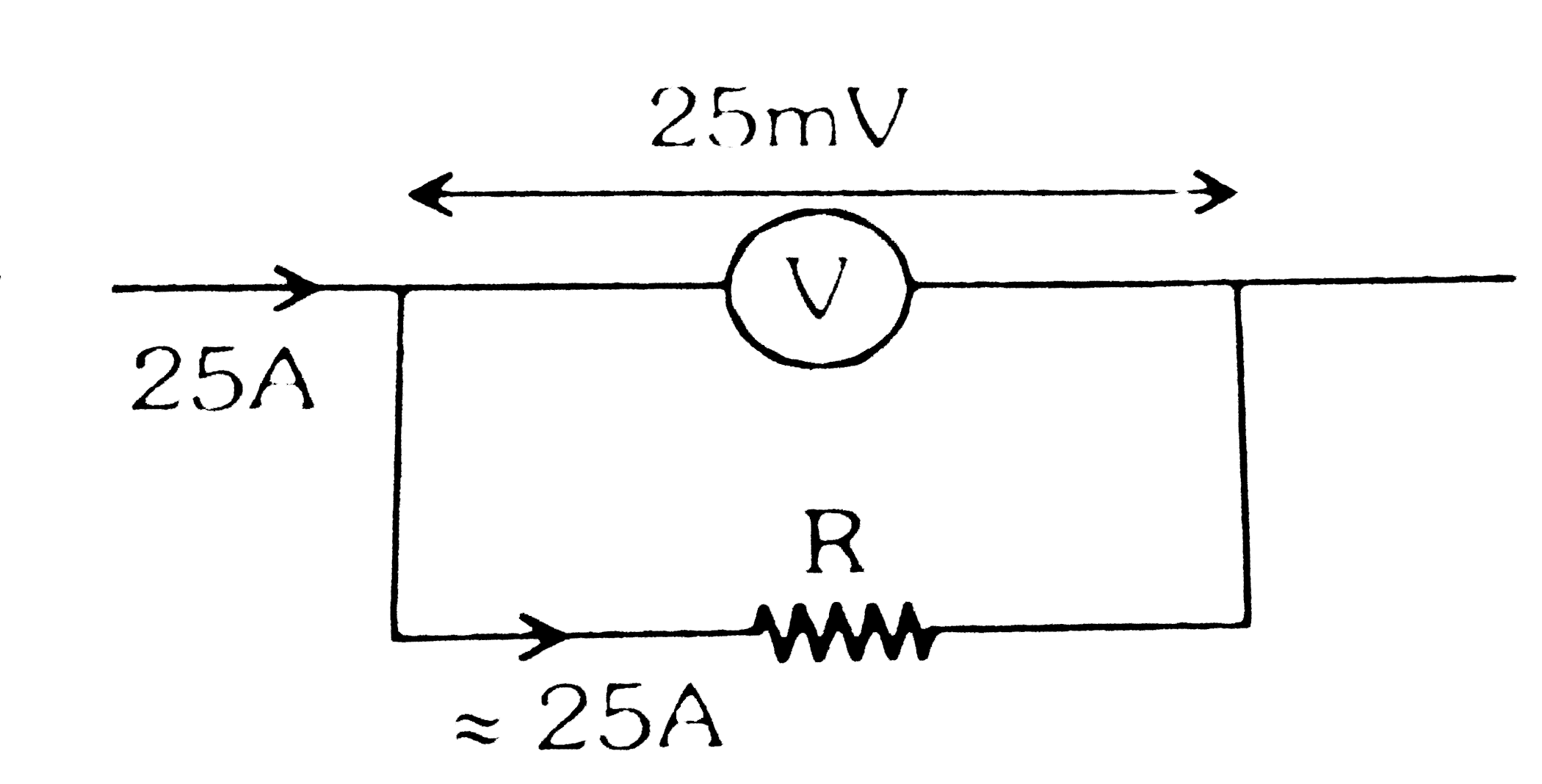
Shunt resistance `=(25xx10^(-3))/(25)=10^(-3) Omega=0.001Omega`



Similar Questions
Explore conceptually related problems
A galvanometer having 30 divisions has a current sensitivity of 20muA//di vision . It has a resistance of 25Omega . How will you convert it into an ammeter upto 1 ampere? How will you convert this ammeter into a voltmeter up to 1 volt?
A galvanometer has resistance G and Current I_(g) produces full scale deflection. S_(1) is the value of the shunt which converts it into an ammeter of range 0-I and S_(2) is the value of shunt for the range 0-2I . The ratio of S_(1) and S_(2) is
In the circuit the current is to be measured. What is the value of the current if the ammeter shown (a) is a galvanometer with a resistance R_G = 60.00 Omega , (b) is a galvanometer described in (a) but converted to an ammeter by a shunt resistance r_s= 0.02 Omega , (c ) is an ideal ammeter with zero resistance?
A voltmeter has a resistance of G ohm and range of V volt. The resistance required in series to convert it into a voltmeter of range nV volt is
The resistance of galvanometer is G ohm and the range is 1 volt. The value of resistance used to convert it into a voltmeter of ragne 10 volt is:-
The scales of an ammeter and a voltmeter are shown below: What is the range of the ammeter and the range of the voltmeter?
The resistance of an ammeter of range 5A is 1.8Omega A shunt of 0.2Omega is connected in parallel to it. When its indicator shows a current of 2A then what will be effective current?
The ciliary muscles of eye control the curvature of the lens in the eye and hence can alter the effective focal length of the system. When the muscles are fully relaxed, the focal length is maximum. When the muscles are strained, the curvature of lens increases. That means radius of curvature decreases and focal length decreases. For a clear vision, the image must be on the retina. The image distance is therefore fixed for clear vision and it equals the distance of retina from eye lens. It is about 2.5cm for a grown up person. A perosn can theoretically have clear vision of an object situated at any large distance from the eye. The smallest distance at which a person can clearly see is related to minimum possible focal length. The ciliary muscles are most strained in this position. For an average grown up person, minimum distance of the object should be around 25cm. A person suffering from eye defects uses spectacles (eye glass). The function of lens of spectacles is to form the image of the objects within the range in which the person can see clearly. The image o the spectacle lens becomes object for the eye lens and whose image is formed on the retina. The number of spectacle lens used for th eremedy of eye defect is decided by the power fo the lens required and the number of spectacle lens is equal to the numerical value of the power of lens with sign. For example, if power of the lens required is +3D (converging lens of focal length 100//3cm ), then number of lens will be +3 . For all the calculations required, you can use the lens formula and lensmaker's formula. Assume that the eye lens is equiconvex lens. Neglect the distance between the eye lens and the spectacle lens. Q. Maximum focal length of a eye lens of a normal person is
The ciliary muscles of eye control the curvature of the lens in the eye and hence can alter the effective focal length of the system. When the muscles are fully relaxed, the focal length is maximum. When the muscles are strained, the curvature of lens increases. That means radius of curvature decreases and focal length decreases. For a clear vision, the image must be on the retina. The image distance is therefore fixed for clear vision and it equals the distance of retina from eye lens. It is about 2.5cm for a grown up person. A perosn can theoretically have clear vision of an object situated at any large distance from the eye. The smallest distance at which a person can clearly see is related to minimum possible focal length. The ciliary muscles are most strained in this position. For an average grown up person, minimum distance of the object should be around 25cm. A person suffering from eye defects uses spectacles (eye glass). The function of lens of spectacles is to form the image of the objects within the range in which the person can see clearly. The image o the spectacle lens becomes object for the eye lens and whose image is formed on the retina. The number of spectacle lens used for th eremedy of eye defect is decided by the power fo the lens required and the number of spectacle lens is equal to the numerical value of the power of lens with sign. For example, if power of the lens required is +3D (converging lens of focal length 100//3cm ), then number of lens will be +3 . For all the calculations required, you can use the lens formula and lensmaker's formula. Assume that the eye lens is equiconvex lens. Neglect the distance between the eye lens and the spectacle lens. Q. Maximum focal length of a eye lens of a normal person is
The ciliary muscles of eye control the curvature of the lens in the eye and hence can alter the effective focal length of the system. When the muscles are fully relaxed, the focal length is maximum. When the muscles are strained, the curvature of lens increases. That means radius of curvature decreases and focal length decreases. For a clear vision, the image must be on the retina. The image distance is therefore fixed for clear vision and it equals the distance of retina from eye lens. It is about 2.5cm for a grown up person. A perosn can theoretically have clear vision of an object situated at any large distance from the eye. The smallest distance at which a person can clearly see is related to minimum possible focal length. The ciliary muscles are most strained in this position. For an average grown up person, minimum distance of the object should be around 25cm. A person suffering from eye defects uses spectacles (eye glass). The function of lens of spectacles is to form the image of the objects within the range in which the person can see clearly. The image o the spectacle lens becomes object for the eye lens and whose image is formed on the retina. The number of spectacle lens used for th eremedy of eye defect is decided by the power fo the lens required and the number of spectacle lens is equal to the numerical value of the power of lens with sign. For example, if power of the lens required is +3D (converging lens of focal length 100//3cm ), then number of lens will be +3 . For all the calculations required, you can use the lens formula and lensmaker's formula. Assume that the eye lens is equiconvex lens. Neglect the distance between the eye lens and the spectacle lens. Q. Maximum focal length of a eye lens of a normal person is
Recommended Questions
- A milli voltmeter of 25 milli volt range is to be converted into an am...
Text Solution
|
- A milli voltmeter of 25 milli volt range is to be converted into an am...
Text Solution
|
- A milli-voltmeter of 25 milli-volt range is to be converted into an am...
Text Solution
|
- एक धारामापी में जिसका प्रतिरोध 50 ओम है, 10 मिली ऐम्पियर की धारा से पू...
Text Solution
|
- एक धारामापी जिसका प्रतिरोध 25 ओम है 0.01A ऐम्पियर की धारा से पूर्ण वि...
Text Solution
|
- एक धारामापी की कुंडली का प्रतिरोध 100 ओम है। इसमें 1 मिली ऐम्पियर की ध...
Text Solution
|
- एक धारामापी का प्रतिरोध 200 ओम है। यह 5 मिली ऐम्पियर धारा के लिए पूर्ण...
Text Solution
|
- एक मिली वोल्टमीटर का परास 25 मिली वोल्ट है। इसे 25A परास के अमीटर में ...
Text Solution
|
- A millivoltmeter of 25 m V range is to be converted into an ammeter of...
Text Solution
|