Home
Class 12
PHYSICS
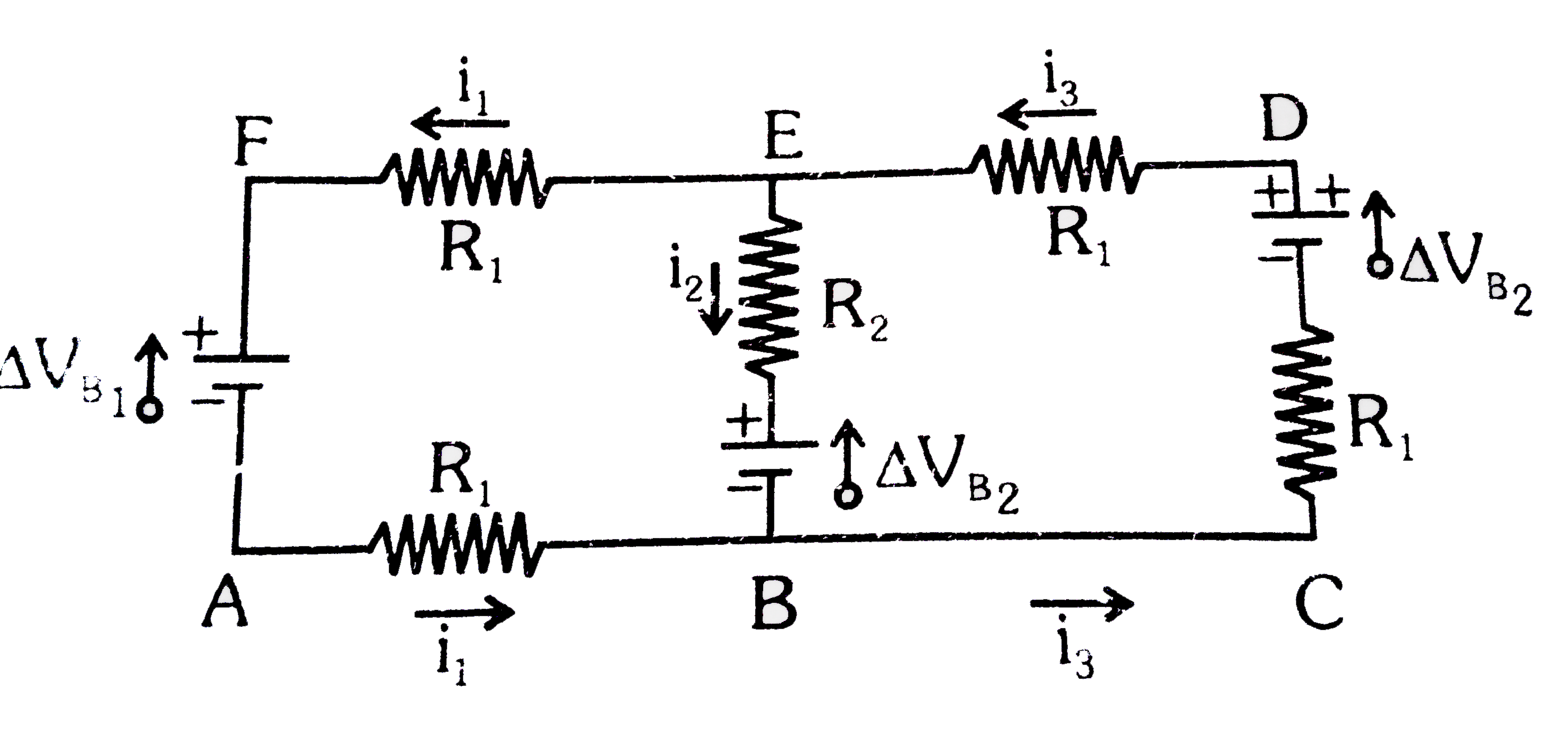
Figure shows a circuit with three ideal ...

Figure shows a circuit with three ideal batteries in it. The circuit elements h ave the following values

`DeltaV_(B_(1))=3.0V,DeltaV_(B_(2))=6.0V`
`R_(1)=2.0Omega,R_(2)=4.0Omega` The currents `i_(1) ,i_(2)` and `i_(3)` as shown in the circuit have the values.

A

0.50A,-0.25A,+0.25A

B

0.25A,-0.50A,-0.25A

C

0.50A,0.50A,1.0A

D

`-0.25A,0.50A,0.25A`

Text Solution

Verified by Experts

The correct Answer is:
1


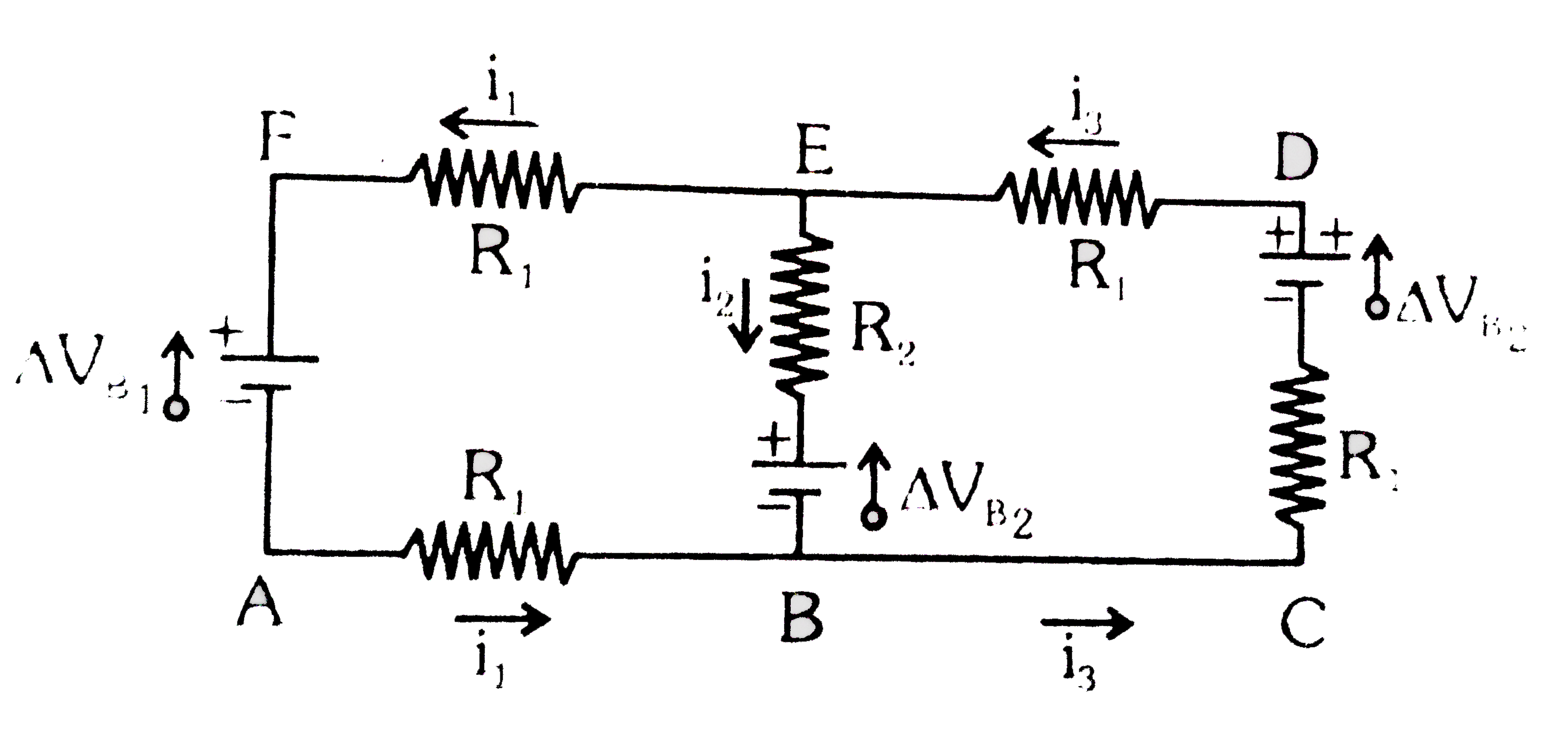
Applying kirchhoff's first law at junction E, we g-t
`i_(3)=i_(1)+i_(2)`
Applying kirchhoff's second law for the closed loop
ABEFA, we get
`-i_(1)R_(1)+DeltaV_(B_(2))+i_(2)R_(2)-i_(1)R_(1)-DeltaV_(B_(1))=0`
`-2i_(1)R_(1)+i_(2)R_(2)+DeltaV_(B_(2))=DeltaV_(b_(1))=0`
`-2i_(1)(2)i_(2)(4)+6-3=0`
`-4i_(1)+4i_(2)+3=0`
`-4i_(1)+4i_(2)=-3`
Again, applying kirchhoff's second for the closed loop BCDEB, we get
`i_(3)R_(1)+DeltaV_(B_(2))-i_(3)R_(1)-i_(2)R_(2)-DeltaV_(B_(2))=0`
`-2i_(3)R_(1)- i_(2)R_(2)=0`
`-2i_(3)(2)-i_(2)(4)=0`
`ri_(3)+4i_(2)=i_(3)+i_(2)=0`
Solving (i),(ii) and (iii), we get
`i_(1)=0.50AA,i_(2)=-0.25A,i_(3)=0.25A`
Promotional Banner

Similar Questions

Explore conceptually related problems

In the circuit shown in figure, epsilon_(1) = 3 V, epsilon_(2) = 2 V , epsilon_(3) = IV and R = r_(1) = r_(2) = r_(3) = 1 Omega . The current through each branch is...... and potential difference between the points A and B is .......

In the circuit shown here, E_(1) = E_(2) = E_(3) = 2 V and R_(1) = R_(2) = 4 ohms . The current flowing between point A and B through battery E_(2) is

For the circuit shown in the figure, calculate the equivalent resistance for the two cases given as : (1) V_(A) gt V_(B) and (2) V_(B) gt V_(A) . Here consider D_(1) and D_(2) to be ideal diodes.

In the circuit shown the cells A and B have negligible resistance. For V_(A) = 12 V, R_(1) = 500 Omega and R = 100 Omega , the galvanometer (G) shows no deflection. The value of V_(B) is

Figure shows a series LCR circuit connected to a variable frequency 230 V source. L = 5.0 H, C = 80muF, R = 40 Omega . (a) Determine the source frequency which drives the circuit in resonance. (b) Obtain the impedance of the circuit and the amplitude of current at the resonating frequency. (c) Determine the rms potential drops across the three elements of the circuit. Show that the potential drop across the LC combination is zero at the resonating frequency.

A current of 3 A flows through the 2 Omega resistor as shown in the circuit. The power dissipated in the 5 Omega resistor is

Compare the power used in the 2 Omega resistor in each of the following circuits: a 4 V battery in parallel with 12 Omega and 2Omega resistors

In the circuit shown in figure, when the input voltage of the base resistance is 10V, V_(BE) is zero and V_(CE) is also zero. Find the values of I_(B), I_(C ) and beta .

In above circuit if current through 10 Omega resistor is 2.5 A, value of R is .... .

If each diode in figure has a forward bias resistance of 25Omega and infinite resistance in reverse bias, what will be the values of the current I_(1), I_(2), I_(3) and I_(4) ?

