Home
Class 12
PHYSICS
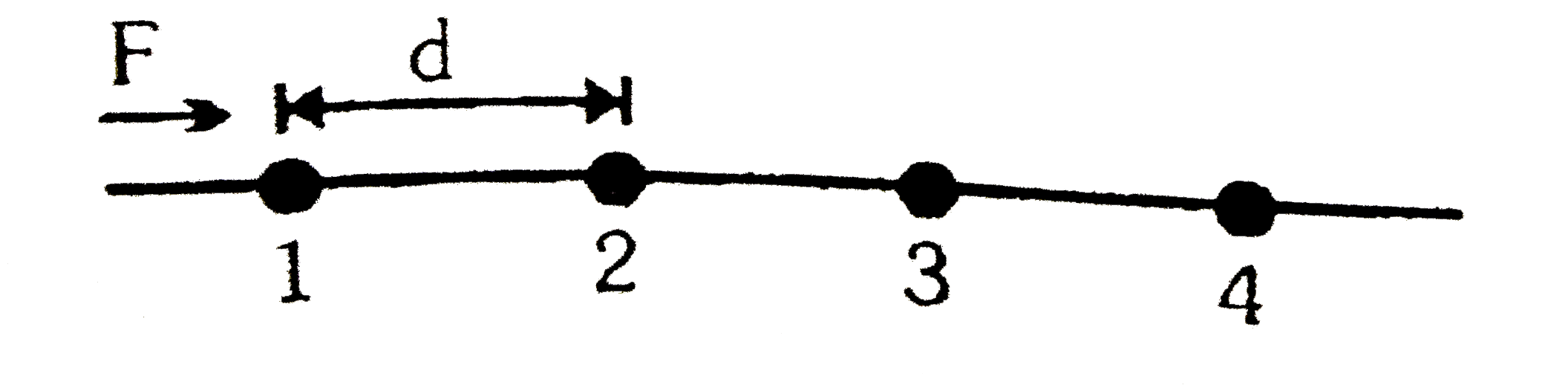
The Fig. shows a string of equally place...

The Fig. shows a string of equally placed beads of mass `m`, separated by distance `d`. The beads are free to slide without friction on a thin wire. A constant force F act on the first bead initially at rest till it makes collision with the second bead. The second bead then collides with the third and so on. Supposed that all collisions are elastic,

A

Speed of first bead immediately before and immediately after its collision with the second bead is `sqrt((2Fd)/(m))` and zero respectively.

B

Speed of first bead immediately before and immediately after its collision with the second bead is `sqrt((2Fd)/(m))and(1)/(2)sqrt((2Fd)/(m))` respectively.

C

Speed of second bead immediately after its collision with the third bead is zero.

D

The average speed of the first bead during its motion is `(1)/(2)sqrt((2Fd)/(m)).`

Text Solution

Verified by Experts

The correct Answer is:

A, C, D
Promotional Banner

Topper's Solved these Questions

  • TEST PAPERS

    ALLEN |Exercise MATHS|1 Videos
  • TEST PAPERS

    ALLEN |Exercise part-2 physic|48 Videos
  • TEST PAPER 4

    ALLEN |Exercise PHYSICS|45 Videos
  • UNIT & DIMENSIONS, BASIC MATHS AND VECTOR

    ALLEN |Exercise Exercise (J-A)|7 Videos

Similar Questions

Explore conceptually related problems

The Fig. showns a string of equally placed beads of mass m, separated by distance. The beads are free to slide without friction on a thin wire. A constant force F act on the first bead initially at rest till it makes collision with the second bead. The second bead then collides with the third and so on. Supposed that all collisions are elastic,

A piece of wire is bent in the shape of a parabola y=kx^(2) (y-axis vertical) with a bead of mass m on it. The bead can slide on the wire without friction. It stays at the lowest point of the parabola when the wire is at rest. The wire is now accelerated parallel to the x-axis with a constant acceleration a. The distance of the new equilibrium position of the bead, where the bead can stay at rest with respect to the wire, from the y-axis is:

A bead of mass m and diameter d is sliding back and forth with velocity v on a wire held between two right walls of length L. Assume that th ecollisions with the wall are perfectly elastic and ther is no friction. The average force that the bouncing bead exerts on the one of the walls is :_

Two beads of masses m_(1) and m_(2) are closed threaded on a smooth circular loop of wire of radius R. Intially both the beads are in position A and B in vertical plane . Now , the bead A is pushed slightly so that it slide on the wire and collides with B . if B rises to the height of the centre , the centre of the loop O on the wire and becomes stationary after the collision , prove m_(1) : m_(2) = 1 : sqrt(2)

The elastic collision between two bodies, A and B, can be cosidered using the following model. A and B are free to move along a common line without friction. When their distance is greater than d = 1 m , the interacting force is zero , when their distance is less d, a constant repulsive force F = 6 N is present. The mass of body A is m_(A) = 1 kg and it is initially at rest, the mass of body B is m_(B) = 3 kg and it is approaching body A head-on with a speed v_(0) = 2 m//s . Find th eminimum distance between A and B :-

A circus wishes to develop a new clown act. Fig. (1) shows a diagram of the proposed setup. A clown will be shot out of a cannot with velocity v_(0) at a trajectory that makes an angle theta=45^(@) with the ground. At this angile, the clown will travell a maximum horizontal distance. The cannot will accelerate the clown by applying a constant force of 10, 000N over a very short time of 0.24s . The height above the ground at which the clown begins his trajectory is 10m . A large hoop is to be suspended from the celling by a massless cable at just the right place so that the clown will be able to dive through it when he reaches a maximum height above the ground. After passing through the hoop he will then continue on his trajectory until arriving at the safety net. Fig (2) shows a graph of the vertical component of the clown's velocity as a function of time between the cannon and the hoop. Since the velocity depends on the mass of the particular clown performing the act, the graph shows data for serveral different masses. If the clown's mass is 80 kg , what initial velocity v_(0) will have as he leaves the cannot?

A circus wishes to develop a new clown act. Fig. (1) shows a diagram of the proposed setup. A clown will be shot out of a cannot with velocity v_(0) at a trajectory that makes an angle theta=45^(@) with the ground. At this angile, the clown will travell a maximum horizontal distance. The cannot will accelerate the clown by applying a constant force of 10, 000N over a very short time of 0.24s . The height above the ground at which the clown begins his trajectory is 10m . A large hoop is to be suspended from the celling by a massless cable at just the right place so that the clown will be able to dive through it when he reaches a maximum height above the ground. After passing through the hoop he will then continue on his trajectory until arriving at the safety net. Fig (2) shows a graph of the vertical component of the clown's velocity as a function of time between the cannon and the hoop. Since the velocity depends on the mass of the particular clown performing the act, the graph shows data for serveral different masses. If the mass of a clown doubles, his initial kinetic energy, mv_(0)^(2)//2 , will :-
